

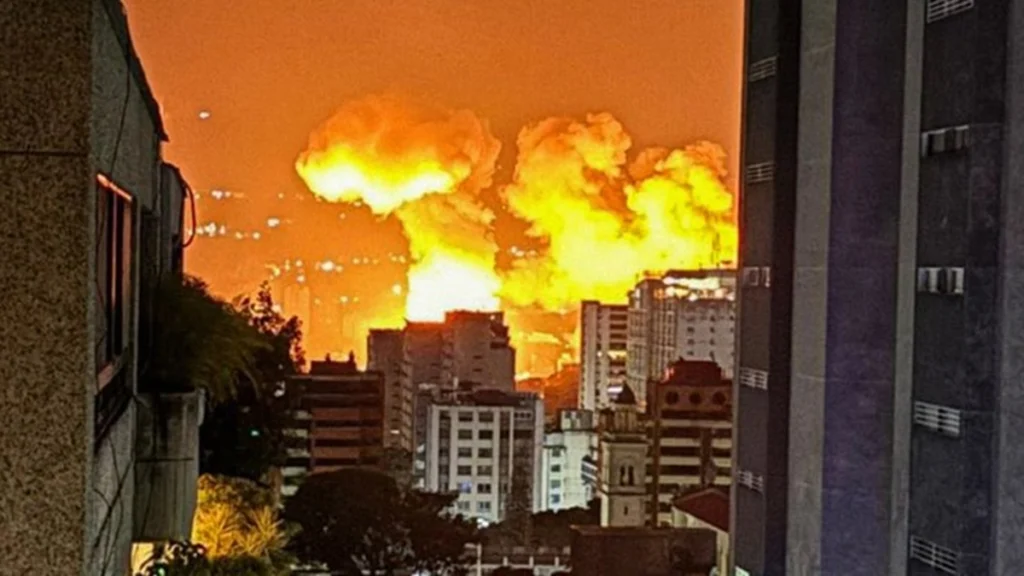
The airstrike against Venezuela is Washington’s 6th military intervention in Latin America in the last 75 years.
On Jan. 3, President Donald Trump confirmed that U.S. forces entered the residence of Venezuelan President Nicolas Maduro and extracted him and First Lady Cilia Flores from the country by air.
RELATED:
2 Vital Reasons China Condemns US Attack on Venezuela as Illegal and Dangerous
Venezuela denounced the missile attack from U.S. helicopters on Caracas and other cities, which caused civilian and military deaths and injuries.
The following is a summary of the main U.S. interventions in Latin America in the last 75 years:
Bay of Pigs – Cuba
On April 15, 1961, U.S. B-26 planes bombed Cuban bases to destroy the Revolutionary Air Force and facilitate the landing at Playa Giron of the so-called Brigade 2506, composed of exiles and mercenaries trained by the CIA in Guatemala and Nicaragua.
The following day, Commander Fidel Castro declared the socialist character of the Cuban revolution that had brought him to power in January 1959. On April 17, some 1,500 men supported by U.S. naval aircraft and ships attempted to land in the Bay of Pigs, about 112 miles southeast of Havana.
The attack sought to overthrow Castro and install a government formed in Miami, but it was suppressed by the Cuban people. The Bay of Pigs invasion occurred in the context of Cuba’s rapprochement with the Soviet Union. The failure of the invasion was a severe setback for U.S. President John F. Kennedy and irreparably damaged relations between the two countries.
everything Chavez said has proven to be right: “The president of the US talks as if he owns the world. What type of “democracy” do you impose with marines, invasions and bombs? If the world could speak with one voice, it would say: Imperialist yankee, go home!” pic.twitter.com/2GuLmqfFN9
—
(@zei_squirrel) January 3, 2026

Dominican Republic
On April 28, 1965, President Lyndon B. Johnson sent 20,000 Marines to the Dominican Republic to suppress a civil conflict that erupted after Juan Bosch, who came to power following the death of dictator Leonidas Trujillo in 1961, was deposed by the military.
The U.S. aim was to prevent the country from falling into communist hands and creating “a second Cuba” in the Caribbean. The U.S. placed General Antonio Imbert Barrera at the head of the government.
In September 1966, U.S. troops left the country, shortly before presidential elections were held in which Bosch was defeated by Joaquin Balaguer, who had been part of the administration of Trujillo dictatorship. Backed by the U.S, Balaguer remained in power until 1996.
Grenada
On Oct. 25, 1983, nearly 2,000 U.S. Marines, along with a symbolic force of 300 soldiers from other small Caribbean countries – Jamaica, Antigua, Barbados, Dominica, Saint Lucia and Saint Vincent – invaded the Caribbean island of Grenada to overthrow the military regime that came to power on Oct. 19, after executing head of government Maurice Bishop, three of his ministers and numerous civilians.
President Ronald Reagan justified the ‘Operation Urgent Fury’ on the need to protect the lives of the approximately 1,000 U.S. residents on the island and to restore democratic institutions. Most U.S. troops left the country on Nov. 1, 1983.
Last night’s attack on Venezuela fits into a long history of brazen US interventions in Latin America and the world. pic.twitter.com/bgU5fX2Oqu
— Alan MacLeod (@AlanRMacLeod) January 3, 2026
Panama
On the night of Dec. 20, 1989, President George H.W. Bush ordered the invasion of Panama with 26,000 soldiers. The objective of Operation ‘Just Cause’ was to dismantle the local army and capture Panamanian leader Manuel Antonio Noriega, accused of drug trafficking.
According to data declassified by the Pentagon in 2019, over 500 people died, 314 of them military personnel and the majority Panamanian. However, humanitarian institutions have stated that U.S. occupying forces killed as many as 4,000 Panamanian civilians.
Noriega, who governed the country between 1983 and 1989 and had been a CIA collaborator, surrendered 13 days later to U.S. troops who had surrounded the Apostolic Nunciature in Panama City where he had taken refuge after the invasion.
Haiti
On Sept. 19, 1994, over 23,000 U.S. military personnel occupied Haiti to facilitate a transition to democracy and the return of Jean-Bertrand Aristide, Haiti’s first president elected in a democratic election (1990), who had been overthrown on Sept. 30, 1991, in a military coup led by General Raoul Cedras.
The arrival of the troops came hours after a U.S. delegation, led by former President Jimmy Carter, reached an agreement with Cedras for the entry of U.S. troops into Haiti, the departure of the coup government from the country, the return of Aristide, and the calling of future elections.
Aristide returned to Haiti on Oct. 15 and resumed his mandate. By the end of March 1995, U.S. forces handed over command of the peacekeeping operation to the United Nations, and legislative and municipal elections were held in June.
Almost a decade later, in February 2004, the United States would again deploy Marines to Haiti, this time as part of a U.N.-authorized international coalition, following an armed revolt that led to Aristide’s departure.
#FromTheSouth News Bits | Honduras’ former President Manuel Zelaya condemned the attack by the United States on Venezuela, showing the regional unity, which is also a target of the imperialist actions in the region. pic.twitter.com/eY8C2EkDSd
— teleSUR English (@telesurenglish) January 3, 2026
teleSUR/ JF
Source: EFE
From teleSUR English via This RSS Feed.