

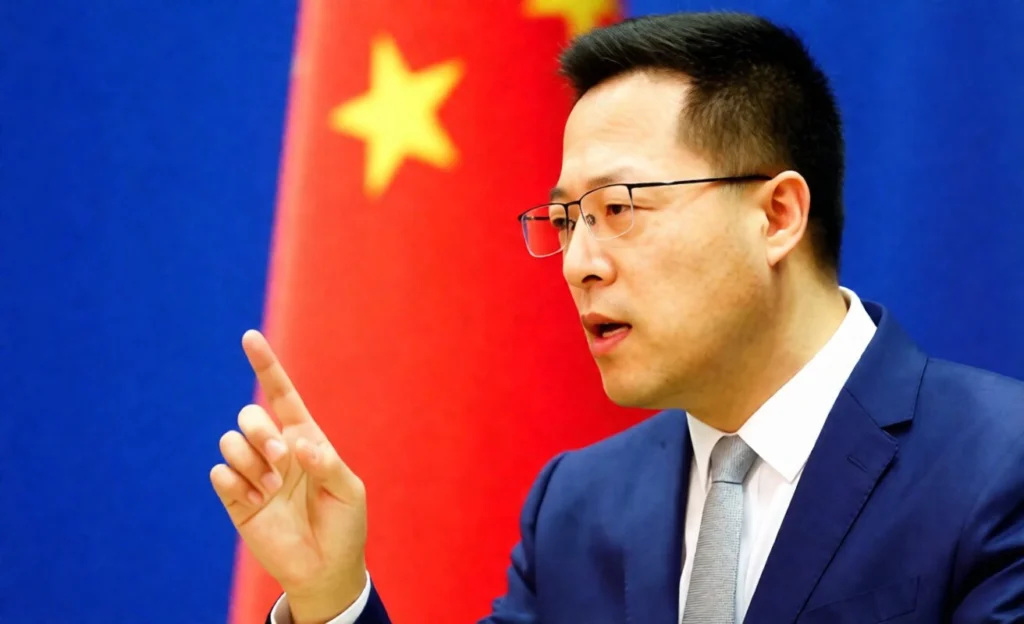
China condemns US attack on Venezuela as a violation of sovereignty and UN Charter. Global South unites against unilateral military aggression.
Related: 3 Reasons Iran Condemns US Attack on Venezuela as a Global Threat
5 Shocking Reasons China Condemns US Attack on Venezuela as Illegal and Dangerous
China condemns US attack on Venezuela in the strongest possible terms following Washington’s large-scale military incursion on Venezuelan soil early Saturday, January 3, 2026. In an official statement issued from Beijing, the Chinese government denounced the operation—which reportedly led to the capture of President Nicolás Maduro and First Lady Cilia Flores—as a “flagrant use of force against a sovereign state” and a direct assault on the foundational pillars of the international legal order.
The Chinese Foreign Ministry labeled the action “hegemonic” and warned it endangers not only Venezuela’s sovereignty but the broader stability of Latin America and the Caribbean—a region long declared a “zone of peace” by its governments. According to Beijing, the U.S. strikes on both military and civilian infrastructure represent a systematic violation of the United Nations Charter and a dangerous precedent that could unravel decades of diplomatic consensus in the Global South.
This condemnation is not merely rhetorical. It reflects China’s deep strategic alignment with Venezuela on issues of sovereignty, anti-imperialism, and multilateralism. In recent years, the two nations have strengthened cooperation across energy, finance, and defense, often positioning themselves as counterweights to Western-led sanctions and regime-change policies. Now, China condemns U.S. attack on Venezuela as both a moral imperative and a defense of a rules-based world order that Washington appears determined to dismantle.
China Condemns US Attack on Venezuela as Hegemonic Violation of International Law
In its formal communiqué, Beijing accused the United States of deploying “hegemony under the guise of security,” highlighting how the military operation breaches core principles of the UN Charter, particularly Article 2(4), which prohibits the use of force against the territorial integrity or political independence of any state.
The Chinese statement emphasized the targeting of civilian infrastructure—including power grids and residential areas—as especially alarming. “Such actions do not restore order; they sow chaos, suffering, and long-term destabilization,” the document read. By attacking non-military sites, Beijing argues, the U.S. has crossed a red line that separates legitimate security operations from acts of aggression that may constitute war crimes under international humanitarian law.
China’s position aligns with longstanding jurisprudence from the International Court of Justice, which has consistently held that unilateral military interventions—regardless of stated intent—violate international law unless authorized by the UN Security Council. Notably, no such authorization was sought or granted in this case, rendering the operation legally indefensible from Beijing’s perspective.
Furthermore, China warned that this intervention fits a disturbing historical pattern: U.S.-led regime change operations in Latin America, the Middle East, and Africa that have repeatedly triggered humanitarian crises, refugee flows, and prolonged instability. “When powerful nations bypass international institutions to impose their will by force,” the statement cautioned, “they do not bring democracy—they export destruction.”
Global South Unites Against U.S. Military Aggression
China’s condemnation arrives amid a rapid and coordinated diplomatic backlash from across the Global South. From Tehran to Montevideo, capitals are denouncing the U.S. attack on Venezuela as a direct threat to the principle of non-intervention—a cornerstone of post-colonial diplomacy. Russia has labeled the operation “armed aggression,” while Cuban President Miguel Díaz-Canel called it “state terrorism.” Colombian President Gustavo Petro has called for an emergency UN session to halt the escalation.
Beijing positioned its response within this broader coalition, stressing that Latin America’s declaration as a “zone of peace” must be respected. “The peoples of Latin America and the Caribbean have the right to determine their own destiny without external interference,” the Chinese statement affirmed, echoing language used by regional bodies like CELAC (Community of Latin American and Caribbean States).
As a leading advocate for multipolarity and South-South cooperation, China sees this moment as a critical test of whether international law will apply equally—or only to the weak. The PRC reaffirmed its strategic partnership with Venezuela, recalling years of mutual support in multilateral forums and joint resistance to unilateral sanctions. “Caracas is not alone,” the statement implied. “It stands with a growing front of nations committed to sovereignty over subjugation.”
Notably, even traditionally neutral actors are breaking ranks. Spanish MEP Irene Montero demanded her government sever ties with NATO, declaring, “The U.S. is a danger. Either we stop them, or they’ll burn everything down.” In Uruguay, while the official government remains silent, prominent figures from the ruling Frente Amplio—such as Rafael Michelini—have called for “total and radical condemnation,” warning that “the prairie of Latin America has been set on fire.”
Geopolitical Context: A Multipolar World Pushes Back
The U.S. attack on Venezuela—and China’s forceful response—marks a pivotal moment in 21st-century geopolitics. For decades, Washington treated Latin America as its “backyard,” intervening with relative impunity. But today’s landscape is fundamentally different. China, Russia, Iran, and regional powers have deepened ties with Caracas, transforming Venezuela into a strategic node in a multipolar network that challenges U.S. dominance.
Beijing’s condemnation is thus both principled and strategic. On one level, it defends the norm of non-intervention that protects smaller states—including, potentially, China itself—from foreign coercion. On another, it reinforces Beijing’s image as a responsible global actor that champions dialogue over bombs, law over might.
Critically, this crisis occurs as global trust in U.S. leadership continues to erode. From climate inaction to endless wars, many nations now view Washington not as a guarantor of peace, but as a source of volatility. China’s stance seeks to capitalize on this disillusionment, offering an alternative vision rooted in mutual respect, economic cooperation, and legal restraint.
If the United Nations fails to act decisively—by condemning the attack, demanding accountability, and ensuring Venezuela’s sovereignty is restored—it may accelerate the very fragmentation the institution was designed to prevent. In that sense, China condemns U.S. attack on Venezuela not just for Caracas’s sake, but for the future of international order itself.
China’s Official Response: “Blatant Use of Force Against a Sovereign State”
Adding further weight to its diplomatic stance, China’s Foreign Ministry Spokesperson issued a direct and unequivocal response during a press briefing on January 3, 2026, when asked about reports of U.S. military strikes on Venezuela and former President Donald Trump’s claim on Truth Social that Maduro and his wife had been “successfully” captured and “flown out of the country.”
“China is deeply shocked by and strongly condemns the U.S.’s blatant use of force against a sovereign state and action against its president,” the spokesperson stated. “Such hegemonic acts of the U.S. seriously violate international law and Venezuela’s sovereignty, and threaten peace and security in Latin America and the Caribbean region. China firmly opposes it.”
The spokesperson went on to stress that Washington must “abide by international law and the purposes and principles of the UN Charter, and stop violating other countries’ sovereignty and security.” This official Q&A—widely circulated by Chinese state media—serves as the clearest articulation yet of Beijing’s rejection of what it frames not as a security operation, but as an act of imperial overreach that endangers the entire regional order. By explicitly referencing Trump’s social media post, China also underscored the volatility of treating geopolitical decisions as political theater—a critique increasingly echoed across the Global South.
Conclusion: Sovereignty as the Last Line of Defense
As smoke rises over Caracas and diplomatic cables flood UN headquarters, one message echoes from Beijing with unwavering clarity: sovereignty is non-negotiable. China’s condemnation of the U.S. attack on Venezuela is more than a defense of an ally—it is a stand for a world where nations, regardless of size or ideology, are shielded from the sword of unilateral power.
China condemns U.S. attack on Venezuela because it sees in this moment the ghost of interventions past—and the shadow of crises yet to come. But it also sees an opportunity: to rally the Global South, uphold the UN Charter, and prove that another world is not only possible, but already being built, one act of solidarity at a time.
From teleSUR English via This RSS Feed.
We’ll be sure to remind them of this when they take Taiwan in the next 18 or so months
