

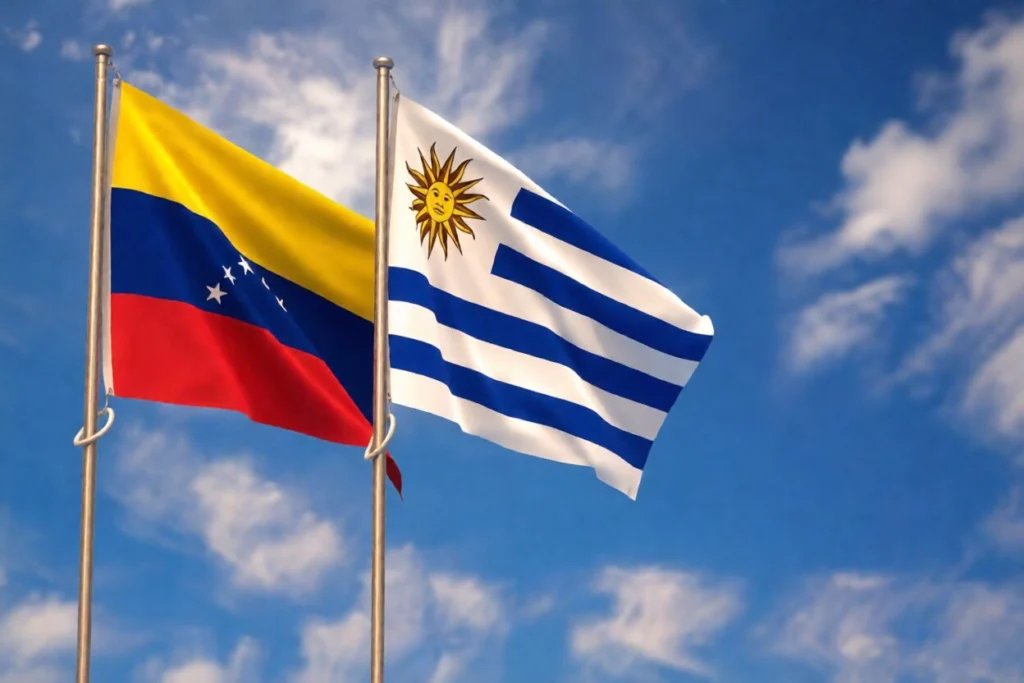
Uruguay condemns US military intervention in Venezuela, reaffirming Latin America as a Zone of Peace and demanding strict adherence to international law.
Related: Russia Condemns U.S. Strikes on Venezuela as ‘Armed Aggression’
Montevideo, January 3, 2026 — The Government of the Oriental Republic of Uruguay issued a formal statement on Saturday expressing its “serious concern” and categorical rejection of the United States’ recent military intervention in Venezuela, following reports of aerial strikes against both military installations and civilian infrastructure in the South American nation. In a strongly worded communiqué, Uruguay’s Ministry of Foreign Affairs reaffirmed that Latin America and the Caribbean must remain a Zone of Peace, and condemned the attacks as a clear violation of the United Nations Charter and fundamental principles of international law.
“Uruguay rejects, as it has always done, the military intervention of one country on the territory of another,” the statement declared, emphasizing that this stance is not a temporary reaction but a historical pillar of Uruguayan foreign policy rooted in multilateralism, sovereignty, and peaceful dispute resolution.
The Uruguayan government stressed that the U.S. airstrikes—reportedly causing civilian casualties and damaging essential infrastructure—exacerbate Venezuela’s humanitarian crisis and risk triggering a broader regional destabilization. By invoking Article 2(4) of the UN Charter, which obliges all states to “refrain from the threat or use of force against the territorial integrity or political independence of any state,” Montevideo explicitly framed the intervention as illegal and illegitimate, regardless of any stated justifications related to “democracy” or “security.”
Uruguay Condemns US Military Intervention in Venezuela: A Doctrine of Peace
Uruguay’s condemnation draws on a long-standing diplomatic tradition that dates back to its advocacy for non-intervention during the Cold War and its consistent support for UN-led conflict resolution. The current statement underscores that the resort to force without Security Council authorization not only breaches international law but also undermines the very foundations of the rules-based order that Uruguay has helped uphold for decades.
“Any military action in our region fractures a political consensus built over generations to keep war away from Latin American soil,” the foreign ministry warned.
The communiqué explicitly rejects narratives that seek to legitimize foreign military action under the guise of humanitarianism or regime change. “Peace cannot be bombed into existence,” the statement implies, echoing Uruguay’s consistent stance that dialogue, mediation, and respect for self-determination are the only legitimate paths to resolving internal conflicts.
Read the CELAC Havana Declaration on Latin America and the Caribbean as a Zone of Peace
In a humanitarian gesture, Uruguay confirmed it is in constant communication with its consulate in Caracas, closely monitoring the situation of Uruguayan nationals residing in Venezuela. Authorities are evaluating potential consular assistance measures should citizens be affected by infrastructure damage, service disruptions, or displacement resulting from the attacks.
This dual approach—diplomatic condemnation paired with citizen protection—reflects Uruguay’s balanced foreign policy: principled on global norms, yet practical in safeguarding its diaspora.
Uruguay sigue con seria preocupación los acontecimientos recientes en Venezuela, incluidos los ataques reportados contra instalaciones militares e infraestructura civil.
Comunicado completo
https://t.co/T7Tw3pP4Ct#Uruguay #Venezuela #DerechoInternacional #ZonaDePaz… pic.twitter.com/oXcjSI6F2Q
— Cancillería Uruguay
(@CancilleriaUy) January 3, 2026
Review the Treaty of Tlatelolco on the denuclearization of Latin America
Geopolitical Context: Defending Regional Sovereignty in a Multipolar World
The Uruguay condemns US military intervention in Venezuela statement arrives at a critical juncture for Latin America. As the U.S. intensifies its military presence in the Caribbean—through naval patrols, drone operations, and strategic partnerships—Uruguay’s position challenges the resurgence of interventionist doctrines that treat the region as a sphere of influence.
Regionally, Montevideo joins a growing chorus of nations—including Mexico, Argentina, Bolivia, and members of ALBA-TCP—that reject unilateralism and uphold CELAC’s 2014 “Zone of Peace” declaration. This collective stance is not anti-American, but pro-sovereignty: it asserts that Latin American nations have the right to determine their own political and economic futures without external coercion.
Globally, Uruguay’s stance aligns with the Global South’s demand for a more equitable international order. At a time when powerful states bypass the UN Security Council to pursue strategic objectives—often under humanitarian pretexts—Uruguay’s invocation of the Charter serves as a moral and legal anchor for smaller nations seeking protection from regime-change campaigns.
Explore UN Office of Legal Affairs on the prohibition of the use of force
Critically, Uruguay’s statement also highlights a historical pattern: military interventions justified as “rescues” often lead to prolonged chaos, refugee crises, and state collapse—as seen in Iraq, Libya, and Syria. By opposing the U.S. strikes on Venezuela, Uruguay is not defending any specific government, but defending the principle that no nation should be bombed into submission, regardless of its internal challenges.
As the communiqué concludes: “The path forward must be political, not military. The future of Venezuela must be decided by Venezuelans—not by foreign bombs.”
In reaffirming its commitment to diplomacy, multilateralism, and regional peace, Uruguay once again positions itself not as a passive observer, but as a moral voice for the rules that bind the international community—rules that, when ignored by the powerful, leave the vulnerable exposed.
Declaración de la cancillería uruguaya en rechazo a la intervención militar de Estados Unidos en Venezuela. https://t.co/1D1OeMb6bR pic.twitter.com/eVdA1MIZ0B
— Pablo Alvarez (@PabloAlvarez_uy) January 3, 2026
From teleSUR English via This RSS Feed.