

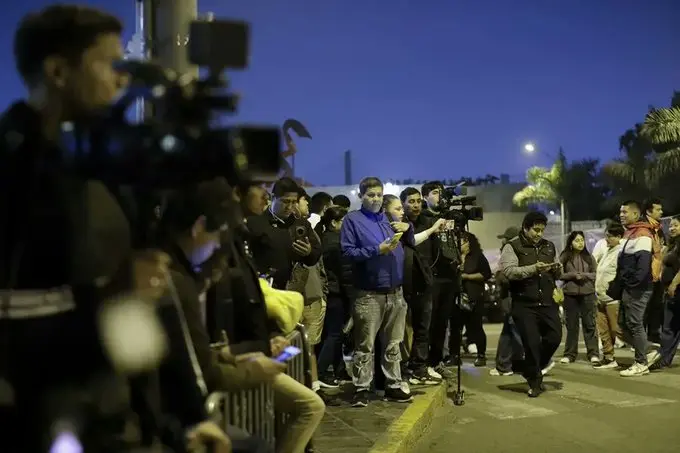
Peru recorded its most lethal year for journalism in 2025, with 458 attacks against reporters and media outlets, including four murders, according to an annual report released by the National Association of Journalists of Peru (ANP).
RELATED:
Peru’s Congress to Consider Barring Ex-PM Mirtha Vasquez from Senate Race
The most recent killing involved journalist Mitzar Castillejos, who died on December 26 in Lima after being shot two weeks earlier by unidentified assailants. He was attacked while traveling to host a radio program in Aguaytía, in the Amazon region of Ucayali.
Castillejos was the fourth journalist killed in Peru in 2025. The other victims were Gastón Medina, murdered in the southern city of Ica; Raúl Celis, killed in the Amazon city of Iquitos; and Fernando Núñez, slain in the northern coastal town of Pacasmayo.
#LoÚltimo | Fiscalía realiza diligencias contra los que resulten responsables de los delitos de homicidio calificado y sicariato en agravio del periodista radial Mitzar Castillejos, quien fue asesinado por disparos en Aguaytía, Ucayali.
La Segunda Fiscalía… pic.twitter.com/QQ4xoNhoIe
— Ministerio Público (@FiscaliaPeru) December 30, 2025
“Four journalists murdered. 458 attacks on the press. They try everything and by all means. The goal is one: to silence us. To silence critical voices. To gag those who investigate. Either through laws or through bullets,” said ANP president Zuliana Lainez in the report.
Lainez stated that “these crimes, in 2025, place Peru second only to Mexico in terms of lethal violence against journalists,” adding that “our country today entails greater risk than Ecuador, Colombia, Haiti or Central American countries, with all that this implies.”
The report, prepared by the ANP’s Office for Journalists’ Human Rights, notes a sustained escalation of attacks on press freedom throughout 2025. ANP legal adviser Miguel Jugo said that in 2025 “aggressions against press freedom have continued to intensify, particularly against journalists who carry out oversight and report on the various negative situations occurring in the country.”
Jugo added that “various institutions monitoring the situation of social communicators indicate that the institutions responsible for the most aggressions are the Executive branch, in first place, followed by Congress.”
According to the data, the 458 incidents included 127 cases of threats or harassment, 114 physical and verbal assaults, 79 instances of stigmatizing discourse, 50 obstructions to journalistic coverage and 46 cases of judicial intimidation. The report also documented 13 legislative threats, 12 restrictions on access to information, four murders, four labor-related violations such as workplace harassment or dismissal, four cases of administrative pressure or sanctions, three detentions and two cyberattacks.
En el 2025 se produjeron 458 ataques contra periodistas y medios de comunicación, entre ellos, cuatro asesinatos de periodistas, lo que hace de este año el más letal para el ejercicio del periodismo en el presente siglo
Ver informe: https://t.co/aYtw8VBcck pic.twitter.com/AJhaRIzsTb
— ANP Perú (@ANP_periodistas) January 2, 2026
The ANP identified 217 public officials as aggressors, followed by 121 security agents—including police, military personnel, municipal guards and private security—71 civilians, 45 unidentified individuals and four employers. By media sector, 219 cases affected digital outlets, 108 television, 66 print and 65 radio. Those targeted included 231 men, 93 women and 134 media organizations.
Geographically, attacks were reported in 65 provinces nationwide. Lima accounted for 256 cases, followed by Huamanga, Huaraz and Puno with 12 cases each, and Maynas with 10.
The findings align with warnings issued in October by the Inter American Press Association (IAPA), which described 2025 as one of the worst years in recent decades for press freedom in Peru. At the time, the IAPA cited not only direct attacks but also judicial persecution of critical journalists, disinformation campaigns, stigmatization of dissenting voices, restrictions on access to public information and legislative proposals that directly threaten informational freedoms.
From teleSUR English via This RSS Feed.