

Bullets:
NATO and European officials are deeply concerned, as China and Russia enjoy scientific, research, and even military breakthroughs across the Arctic region.
The two countries have strong diplomatic and economic ties, and are opening up the vast Arctic region to energy and minerals, and opening new trade routes.
Russia has deep expertise in Arctic operations and deep-sea technologies, while China deploys massive industrial capacity and investment in the building of new ports, undersea vehicles, and icebreakers.
Inside China / Business is a reader-supported publication. To receive new posts and support my work, consider becoming a free or paid subscriber.
Please go here for the YouTube video for this report:
Report:
Good morning.
The most important geopolitical development today is the rise of this bloc of nations, the BRICS bloc. Or, pulling back farther — the Global Majority countries that are much more friendly with China, than with the West. The world is a very big place, and most of the countries in it are far removed from London and Brussels and Washington, and they’re happy to keep it that way. And they are deepening their relationships with each other, in lots of ways.
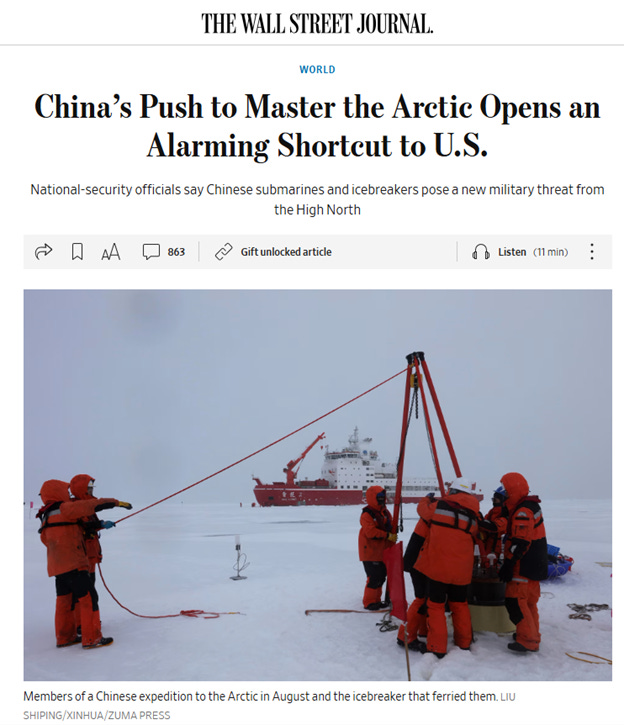
China is the industrial and scientific powerhouse driving these trends along. From the Wall Street Journal, NATO officials are insisting that Chinese submarines and icebreakers pose a new military threat from the High North, the Arctic. Research subs from China are traveling deep under the ice, and Chinese military and research ships are in operation around Alaska and elsewhere in the Arctic, at the highest level ever.
By opening up the polar regions, the benefits to China are obvious: China is the world’s largest manufacturer, and it’s helpful to know where new sources of raw materials may be. Mapping the Arctic and developing the expertise to navigate it are boons to shipping and logistics, and it all opens up strategic possibilities for the Chinese military.
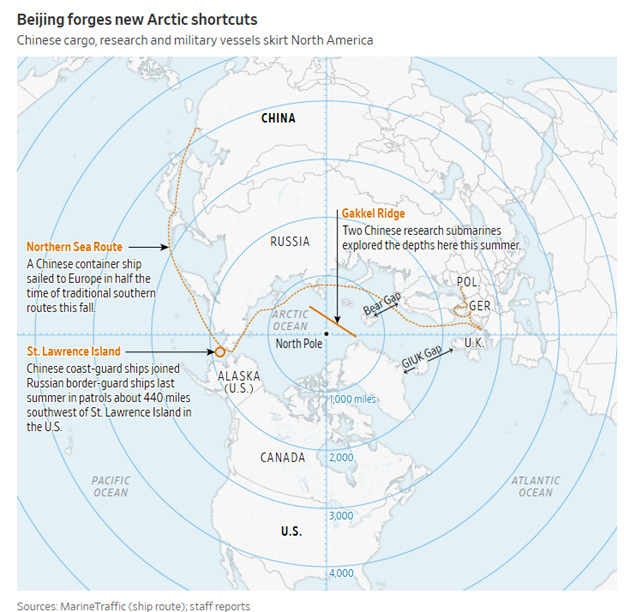
This map is the problem, and we’ll return to it later. Russia wraps nearly halfway around the Arctic Ocean, and China and Russia are neighbors. Friendly neighbors. Chinese ships going that way to ports in Europe would necessarily need, or at least want, friendly shores for that trip, and Russia is that.
For European ships going the other way, the Polar route skirting Russia is not an option: they’ve no choice but to go the long way around. There are big plans for new trade routes anyway with Russia and China, and for energy, and both militaries are training and performing missions together from Russian bases, which has the commander of NORAD looking for more money.
I’m not crazy about designating the relationship between Russia and China as a partnership of convenience, as the WSJ does. This is not a shallow, transactional alliance. They have deep relationships in Asia, and in the Arctic, and in space. China builds electronics and military hardware and components. Russia has deep experience in space, aeronautics, and submarines. They have a lot to offer each other, in other words. For icebreakers, Russia has 40. China just built its fifth, and the United States only has 2.
And China is learning that industry fast. Six years ago they launched their first icebreaker, in a cooperation with Finland. One year ago they did it all themselves, building and launching one in just ten months. That was noted with deep concern in NATO countries, along with the plans for Russia and China to build out new infrastructure and trade routes in the North.
Chinese media are reporting on the breakthroughs in the Arctic. The mission by China’s Explorer Three made the country the first capable of continuous manned deep-sea dives in the Arctic, and China owns over half of all the global patents for building marine equipment, now ahead of South Korea, the US and Japan.
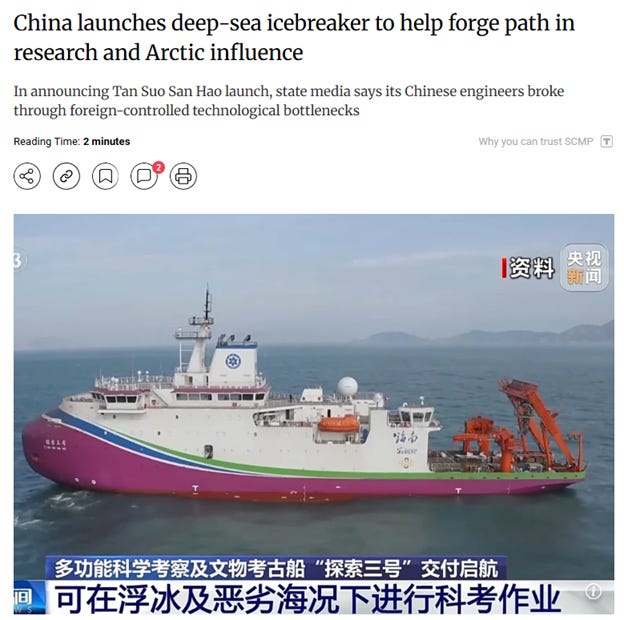
This is the new icebreaker, designed and built by Chinese engineers, and allows China to be second only to Russia in deep-sea polar exploration, and they’ve developed deep-sea drones for that purpose.
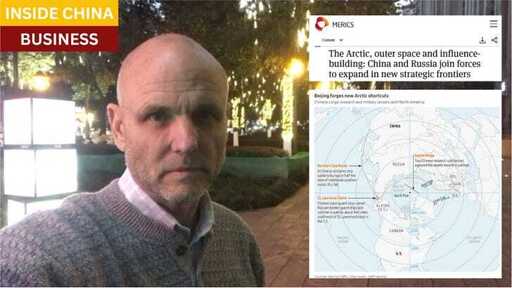
MERICS is the Mercator Institute of China Studies. They’re based in Berlin, and point out here that China and Russia are key partners in the polar regions, space, cyberspace, and deep sea, and those have profound military implications as well, especially for Europe. The EU and its members have some difficult choices to make, and it starts with the understanding that this is not a mere “partnership of convenience” between Russia and China.
For years, Europe has been decoupling from China, while imposing sanctions on Russia and seizing Russian sovereign reserves held in European banks. These developments are recent. Europe and China used to be much closer, sharing research and facilities in the Arctic, with Chinese research stations set up in Norway, Sweden, and Iceland. That’s not true anymore—new projects are blocked or canceled outright.
For China, Russia is a better partner anyway. It’s a lot bigger, and the Russians have sovereign rights in the Arctic, and a comprehensive network of facilities—scientific, commercial, and military. China brings heavy industry and technology, Russia brings the history, the geography, and the deep expertise that China – and everyone else – lacks.
This cooperation is far along, with heavy Chinese investment in mining and energy, and a new deepwater port on the White Sea under construction.
Besides that, the Arctic completes the circle for China’s Beidou system. Beidou is China’s satellite navigation system, and directly competes with GPS and Galileo. Those Arctic stations dramatically improve the accuracy of Beidou everywhere in the world, and countries with poor coverage under GPS are signing up to use Beidou instead, including for their militaries.
This all leaves Europe in a tight spot. The EU has raw materials and energy supply chain problems that may be solved by what is sitting under all that ice, but China and Russia are already mapping the sea floors and building the ships and the harbors to get those resources for themselves, and Europe has probably burned too many bridges with Moscow, and probably with China too.
So MERICS suggests that Europe finds new partners, quickly, and get back in the race. But they admit that’s got some problems: full cooperation with the United States doesn’t seem likely, so Europe should reach out to the UK, Canada, or India. NATO “could be used as a platform to monitor China’s activities.”
And now we’ll look again at that map from before. The UK isn’t on the Arctic Ocean at all, and it’s hard to imagine just what India might bring to the table, and they’ve maybe forgotten that India is a BRICS country, along with Russia and China.
Be good.
Resources and links:
China launches deep-sea icebreaker to help forge path in research and Arctic influence
https://www.scmp.com/news/china/science/article/3292430/chinese-launches-deep-sea-icebreaker-help-forge-path-research-and-arctic-influence
Wall Street Journal, China’s Push to Master the Arctic Opens an Alarming Shortcut to U.S.
https://www.wsj.com/world/china-arctic-military-submarines-b4e988b9
China has big ambitions in space and the Arctic. Should the West be worried?
https://www.scmp.com/economy/china-economy/article/3332333/china-has-big-ambitions-space-and-arctic-should-west-be-worried
The Arctic, outer space and influence-building: China and Russia join forces to expand in new strategic frontiers
https://merics.org/en/report/arctic-outer-space-and-influence-building-china-and-russia-join-forces-expand-new-strategic
China’s geopolitical competition expands into new frontiers with scientific milestones
https://www.scmp.com/economy/china-economy/article/3330611/chinas-geopolitical-competition-expands-new-frontiers-scientific-milestones
This sea route has been dismissed as too treacherous. China’s taking the risk
https://edition.cnn.com/2025/10/03/climate/china-arctic-shipping-northern-sea-route
Why China’s Ice Silk Road has Trump up in Arctic arms
https://asiatimes.com/2025/01/why-chinas-ice-silk-road-has-trump-up-in-arctic-arms/
Inside China / Business is a reader-supported publication. To receive new posts and support my work, consider becoming a free or paid subscriber.
From Inside China / Business via This RSS Feed.