

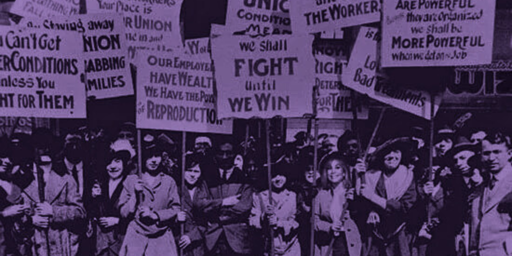
Boy Genius’s Lucy Dacus took the stage with a rendition of one of the most powerful anthems of the feminist and labor movements, “Bread and Roses.” Singing before millions of people watching across the city, the country, and the world, Dacus recited the rallying cry of workers and feminists who have carried on the fight against oppression and exploitation.
More than a nod to the struggles of the past, the legacy of “Bread and Roses” is one of class struggle and the independent power of the working class.
The lyrics have their origins in the suffragette movement of the early twentieth century as women fought for political rights. Beyond demanding the right to vote, the movement raged against the double exploitation of women both in the home and in the workplace. Working women played a key role, taking the politics of the feminist movement to the factory floor and the demands for better working conditions to suffragist meeting halls and protests.
The song has deep roots in the labor movement, associated with the “Bread and Roses” strike of 1912 in Lawrence Massachusetts. From January to March, the majority immigrant and woman workforce went on strike against reductions in hours and pay, confronting both the bosses and labor leaders who preferred to ignore so-called “women’s issues.”
The idea embodied in this slogan — that the fight against exploitation and oppression are inseparably intertwined — has inspired the struggles of millions of women, queer people, and socialists across the world in the last century.
Against a feminism that celebrates exploitation in the race to “the top” that we’ll never reach, that urges us to step on the backs of other working people, that is content with representation while our conditions remain unchanged, and that ignores racism and imperialism, “Bread and Roses” is a rallying call for something different: socialist feminism.
It is a banner is proudly taken up by the international “Pan y Rosas”/”Bread and Roses” movement that began in Argentina with feminists fighting against femicide and for reproductive rights. Today these activists fight in over 14 different countries against the attacks of the Far Right, austerity and the attacks of the bosses, racism, imperialism, and for a socialist society where we can all be free.
Intentionally or not, Dacus’s choice of song carries immense weight in the United States today because it is a challenge for the feminist movement to rear its head. The rights of immigrants, trans people, and queer people are under attack; the highest offices of government and the institutions of capitalism have been implicated in the Epstein Files; working people cannot make ends meet; and the U.S. is launching a new imperialist offensive on our class siblings in Latin America and Africa.
The socialist feminist legacy that we claim in the slogan “Bread and Roses” is a challenge to rebuild the feminist movement by putting the fight against capitalism at the center. It is one that fights to transform society, not to soften its harshest edges.
That can’t be done stuck inside the Democratic Party, which props up the pillars of exploitation and oppression. Rebuilding a combative feminist movement means building that fight in the independent organization of the working class, not relying on rotten institutions to grant us our freedom.
The post Bread & Roses: The Socialist Feminist Roots of Lucy Dacus’s Performance at Mamdani’s Inauguration appeared first on Left Voice.
From Left Voice via This RSS Feed.