

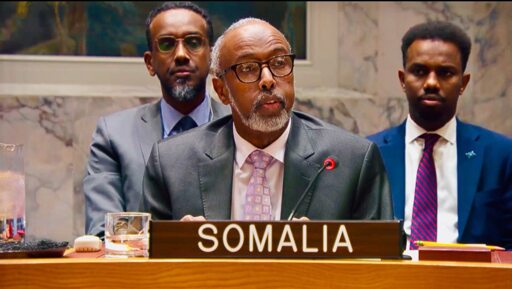
Israel’s recognition of Somaliland (a separatist enclave in Somalia’s northwest) as a sovereign entity has provoked a global outcry, with 14 of the 15 UN Security Council (UNSC) members opposing it at the emergency meeting convened on December 29. The US was the only country defending Israel’s action at the meeting in New York, convened at the request of Somalia.
Others argued that the move undermines Somalia’s sovereignty and raised concerns about its destabilizing effects on the Red Sea region.
Speaking on behalf of the A3+ (the group of non-permanent African member states on UNSC and includes Algeria, Sierra Leone, and Guyana) Somalia’s UN envoy Abukar Osman said the grouping condemned it as a “flagrant assault by Israel on the unity and the territorial integrity of Somalia”. He warned against Israel’s attempts to forcibly “relocate the Palestinian population from Gaza to the north-west region of Somalia”.
Separatist forces, predominantly from one clan, called the Isaaq, took control of the region called Somaliland and declared independence in 1991, in the aftermath of the state’s collapse following the civil war.
Read more: Separatist Somaliland escalates war on Somali unification movement
However, its claim to sovereignty is not recognized by the UN, the African Union, or any country in the world, other than Israel, which announced its decision to recognize Somaliland and establish mutual diplomatic relations on December 26.
A forward base against Yemen
Located on the Red Sea coast right across Yemen, whose Ansar Allah government has blocked Israel’s shipping and carried out drone strikes in the country to disrupt its genocide in Gaza, Israel’s recognition of Somaliland “gains” it “a strategic foothold in proximity to Yemen,” Zionist blogger Samuel Rothmann explained in the Times of Israel.
“Somaliland’s significance lies in its geostrategic location and in its willingness… to work closely with Western countries,” Israeli think tank, the Institute for National Security Studies, elaborated in a briefing published in late November.
“Since the Gulf states, the United States, and Israel have all fought the Houthis [Ansar Allah] in recent years without achieving a decisive outcome, Somaliland’s location—and the possibility of operating from its territory—could be a game changer,” it went on to explain.
“Somaliland could serve as a forward base for a range of missions: intelligence collection and monitoring of the Houthis and their military buildup; logistical support for… [the] war against the Houthis; and direct operations”, including “offensive actions”.
Condemning the “hostile stance targeting Somalia and its African surroundings, as well as Yemen… and the countries along both shores of the Red Sea,” Ansar Allah chief Abdulmalik al-Houthi warned that “any Israeli presence in Somaliland” will be “a military target for our armed forces.”
Somalia’s government will not allow its territory to be used by Israel to launch aggression on other countries in the region, Somalia’s President Hassan Sheikh Mohamud told the joint session of the two chambers of the Somali federal parliament on December 28.
“Israel should instead recognize Palestine”
In a separate statement, Prime Minister Hamza Abdi Barre warned that Israel’s use of the territory for its aggression on the region endangers the security of citizens in northern Somalia. Deeming its diplomatic recognition of Somaliland as illegal and therefore “null and void”, he said Israel should instead recognize Palestine, which “remains under occupation and aggression”.
Expressing their “total rejection and condemnation of Israel’s recognition of the Somaliland region”, the foreign ministers of Egypt, Turkey, and Djibouti said in a joint statement: “This initiative by Israel, which aligns with its expansionist policy and its efforts to do everything to prevent the recognition of a Palestinian state, constitutes overt interference in Somalia’s domestic affairs.”
The African Union warned that “any attempt to undermine the unity, sovereignty, and territorial integrity of Somalia … risks setting a dangerous precedent with far-reaching implications for peace and stability across the continent.”
The Intergovernmental Authority on Development (IGAD), composed of eight East African countries, added, “Any unilateral recognition runs contrary to the Charter of the United Nations, the Constitutive Act of the African Union, and the Agreement establishing IGAD.”
The Arab League, the Gulf Cooperation Council (GCC), and the Organization of Islamic Cooperation (OIC) also voiced their condemnation. Even the European Union (EU) reaffirmed “the importance of respecting the unity, the sovereignty and the territorial integrity of the Federal Republic of Somalia.”
It is against the backdrop of universal opposition to Israel’s move that the UNSC’s emergency meeting was convened on December 29. At the meeting, the 22-member Arab League’s UN envoy Maged Abdelaziz reiterated the group’s rejection of “any measures arising from this illegitimate recognition aimed at facilitating forced displacement of the Palestinian people, or exploiting northern Somali ports to establish military bases”.
Israel accuses Somalia of genocide
Defending Israel’s position before the Council, its Deputy Permanent Representative to the UN, Jonathan Miller, claimed before the UNSC that during the civil war, Somalia had committed a “genocide” against the Isaaq clan, which controls Somaliland.
It is “ridiculous and unbelievable” that the “occupying power in Palestine” that is “killing and maiming hundreds of thousands”, starving “innocent people”, and forcibly displacing “the whole community” is “lecturing us” about “genocide”, retorted Somali envoy Osman. “If we want to talk about genocide, it is Israel that is committing” it before “our own eyes every day”.
“It is ironic and cynical that Israel wishes to be the only state to recognize Somaliland, while at the same time rejecting recognition of the State of Palestine, which the overwhelming majority of UN member states have recognized as being legal in terms of international law,” pointed out Mathu Joyini. She is the UN ambassador from South Africa, which, although not a current member of the UNSC, requested to speak.
Diplomatic acrobatics by the US
Trying to flip the Palestine comparison on its head, US Ambassador Tammy Bruce said in her defense of Israel: “Earlier this year [2025], several countries, including members of this council, made the unilateral decision to recognise a nonexistent Palestinian state, and yet no emergency meeting was called to express this Council’s outrage.” She went on to accuse the UNSC of “double standards”.
Rebutting her argument, Slovenia’s UN ambassador, Samuel Zboga, countered, “Palestine is not part of any state. It is illegally occupied territory… Palestine is also an observer state in this organization [the UN],” he added. Somaliland, on the other hand, is a part of a UN member state, and recognizing it goes against… the UN Charter.”
Insisting that “no country should aid and abet separatist forces in other countries to further their own geopolitical interests,” China’s deputy UN envoy Sun Lei said that Israel “has further increased the tensions in the Horn of Africa.”
“Africans are rightly gravely concerned by the repercussions and implications of this negative development for the security and stability of the continent,” added Mohamed Siad Doualeh, Djibouti’s Permanent Representative to the UN.
“Hundreds of millions of people in the whole of Africa are watching us today, and they are expecting this Council to take vigorous action. The Security Council must therefore respond with clarity, courage, resolve, and fidelity to the principles of the United Nations Charter.”
“We understand the justified reaction… from the Somali government, the leadership of the African Union, the countries of the region, and the nations of the Arab-Muslim world,” said Dina Gilmutdinova, senior counsellor at the Russian mission to the UN. “We express concern about the possible consequences, including a potential escalation of tensions in the Horn of Africa and beyond.”
Even James Kariuki, charge d’affaires of the UK, which has historically been a key backer of the secessionist project, said, “We regret any action that risks undermining peace and security in the region.”
“The greatest benefit to American national security interests”
Amid this chorus, US Ambassador Bruce condemned the emergency meeting itself as a distraction “from serious work”, insisting, “Israel has the same right to conduct diplomatic relations as any other sovereign state.”
However, she added that the US itself has “no announcement to make regarding US recognition of Somaliland. And there has been no change in American policy” – namely, One Somalia. Earlier this June, a Republican member of the US House of Representatives, Perry Scott, introduced a Bill to promulgate the ”Republic of Somaliland Independence Act” to “recognize Somaliland of the Federal Republic of Somalia as a separate, independent country.”
Later in August, the Chairman of the Senate Foreign Relations Subcommittee on Africa and Global Health Policy, Republican Senator Ted Cruz, wrote a letter urging President Donald Trump to recognize Somaliland.
Arguing that it will be of “the greatest benefit to American national security interests” in the Horn of Africa, he went on to explain: Somaliland “has enabled the opening of a Taiwanese Representative Office in the capital of Hargeisa, sought to strengthen ties with Israel, and voiced support for the Abraham Accords. It has proposed hosting a US military presence near the Red Sea along the Gulf of Aden and is open to critical minerals agreements.”
The post Global outcry against Israel’s recognition of Somaliland appeared first on Peoples Dispatch.
From Peoples Dispatch via This RSS Feed.