

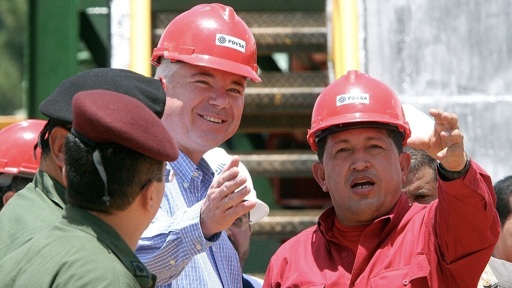
The United States had no problem with Venezuela per se, not with the country nor with its former oligarchy. The problem that the United States government and its corporate class have is with the process set in motion by the first government of Venezuelan President Hugo Chávez.
In 2001, Chávez’s Bolivarian process passed a law called the Organic Hydrocarbons Law, which asserted state ownership over all oil and gas reserves, held upstream activities of exploration and extraction for the state-controlled companies, but allowed private firms – including foreign firms – to participate in downstream activities (such as refining and sale). Venezuela, which has the world’s largest petroleum reserves, had already nationalized its oil through laws in 1943 and then repeated in 1975. However, in the 1990s as part of the neoliberal reforms pushed by the International Monetary Fund (IMF) and by the large US-owned oil companies, the oil industry was substantially privatized.
When Chávez enacted the new law, it brought the state back into control of the oil industry (whose foreign oil sales were responsible for 80% of the country’s external revenues). This deeply angered the US-owned oil companies – particularly ExxonMobil and Chevron – which put pressure on the government of US President George W. Bush to act against Chávez. The US tried to engineer a coup to unseat Chávez in 2002, which lasted for a few days, and then pushed the corrupt Venezuelan oil company management to initiate a strike to damage the Venezuelan economy (it was eventually the workers who defended the company and took it back from the management). Chávez withstood both the coup attempt and the strike because he had the vast support of the population. Maria Corina Machado, who was awarded the Nobel Peace Prize in 2025, started a group called Sumaté (“Join Up”), which placed a recall referendum on the ballot. About 70% of the registered voters came to the polls in 2004, and a large majority (59%) voted to retain Chávez as the president.
But neither Machado nor her US backers (including the oil companies) rested easy. From 2001 till today, they have tried to overthrow the Bolivarian process – to effectively return the US-owned oil companies to power. The question of Venezuela, then, is not so much about “democracy” (an overused word, which is being stripped of meaning) but about the international class struggle between the right of the Venezuelan people to freely control their oil and gas and that of the US-owned oil companies to dominate Venezuelan natural resources.
The Bolivarian process
When Hugo Chávez appeared on the political scene in the 1990s, he captured the imagination of most of the Venezuelan people – particularly the working-class and the peasantry. The decade was marked by the dramatic betrayals by presidents who promised to secure the oil-rich country from IMF-imposed austerity and then adopted those same IMF proposals. It did not matter if they were social democrats (such as Carlos Andrés Pérez of Democratic Action, president from 1989 to 1993) or conservatives (such as Rafael Caldera of the Christian Democrats, president from 1994 to 1999). Hypocrisy and betrayal defined the political world, while high levels of inequality (with the Gini index at a staggering 48.0) gripped the society. The mandate for Chávez (who won the election with 56% against 39% for the candidate of the old parties) was against this hypocrisy and betrayal.
It helped Chávez and the Bolivarian process that oil prices stayed high from 1999 (when he took office) till 2013 (when he died at 58, very young). Having taken hold of the oil revenues, Chávez turned them over to make phenomenal social gains. First, he developed a set of mass social programs (misiones) that redirected oil revenues to meet basic human needs such as primary healthcare (Misión Barrio Adentro), literacy and secondary education for the working-class and peasantry (Misión Robinson, Misión Ribas, and Misión Sucre), food sovereignty (Misión Mercal and then PDVAL), and housing (Gran Misión Vivienda).
The state was reshaped as a vehicle for social justice and not an instrument to exclude the working-class and peasantry from the gains of the market. As these reforms advanced, the government moved to build popular power through participatory instruments such as the communes (comunas). These communes emerged first out of popular consultancy assemblies (consejos comunales) and then developed into popular bodies to control public funds, plan for local development, generate communal banks, and form local, cooperative enterprises (empresas de producción social). The communes represent one of the Bolivarian process’ most ambitious contributions: an effort – uneven but historically significant – to construct popular power as a durable alternative to oligarchic rule.
The US-imposed hybrid war on Venezuela
Two events took place in 2013-14 that deeply threatened the Bolivarian process: first, the untimely death of Hugo Chávez, without doubt the driving force of revolutionary energy in the country, and second, the slow and then steady collapse of oil revenues. Chávez was followed as president by the former foreign minister and trade unionist Nicolás Maduro, who tried to steady the ship but faced a severe challenge when oil prices, which peaked in June 2014 at roughly USD 108 per barrel, fell dramatically in 2015 (below USD 50) and then by January 2016 (below USD 30). For Venezuela, which relied upon foreign crude oil sales, this decline was catastrophic. The Bolivarian process could not revise the oil-dependent redistribution (not just within the country but in the region, including through PetroCaribe); it remained trapped by dependence on oil exports and therefore by the contradictions of being a rentier state. Equally, the Bolivarian process had not expropriated the wealth of the dominant classes, which continued to lean heavily on the economy and society, and therefore prevented a full-scale transition to a socialist project.
Before 2013, the United States, its European allies, and oligarchic forces in Latin America had already forged their weapons for a hybrid war against Venezuela. After Chávez won his first election in December 1998 and before he took office the next year, Venezuela saw accelerated capital flight as the Venezuelan oligarchy took their wealth to Miami. During the coup attempt and the oil lockout, there was more evidence of capital flight, which weakened the monetary stability of Venezuela. The United States government began to lay the diplomatic groupwork to isolate Venezuela, characterizing the government as a problem and building an international coalition against it. This led, by 2006, to restrictions on Venezuela for access to international credit markets. Credit rating agencies, investment banks, and multilateral institutions steadily raised borrowing costs, making refinancing more difficult well before the US placed formal sanctions on Venezuela.
After the death of Chávez, and with oil prices lowered, the United States began a focused hybrid war against Venezuela. Hybrid war refers to the coordinated use of economic coercion, financial strangulation, information warfare, legal manipulation, diplomatic isolation, and selective violence, deployed to destabilize and reverse sovereign political projects without the need for full-scale invasion. Its objective is not territorial conquest but political submission: the disciplining of states that attempt redistribution, nationalization, or independent foreign policy.
Hybrid war operates through the weaponization of everyday life. Currency attacks, sanctions, shortages, media narratives, NGO pressure, judicial harassment (lawfare), and engineered legitimacy crises are designed to erode state capacity, exhaust popular support, and fracture social cohesion. The resulting suffering is then presented as evidence of internal failure, masking the external architecture of coercion. This is precisely what Venezuela has faced since the US illegally placed financial sanctions on the country in August 2017, these were then deepened with secondary sanctions in 2018. Because of these sanctions, Venezuela has faced the disruption of all payment systems and trade channels and forced overcompliance with US regulations. Meanwhile, media narratives in the West systematically downplayed sanctions, while amplifying inflation, shortages, and migration as purely internal phenomenon, reinforcing regime-change discourse. The collapse of living standards in Venezuela between 2014 and 2017 cannot be divorced from this layered strategy of economic asphyxiation.
Mercenary attacks, sabotage of the electrical grid, creation of a conflict generated to benefit ExxonMobil between Guyana and Venezuela, invention of an alternative president (Juan Guaidó), provision of the Nobel Peace Prize to someone calling for a war against her own country (Machado), attempted assassination of the president, bombings of fishing boats off the Venezuelan coast, seizure of oil tankers leaving Venezuela, buildup of an armada off the coast of the country: each of these elements is designed to create neurological tension within Venezuela leading to the surrender of the Bolivarian process in favor of a return to 1998 and then an annulment of any hydrocarbon law that promises the country sovereignty.
If the country were to return to 1998, as Maria Corina Machado promises, all the democratic gains made by the misiones and the comunas as well as by the Constitution of 1999 will be invalidated. Indeed, Machado said that a US bombing of her fellow Venezuelans would be “an act of love”. The slogan of those who want to overthrow the government is Ahead to the Past.
In October 2025, meanwhile, Maduro told an audience in Caracas in English, “listen to me, no war, yes peace, the people of the United States”. That night, in a radio address, he warned, “No to regime change, which reminds us so much of the endless, failed wars in Afghanistan, Iraq, Libya, and so on. No to CIA-orchestrated coups d’état.” The line, “no war, yes peace”, was taken up on social media and remixed into songs. Maduro appeared several times at rallies and meetings with music ablaze, singing, no war, yes peace, and – on at least one occasion – wearing a hat with that message.
The post The US War on Venezuela began in 2001 appeared first on Peoples Dispatch.
From Peoples Dispatch via This RSS Feed.