

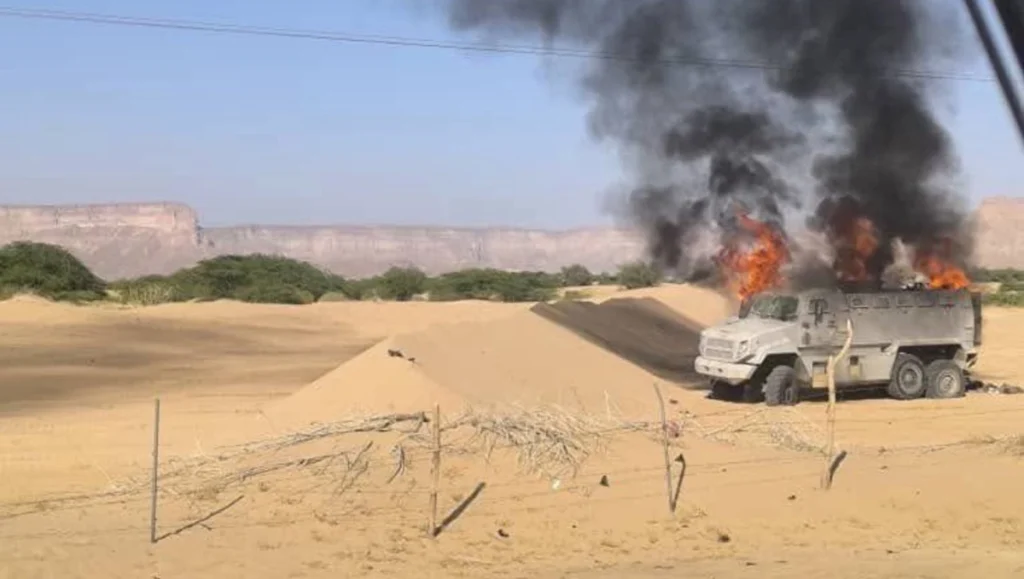
Attacks on Southern Transitional Council forces kill at least seven people.
On Friday, Saudi Arabia carried out airstrikes against positions of the UAE-backed Southern Transitional Council (STC) in Yemen’s Hadramaut province, marking a direct military escalation against the separatist group.
RELATED:
Why is Yemen’s Anti-Houthi Coalition Facing Instability?
The bombings took place in the Al-Khasah area near the Saudi border, killing at least seven people and wounding more than twenty. Local media also reported ground clashes between STC forces and militias of the “National Shield,” which remain loyal to Hadramaut Governor Salem al-Khanbashi, a Saudi ally.
Saudi Arabia’s ambassador to Yemen’s Presidential Leadership Council, Mohammad Al Jaber, publicly accused STC President Aidarous al-Zubaidi of ordering a full closure of Aden International Airport, blocking the landing of a plane carrying an official Saudi delegation.
“We face persistent refusal,” Al Jaber said, referring to Riyadh’s efforts to resolve the crisis. The airport closure was decreed by Transport Minister Abdel Salam Humaid of the Aden-based Yemeni government, an STC ally.
In response, Governor al-Khanbashi – whom the Saudi-backed government recently granted full military powers in Hadramaut – announced the start of a “peaceful operation” to reclaim STC-held camps and military bases in the province. “The operation is not a declaration of war or an escalation,” he stated, although his forces are already engaged with separatists on the ground.
🇾🇪🇸🇦 Clashes intensify in Hadhramaut: after #Saudi airstrikes on Khasha‘a, STC forces pulled back and National Shield units took control. Saudi jets also hit STC sites in Seiyun and Wadi Hadhramaut, as National Shield aims to push toward Al-Qatn, Shibam and eventually Seiyun. pic.twitter.com/YHZzeWTQ6o
— IWN (@A7_Mirza) January 2, 2026
A Split Between Former Allies
The conflict reveals a sharp divide within the former Saudi-led coalition that fought against the Ansar Allah movement, led by the Al Houthi family and supported by much of Yemen’s population.
While Riyadh backs the internationally recognized Presidential Leadership Council (PLC) government, the United Arab Emirates has militarily and politically strengthened the STC, which seeks the secession of southern Yemen.
Saudi Arabia views the STC’s growing presence in Hadramaut and Al-Mahra provinces – which border Saudi territory – as a threat to its national security.
In late December, Saudi coalition aircraft bombed a shipment of weapons from the UAE at Mukalla port in Hadramaut intended for the separatist group.
Yemeni government leader Rashad al-Alimi supported the decision to “end the Emirati military presence,” calling it an effort to “correct the course” of the coalition and “halt any support for elements outside the state.”
With active fighting in the south and Saudi airpower directly targeting a former ally, the Yemeni conflict grows more complex, further diminishing prospects for a unified peace and deepening the country’s divisions.
The United States bombed Yemen, Iran, Nigeria, Venezuela, Somalia, and Syria in 2025.
Will there be more war in 2026? pic.twitter.com/z5xUoqfdmQ— teleSUR English (@telesurenglish) December 31, 2025
Sources:
Al Mayadeen – Al Jazeera
From teleSUR English via This RSS Feed.