

British political discourse is a masterpiece of misdirection. For forty years, all our problems have been successively caused by single mothers, the European Union, Poles, Romanians, and trans people. Now it’s, oh, I don’t know, people in boats, probably. Coming over here, causing potholes, and raising utility bills. A few flags will fix everything. Not Pride flags, mind. Kindness is so woke.
The semi-serious press is little better. Labour isn’t making a mess; they’re just communicating poorly. Changing the leader will fix it – the underlying ideology is fine. Government is just fine-tuning a dial – an extra 1p on or off income tax here and there. Anything else is populism.
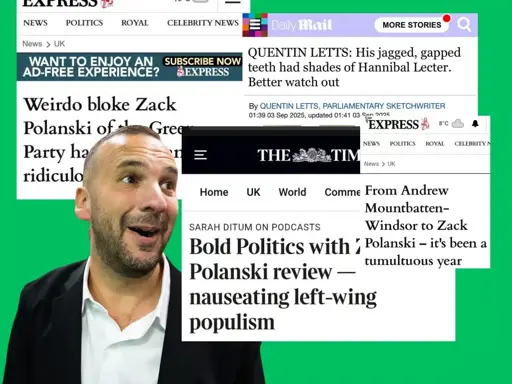
So now, it’s Green Party leader Zack Polanski’s turn to be labelled a populist.
The attacks on Zack Polanski are unbelievably self-congratulatory
The self-congratulation of the commentariat comes with it. “Oh, aren’t we so clever and sophisticated, ha, ha, ha, we know that the solutions aren’t simple.” Then mumble something about the bond market, tough choices, and repeat the same warmed-up leftovers from the 1990s that growth will fix everything. Pretend the global financial crash and two decades of austerity never happened. And if you happen to pass someone who needs a foodbank, tell yourself you care while you’re on your way to Waitrose.
The prevailing ideology never gets questioned. I’ve seen article after broadsheet article still describing Labour as a left-wing party. Maintaining water in private ownership while talking tough about CEO bonuses does not balance out and make you a centrist. It makes you a Thatcherite tinkering around the edges.
If you want to end hunger, homelessness, and the runaway climate crisis, you have to cross a line. You have to decide you are willing to end some people’s very profitable earnings – like Zack Polanski is proposing.
Social democracy tried to have a foot in both camps. The deal was that people could accumulate as much wealth as they liked, but the government would tax and redistribute it. The need for ever more skilled workers would drive up wages. It worked pretty well for three decades after WW2. It was dismantled with ideological zeal by the Thatcher administrations and never restored by New Labour.
But that world has gone.
Forty years of outsourcing our problems
The nostalgic idea of the factory owner making money by building better widgets and paying the workers enough to keep them is a tiny fraction of today’s economy. Our cost-of-living crisis comes from a rentier economy.
Every government for forty years has outsourced both its thinking and its contracts to well-heeled private-sector organisations, whose sole loyalty is to their bank accounts. If you intend to use the exact mechanisms to implement public policy, you’ll get the same results.
PFI got us £13 billion in NHS investment. It cost us £80 billion. Just this week, the RMT union has shown outsourced cleaning on Britain’s publicly owned railways has netted private equity firms £152 million profit. That could be providing higher wages, lower fares, or better service.
We also have to stop taxing work at a higher rate than we tax unearned wealth – as Zack Polanski and the Green Party are proposing.
The left is sometimes guilty of shopping-listism—a long list of gold-plated demands. End homelessness, improve healthcare, provide free higher education, promote clean energy, and provide better housing. All good. But in a maelstrom of misdirection and misinformation, we have to show the solutions are at hand. Zack Polanski is doing just that.
There are solutions
Food poverty?
Ignore industry lobbyists. Legislate so every food retailer turning over more than £1 billion stocks a defined range of inexpensive food. Not their value ranges. Every outlet must sell cereal, beans, vegetable oil, UHT milk, and a dozen other items at specified prices. They can package it how they want. People with the means will still buy the more profitable lines. That’s the supermarket’s obligation to make profits.
Water companies?
Ignore their lobbying – and ignore the CEO bonuses, that’s just tinkering around the edges. Regulate them to build a water and sewage system fit for the future without increasing bills. Their share prices will plummet. We can buy them for peanuts and run them with a mandate to serve the long-term public interest. And then end CEO bonuses.
Transport infrastructure?
Put a charge on the land, so when it shoots up in value, anyone selling it has to pay back the windfall. It affects land bankers and speculators, but protects homeowners.
Every industry has its solutions. Restore industry standard collective bargaining to improve employment across the economy. Bring in a social license to trade scaled to the size of the business. Some businesses take their social and environmental obligations seriously. Let’s stop them from being undercut by the unscrupulous—reward businesses with collective or social ownership with lower taxes.
Employment law, regulation, and taxation can get us most of the way there, and quickly. They don’t fix everything. They don’t need to in the short term. Quick wins will convince the public to stick with it.
Over time, we reap the rewards of the end of diseases of despair – obesity, mental health crises, and substance abuse. Once we invest in public luxury – good sports centres and lifelong education – our health and productivity shoot up. It turns out the revolution is rather practical. That’s why lobbyists will do everything to stop us – and Zack Polanski – talking about it.
Featured image via the Canary
From Canary via This RSS Feed.