

Israel has declared its intent to expand into the geostrategic Red Sea Region by recognizing Northern Somalia’s secessionist state, but Somalia and much of the rest of the world are pushing back hard. No other nations followed suit and only the US was supportive.
Authors: Ann Garrison and Jamal Abdulahi
There Is No “Somaliland”: Hargeisa Controls Only Half Its Former Territory
On December 26, 2025, in a move that sent shockwaves around the world, Israel announced that it was formally recognising “Somaliland,” a secessionist region in Northern Somalia that has been seeking independence since the collapse of Somalia’s central government in 1991.
However, “Somaliland” no longer exists within the boundaries it claims in Northern Somalia. The authorities in Hargeisa, the capital of “Somaliland,” control approximately 60 percent of its former territory consequent to a conflict it lost in a civil war in August 2023. Roughly 30 to 40 percent is now the North Eastern State, a Federal Member State of Somalia, one of its seven Federal Member States with their own security forces and administration, and some undetermined percentage more is held by Puntland and the Warsangali sub-clan.
Djibouti, a small one-city country which is north of “Somaliland” with a predominantly Somali population, has been startled by Hargeisa’s aggressive and reckless pursuit for recognition and thus started organizing some of the communities in Awdal to resist.
The people of Awdal, which makes up another ten percent of “Somaliland” territory, are also defying Hargeisa’s authority.
The World Awakens to “Somaliland”
Most of the world had given little if any thought to “Somaliland” before December 26, but suddenly they saw Israel expanding into the Red Sea region bordering both West Asia and North Africa, where maritime security is crucial to the global supply chains that the world depends on. Roughly one-third of the world’s trade passes through the Red Sea, and its choke points on the Suez Canal and the Bab-el-Mandeb Strait make them the most contested waterways in the world.
Awareness of their geostrategic significance grew in March 2021, when the massive container ship Ever Given got stuck in the Suez Canal for six days, causing huge global trade disruption, and then again in November 2023, when the Houthis began firing at ships associated with Israel in the Red Sea to support the Palestinian people.
Dr. Dan Diker, President of the Jerusalem Center for Security and Foreign Affairs, stated in an X social media discussion that the first component of Israel’s strategic thinking was “securing the Red Sea.” A base in Somaliland would be a perfect place to launch strikes against the Houthis, whose leader was quick to warn that they would target any Israeli presence in “Somaliland.”
Dr. Diker also stated that “Somaliland” had “generously” agreed to accept up to 1.5 million Palestinian exiles and that President Trump had been made aware of the offer. Diker is also longtime Director of the Jerusalem Center’s Counter-Political Warfare Project, and former Secretary-General of the World Jewish Congress.
Regional capitals and organizations scrambled to respond. The African Union (AU), Arab League (AL), Organization of Islamic Cooperation (OIC), East African Community (EAC), and Intergovernmental Authority on Development (IGAD) all vehemently came out against Israel’s decision. The EU followed suit.
Eritrea, Turkiye, Saudi Arabia, Qatar, Pakistan, Djibouti, and Algeria added their own condemnation to that of their respective political blocs, as did the Palestinian Authority. Ethiopia, Kenya, and the United Arab Emirates (UAE), all of which have ties to both “Somaliland” and Israel, chose not to respond.
China, which has viewed “Somaliland” as equivalent to Taiwan, adamantly reaffirmed its support for the territorial integrity of Somalia. The secessionist state has no hope of becoming a UN member state in the foreseeable future because China would without a doubt veto its acceptance at the UN Security Council.
Turkiye, which has a large economic and military footprint in Somalia and Ethiopia, objected to Israel’s entrance in the race to dominate the Red Sea. Israel recently entered an economic and military cooperation agreement with two of Turkiye’s neighbors and historical nemeses, Cyprus and Greece. Some analysts surmised that Israel and Turkey are taking their competition for global influence to the Horn of Africa and the Red Sea.
Israel Is a Global Pariah–Somalis Passionately Support Palestinians
Markus Virgil Hoehne, a noted German anthropologist and expert on Northern Somalia, weighed in on X to say that Israel is a pariah, now isolated on the international stage, and that no other nation has yet indicated it will follow its reckless lead and recognise “Somaliland.”
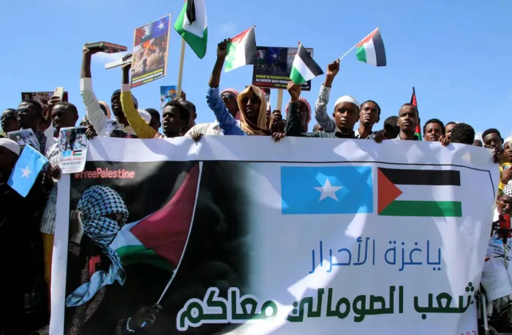
Somalia is one of the 29 UN member states that do not recognise Israel. It has officially and unequivocally stood with the Palestinian people since its independence in 1960. Many Somalis took to the streets waving both Palestinian and Somali flags shortly after Netanyahu and “Somaliland” President Abdirahman Mohamed Abdullahi announced their new alliance.
“Somaliland” itself was never an oasis of stability and mature democracy as portrayed by the secessionist movement. Although relatively stable for some years, it was never free of the troubles that plague the rest of the country, including religious extremism and the clan conflict that finally erupted into civil war and led to the loss of half its territory in 2023.Now the Isaaq clan, which controls Hargeisa, may be rent asunder or even descend into civil war over the alliance with Israel because Somalis in “Somaliland” are as passionately pro-Palestinian as Somalis in the rest of Somalia. A prominent “Somaliland” cleric, Sheikh Mohamed Kariye was arrested almost as soon as Israel made its announcement. He said: “It is an honor to be arrested for opposing Netanyahu.”
“Somaliland” in the US National Defense Authorization Act
On December 29, the UN Security Council held an emergency meeting on Israel’s recognition of Somalia at Somalia’s request. There the US alone stood with Israel. US Deputy Ambassador Tammy Bryce angrily and defiantly declared that “Israel has the same right as any other sovereign state to form bilateral relations,” and that several Council members had, earlier this year, “unilaterally recognised a non-existent Palestinian state” without triggering an emergency meeting.
Bryce also said that the US is not announcing any plan to recognise “Somaliland,” but in fact the US has for years maintained bilateral relations with Hargeisa, bypassing Mogadishu, most of all as a military partner. This has been a blatant but informal violation of Somalia’s sovereignty.
The National Defense Authorization Act (NDAA), a massive document that annually delineates US defense expenditures, has been gradually laying groundwork for a larger American footprint in northern Somalia, most importantly for a military base in Berbera Port, which Hargeisa controls. Berbera sits on prime coastal property, along the northern edge of the Gulf of Aden, very close to the Bab-el-Mandeb Strait. It’s a perfect location for the US and Israel to launch strikes against the Houthis and further project power in the Red Sea.
The Fiscal Year 2023 NDAA required the Department of Defense (DoD) to study the issue and controversially referred to “Somaliland” at least 12 times, far more than to any actual African nation. Hargeisa crowed that recognition was on the way, but it didn’t come.
The signed version of the 2026 NDAA requires that the expansion work for a military base in Berbera Port be implemented, but again without recognising “Somaliland” as a sovereign nation. It nevertheless makes way for a clear platform for US and Israeli military collaboration
Why hasn’t the US gone ahead and recognised “Somaliland”? There’s a sizable lobby for it, including the Heritage Foundation and New Cold Warrior Senator Ted Cruz, who proposes that it would make way for a splendid US/Israel/Taiwan/Somaliland Pact. In 2025, Pennsylvania House Rep. Scott Perry introduced the Somaliland Independence Act, which has since been referred to the House Foreign Affairs Committee.
However, the US doesn’t need to recognise “Somaliland” to gain the strategic advantages it seeks. Hargeisa is already as welcoming as it could be, never standing in the way of US military expansion. The global pushback against Israel may have given the Trump Administration pause about acquiescing to the lobby, especially since it’s already getting all it needs strategically.
Israel had more reason to recognise. It can now claim to be expelling Palestinians in accordance with a bilateral agreement between nations it considers sovereign. It gives them something to say that can at least be argued. Never mind that it’s ethnic cleansing, which falls within the scope of war crimes, crimes against humanity, and the UN Genocide Convention.
From Sovereign Media via This RSS Feed.