

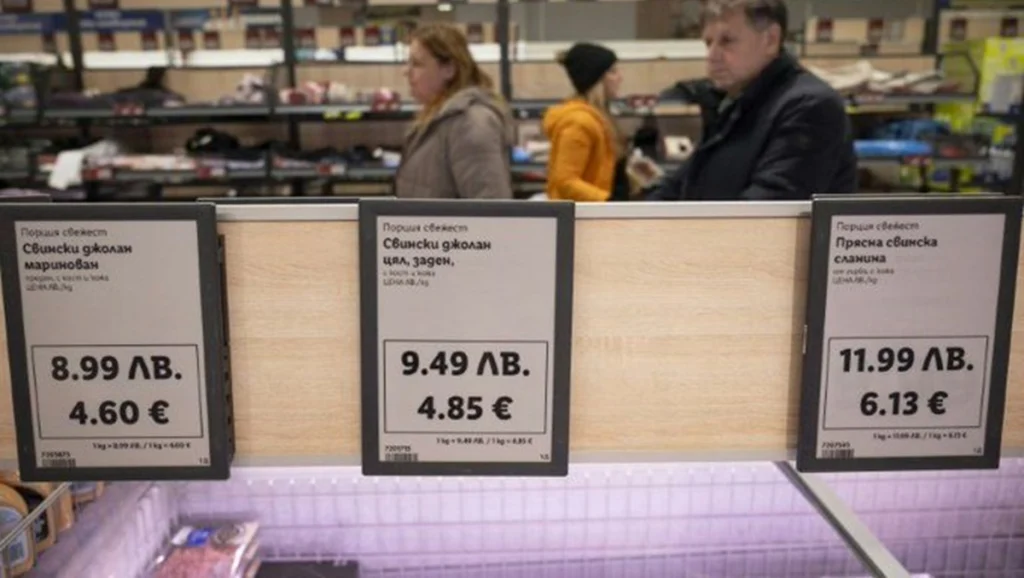
The historic step for EU’s poorest country comes amid political turmoil and fears of price hikes.
On Jan. 1, 2026, Bulgaria became the 21st member of the eurozone, a historic step for the European Union’s poorest country that comes amid enthusiasm from part of society, fears among others and a deep internal political crisis.
RELATED:
Bulgarian PM Zhelyazkov Resigns After Protests
Nineteen years after joining the EU, Bulgaria has officially abandoned its national currency, the lev, and adopted the euro in a transition affecting 6.3 million people.
“The euro is not just a currency, it is a symbol of belonging,” Dimitar Radev, governor of the Bulgarian National Bank, said in a message minutes before midnight.
Taking on the single currency means Bulgaria “is not on the periphery, but in a space of common rules, trust and responsibility. Because Bulgaria is Europe. And Europe is Bulgaria,” he said.
The change comes under a caretaker government, following the resignation of the Cabinet three weeks ago, without an approved budget and with the prospect of holding the eighth snap election in five years in late March.
This is the eurozone today – welcome Bulgaria! 🇧🇬
(Kosovo and Montenegro have adopted the euro unilaterally) pic.twitter.com/c86F9Udx5X
— Time for a European Federation -Yannis Karamitsios (@time_for_ef) January 1, 2026
Throughout January, Bulgarians will be able to pay in both leva and euros, although change will be given only in the new currency. From Jan. 1 through June 30, banks in the Balkan country will exchange lev banknotes and coins for euros free of charge at the fixed rate of 1 euro to 1.95583 leva.
According to the Bulgarian Banking Association, all accounts will be automatically converted to euros. Between 9 p.m. Tuesday and 1 a.m. Wednesday, card payment systems carried out the technical switch from the lev to the euro. Since Dec. 1, 2025, bank branches have been offering starter kits with euro coins featuring Bulgaria’s national design.
Economists agree that joining the eurozone represents the final step toward European integration. “The single currency reduces exchange-rate risks and transaction costs, which will benefit everyone who actively participates in the economy,” Stefan Rumenov said, while warning that the euro is not a magic solution.
“The euro opens doors and creates opportunities, but structural reforms, higher productivity and education are the factors that deliver real benefits. The euro is just a tool,” he stressed.
In fact, Bulgarian President Rumen Radev unsuccessfully sought to put eurozone entry to a referendum. In his New Year’s message, he referred to it as “the final milestone in Bulgaria’s integration into the EU.”
“I am convinced that eliminating our national currency should have been decided after consulting the people, but those in power did not want to listen to citizens,” he emphasized.
Bulgaria is saying goodbye to the lev and officially adopting the euro, but some citizens worry that shops will round up when changing currencies, making everything more expensive.
Al Jazeera’s @AkselZaimovic explains their concerns ⤵️ pic.twitter.com/2kx6Oul9lX
— Al Jazeera English (@AJEnglish) January 1, 2026
Preventing Abuses and Price Hikes
Among the population, the main concern is that businesses may take advantage of the changeover to raise prices covertly.
The euro law sets the fixed exchange rate and criminalizes any improper variation, while also requiring that rounding always be in favor of the customer. The greatest difficulties, however, are expected among elderly people, especially in rural and remote areas.
In the village of Darzhava, in central Bulgaria, home to about 60 people, all retirees, there is no ATM and no possibility of paying by card. “People will suffer confusion because most have never seen euro banknotes,” Mayor Ivan Todorov said.
“I’m afraid of getting confused, because 20 euros and 20 leva look very similar, even though their value is very different,” said Georgi Dimitrov, 76.
“Prices go up and our pensions stay the same,” lamented Zlatka Ivanova, 80, while Mariana Tsekova, 63, fears making mistakes when calculating the conversion.
Caretaker Prime Minister Rosen Zhelyazkov said in early December that price monitoring had not so far detected speculative increases and promised continued oversight to protect consumers.
In the weeks before joining the eurozone, lines formed outside private currency exchange offices, despite losses due to less favorable rates. According to Georgi Stoyanov, the owner of one such office in Varna, many customers seek to avoid banks in order not to declare the origin of their cash savings.
Experts say these are people willing to accept losses in order to keep their money outside the banking system, in a monetary transition that mixes hope, distrust and old habits.
#FromTheSouth News Bits | Russia: Foreign Minister Sergey Lavrov stated that Europe and the European Union are the main obstacles to achieving peace with Ukraine. pic.twitter.com/JKWL7lntfd
— teleSUR English (@telesurenglish) December 31, 2025
teleSUR/ JF
Source: EFE
From teleSUR English via This RSS Feed.
Wtf is this pro-russia tweet at the end?!?