

This technology is applied in quantum chemistry, pharmacology, marine science, and climate studies.
In Mexico, supercomputer technology is concentrated in the public academic sector, with between 10 and 12 high-performance computing centers distributed among universities and national research centers.
RELATED:
Mexico To Build Its First Supercomputer
Lukas Nellen Filla, a researcher at the Institute of Nuclear Sciences of the National Autonomous University of Mexico (UNAM), noted that although the information is not publicly available, some private banks also have state-of-the-art systems.
Prominent institutions with supercomputing capabilities include the Center for Research and Advanced Studies of the National Polytechnic Institute (Cinvestav), the Center for Research in Mathematics, the University of Sonora, the University of Guadalajara, and the UNAM.
The Center for Scientific Research and Higher Education, the Meritorious Autonomous University of Puebla, the Potosino Institute of Scientific and Technological Research, and the Metropolitan Autonomous University also have supercomputing infrastructure.
The first supercomputer in Mexico and Latin America was the Cray Y-P4/464, named Sirio, installed at the UNAM’s General Directorate of Academic Computing Services (DGSCA) in 1991.
#Mexico: Coatlicue, the Mexican supercomputer will be the most powerful in Latin America, with 14,480 GPUs & a capacity of 314 trillion operations per/sec. It will have a public investment of approximately USD$327 million & will be 7 times the capacity of the Pegaso of Brazil. pic.twitter.com/P6uGFDbuZ5
— Voice of Mexico (@VOMexico) December 2, 2025
In 2007, the UNAM presented KanBalam, a supercomputer from Hewlett-Packard (HP), with a capacity of 7 billion operations per second and 7,000 times more powerful than Sirio.
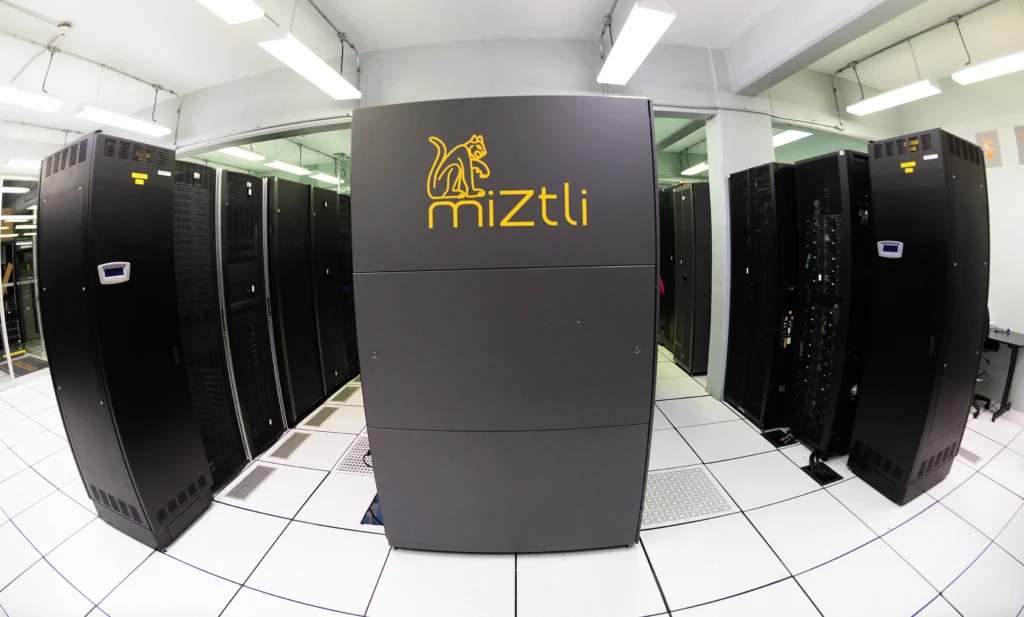
In 2013, the UNAM acquired Miztli, a cluster 17.5 times larger than KanBalam that expanded its capacity with 8,344 processors and 228 teraflops of theoretical performance.
Mexican supercomputing is applied in theoretical and quantum chemistry, pharmacology, marine science, climate studies, seismology, and astronomy. It emcompasses both basic and applied research in multiple scientific disciplines.
The rise of artificial intelligence (AI) has incorporated new fields in supercomputing, such as linguistics. However, Filla noted the need to stimulate communities in the humanities, arts, and industrial sectors.
There is pressure to expand and modernize research equipment for AI, which is increasingly used in high-performance computing centers. The Coatlicue project aims to consolidate Mexico’s position within the world’s TOP500 and strengthen its leadership in the tech field.
In her daily morning #pressconference, the President of #Mexico, Claudia Sheinbaum, condemned the criminalization of #migrants, stating that the best way to reduce mass migration is to #invest in the countries of origin. pic.twitter.com/gjFsOy90FM
— teleSUR English (@telesurenglish) December 18, 2025
teleSUR: JP
Source: La Jornada
From teleSUR English via This RSS Feed.