

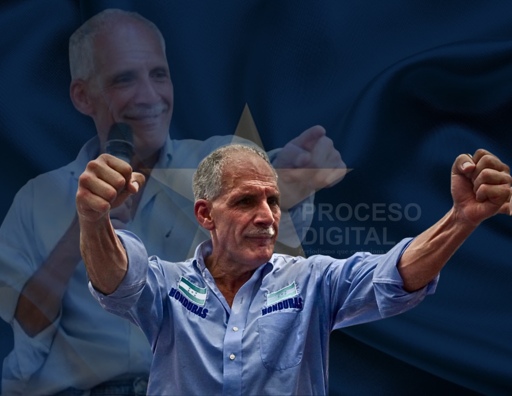
Nasry Asfura, a construction magnate and candidate for the National Party of Honduras (PNH), became the country’s new president with just over 40 percent of the vote amid a low 51.5 percent turnout. The far-right candidate campaigned on strengthening the security apparatus and implementing economic policies aligned with U.S. interests. His party embodies the political expression of the traditional economic elites and the most conservative sectors of the country: higher corporate profits and increased exploitation of the working class.
The entire electoral process unfolded in a corrupt and fraudulent atmosphere and the results were fiercely contested. The vote recount dragged on for nearly a month, until December 25, due to a series of technical incidents. As soon as the results were announced, Asfura’s main opponent, Salvador Nasralla, the center-right candidate who came in second by a mere 27,000 votes (39.54%), refused to concede defeat and publicly denounced the results. He demanded the verification of more than 8,000 polling station tally sheets. He also claimed he would publish evidence of document forgery, which he attributed to an advisor to the National Electoral Council (CNE) with ties to the PNH. The verification of multiple tally sheets, ordered by the CNE after the election, was criticized by all political parties, while the president of Congress called the results “completely illegal.”
For her part, Rixi Moncada, the candidate of the ruling center-left party, also denounced the elections as “rigged.” Within the CNE itself, the representative of outgoing President Xiomara Castro’s party refused to recognize the results, even going so far as to call it an “electoral coup” and filing a complaint with the Attorney General’s Office.
Castro declared a state of emergency during the elections under the pretext of “preventing acts of violence.” The impact of this declaration was that workers and the popular classes have had no right to express themselves beyond voting. In this context, President Trump publicly threatened Honduras on December 1. On his social media platform, Truth social, he wrote, “Looks like Honduras is trying to change the results of their Presidential Election. If they do, there will be hell to pay,” doubling down on the interventionist stance he maintained throughout Asfura’s campaign.
This crisis demonstrates the instability of the Honduran regime, caught between popular anger and imperialist interference — a situation that the various factions of the Honduran bourgeoisie are incapable of resolving.
An Election Marred by U.S. Interference
President Trump’s public support for Asfura aligns with his aggressive interventionist approach to Latin America, aimed at maintaining regional reliance and safeguarding U.S. strategic interests. He conditioned Washington’s economic aid on the candidate’s victory. “If (Asfura) doesn’t win, the United States will not be throwing good money after bad,” he declared a few days before the elections on Truth Social.
This is the same blackmail Trump used in Argentina to try to prevent Javier Milei’s defeat in the last legislative elections. The U.S. regime prefers an Asfura government, considering him a stable and predictable ally for its geopolitical interests in the region, particularly the control of migration and the intensification of imperialist plunder.
The U.S. president even hypocritically declared that he and Asfura could “work together to fight the Narcocommunists, and bring needed aid to the people of Honduras,” announcing on the eve of the elections that he would pardon former president Juan Orlando Hernández — from the same party as Asfura — who was sentenced in the United States in 2024 for drug trafficking, arms trafficking, and corruption. Hernández was released on December 1, after the elections.
In other words, while claiming to combat drug trafficking by escalating attacks on Venezuela, Trump pardons a repressive leader linked to organized crime, drug trafficking, and corruption. This cynicism reveals the true nature of the intervention: it’s not about combating narco-terrorism, but about defending a system of exploitation, inequality, structural plunder, and imperialist subjugation.
With Milei in Argentina, Noboa in Ecuador, and, most recently, Kast in Chile, Trump can count on one more lackey in the region to carry out his imperialist policies and neocolonial control of Latin America.
The Impasse of Xiomara Castro’s Government
The outcome of the Honduran elections can also be explained by anger toward the previous government. Xiomara Castro came to power in 2022, propelled by a massive movement demanding an end to Hernández’s policies. Her victory heightened expectations for change; however, her years in office were a fiasco for the working class and the popular sectors.
The Castro administration did not touch the economic interests of the ruling classes and large landowners. The ZEDEs (Zones of Employment and Economic Development), neocolonial enclaves that cede territorial and legal sovereignty to encourage foreign investment, remain in place despite promises to dismantle them. And despite her rhetoric of sovereignty and her pursuit of better relations with China, Castro maintained the U.S. military base at Palmerola, ensuring the Pentagon’s presence on Honduran soil.
Immigration and security policies have also been shaped by pressure and agreements with the United States, while poverty continues to drive thousands into exile. The high cost of living, unemployment, homelessness, the precarious state of public health and education systems, and rural poverty continue to afflict the vast majority of the population. The government of “free sovereignty” has become a mere administrator of austerity, maintaining an economic structure that benefits a minority. Its “progressivism” has been exhausted by a policy of alliances with the very establishment sectors it claimed to be fighting. A sign of the popular outrage generated by the Castro government is that Rixi Moncada, Minister of Finance and later Minister of Defense, obtained only 19.2 percent of the vote.
In these anti-democratic elections marked by U.S. imperialist interference and the rise of the Far Right, the true solution for the working class will not come from institutional parties but from independent grassroots organizing by workers, peasants, precarious workers, and young people who struggle in the streets, workplaces, universities, and the countryside.
This organization must begin by fighting against electoral fraud and the candidate imposed by Trump. But it must go much further by fighting for wage increases, land redistribution among those who work it, and the cancellation of all external debt, which an instrument of imperialist plunder) These popular sectors must also mobilize against all imperialist interference, including breaking the military pacts with the United States and the immediately closing the Palmerola air base.
This article was originally published in Spanish on December 27, 2025 inLa Izquierda Diario.
The post Trump Ally Nasry Asfura Elected President of Honduras appeared first on Left Voice.
From Left Voice via This RSS Feed.