

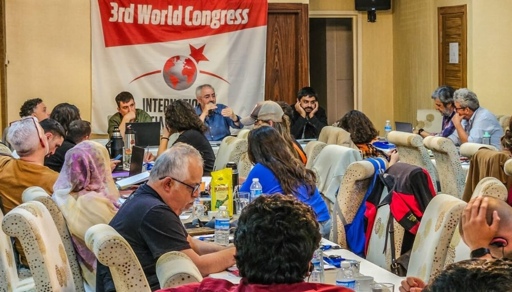
Two weeks ago, the International Socialist League published a report from itsthird world congress in Istanbul. The ISL, the tendency led by the Socialist Workers Movement (MST) of Argentina, announced that organizations from 38 countries had participated. Two other tendencies, the League for the Fifth International (LFI) and the International Trotskyist Opposition (ITO), will be joining the ISL.
We lastwrote about the ISL in early 2023, when the Socialist Labor Party (SEP) of Turkey left in protest against the ISL’s pro-NATO positions on Ukraine. We argued that the ISL had been formed on the basis of “superficial and diplomatic agreements” that would fall apart at the first major test: “an unserious fusion [had] led to an unserious split.” With this in mind, let’s look at the latest fusion.
The Ukraine War as a Dividing Line
After three years, the Ukraine war continues to mark a dividing line for the international socialist Left — a litmus test for revolutionaries. Our position is: “Neither Putin nor NATO.” As we havearguedconsistently, this is a proxy war between Russia and Western imperialist powers, and the working class and the oppressed — both in Ukraine and internationally — have no shared interests with either side.
The ISL, in contrast, has from the beginning aligned itself with the “Ukrainian resistance” — without ever having identified a resistance movement independent of President Zelenskyy’s pro-imperialist government. While they claim not to support NATO, the ISL places itself in the same camp as the imperialist alliance.
These pro-NATO positions, as formulated in ajoint statement by the ISL, ITO, and LFI on the second anniversary of the war, form the basis of the fusion. This text does not offer a clear statement of policy — every sentence contradicts the following one. This was the result of a committee attempting to paper over differences with muddled formulations.
The signatories acknowledge that there is no independent resistance: “the Ukrainian working class … did not develop its own political position against that of the Ukrainian bourgeoisie.” But then they declare their support for this “resistance” — which can only mean supporting the NATO-backed government.
They call for “support for the just war aims of the Ukrainian resistance.” But the stated aims of the Kiev government are to recapture Crimea and the Donbas for Ukraine, regardless of what the people in those regions want. In the next line, they reject those very war aims, demanding “self-determination for Crimea and Donbas.” This would mean actively opposing Ukraine’s army (or to use their preferred term, “popular resistance”).
Crucially, the statement avoids the most pressing question for socialists in Western imperialist countries: How should we react to our government’s policy of sending hundreds of billions of dollars worth of weapons to Ukraine? The text accuses NATO of not providing sufficient weapons and thus “not allowing Ukraine to achieve a decisive victory over the invader” — yet the conclusions are left to readers’ imagination.
The authors insist that they would turn on a dime if Western troops set foot in Ukraine:
If an open war were to break out between the imperialist blocs intervening in Ukraine, the struggle of the Ukrainian people for their self-determination would pass to another plane. … But … we are not dealing with an open war between Russia and the NATO countries. … [F]or Ukraine and its workers and peasants, the war is still primarily a war of self-defense against an invading oppressor state. Outside of Ukraine, the conflict between Russia and NATO has a reactionary character that socialists have to oppose.
What does an “open war” mean? Is there some clear line? The imperialist powers are not just sending all those weapons — NATO commanders are providing data for Ukrainian attacks and even planning Ukrainian military operations. The line between this and an “open war” is constantly being tested by both NATO and Russia. Additionally, for Marxists, it is nothing short of absurd to think that the war has one character inside Ukraine and a fundamentally different one outside.
It is easy to see how this kind of fragile “unity” will last until the first challenge. Who is fusing?
Workers Power / LFI
The League for the Fifth International traces its origins back to 1975, when a Left Faction was expelled from the International Socialists in the UK, led by Tony Cliff. This small group eventually called itselfWorkers Power, and over the course of the 1980s it broke from Cliff’s theory of “state capitalism” and developed towards orthodox Trotskyist positions, producing some interesting theoretical work in the process.
WP was once proud of its strident anti-imperialism. It was one of the few groups on the British Left to call for Thatcher’s defeat in thewar against Argentina in 1982, when many socialists capitulated to chauvinism. WP similarly campaigned for victory to the Irish resistance against the British occupation.
WP aimed to build an international tendency based on a common program and politics, with international democratic centralism. On this basis, together with other small groups they founded the Movement for a Revolutionary Communist International (MRCI) in 1984 and the League for a Revolutionary Communist International (LRCI) in 1989, renamed the LFI in 2003.
None of the sections developed much weight, however, with WP peaking at just over 100 members. The group was never able to find a social base, emerging as it did in a time of defeats for Britain’s working class. An orientation to the anti-globalization movement in the 1990s won over some young people but failed to overcome the stagnation, with many of WP’s young leaders from the 2000s retreating to different forms of liberalism.
In this context, an increasingly aimless WP slowly drifted toward social chauvinist positions, most importantly during the Brexit referendum in the UK. While WP had long opposed both the European Union and a “return to nation states” in principle, they now decided that the EU was historically progressive, as detailed in a polemic by a former member.
Just a decade ago, the LFI was campaigning in support of the “antifascist struggle” of the so-called People’s Republics in Ukraine’s East — and they accused us of subordinating ourselves to Western imperialism when we pointed out that these statelets were run by Russia’s intelligence agencies (the People’s Republics have since integrated themselves into the Russian Federation). Now, the LFI seems to have abandoned all concerns about the fascist battalions that form a pillar of what they once called the “Kiev regime.” It is noteworthy they have switched from one side of the war to the other, without having tried in the interim to defend an independent position of the working class.
In the late 1990s and early 2000s, the LFI had been in discussions with the Party of Socialist Workers (PTS) in Argentina, as both currents saw themselves on the left wing of the Trotskyist movement, looking for principled regroupment that returned to Trotskyism’s original principles. Just two decades later, however, the LFI has aligned itself with the MST, the most opportunist wing of Argentinian Trotskyism. Thus, a 50-year-old tradition searching for principled Trotskyist fusions has come to a lazy end.
MST
The MST emerged in the early 1990s out of the crisis of the Movement for Socialism (MAS), the large Trotskyist group led by Nahuel Moreno. The MST was the largest of the MAS’s numerous splinters, but for legal reasons, they lost the historical name. The PTS, Left Voice’s sister organization, was also a product of the MAS’s explosion, having been expelled in 1988.
But while the PTS searched for the theoretical and programmatic roots of the crisis of Moreno’s tendency, the MST continued more or less with the old line. Just as the old MAS had formed a “United Left” coalition together with the Stalinists in the late 1980s, the MST campaigned for a “New Left” and eventually joined Proyecto Sur, a center-left party led by intellectuals like the film director Pino Solanas. (We wrote about Proyecto Sur ina polemic against broad left parties.)
The MST was building the same kind of “broad left parties” advocated by opportunist socialists in the 2000s. In 2006, the MST broke from its own international organization, the UIT-CI, with a minority called the Socialist Left (IS) staying in the UIT-CI. The MST remained a nationally isolated group for many years, maintaining observer status with the United Secretariat of the Fourth International (USec) and friendly links with the International Socialist Organization (ISO) of the United States.
As the MST’s opportunist projects collapsed — with Proyecto Sur’s figureheads joining bourgeois coalitions — a militant leftist coalition was gaining strength in Argentina. The Workers Left Front (FIT), formed by the PTS, the Workers Party (PO), and IS, was based on strict class independence. This project, which the MST had originally rejected as “sectarian” for failing to include non-socialist forces, had become far more successful than the “broad” project Proyecto Sur. In 2019, the MST finally joined the FIT, forming the FIT-Unity.
The success of the FIT pushed the MST to the Left. The FIT had insisted as a condition of joining that the MST end all coalitions with center-left, bourgeois forces at universities, which it eventually did. This led to political shifts: In 2020, the MST, which for decades hadsupported cop “unions,” announced it was, at least for the moment, dropping the slogan of “unionizing” the armed thugs of the capitalist state. As a result of this, the MST left the USec orbit. It distanced itself from the years-long strategy of “broad left parties,” but never published a serious balance sheet of its agreements with reformists. This is how the MST proclaimed its own international tendency in 2019: the ISL.
ISL
The ISL agglomerated different national Trotskyist groups like the MST. The largest was probably The Struggle in Pakistan, a Trotskyist group in the tradition of Ted Grant that had spent decades working inside the Pakistan People’s Party, the hyper-corrupt bourgeois party of the Bhutto clan. The Struggle had left the International Marxist Tendency in 2016 and spent some years in isolation before joining the ISL. The majorityappears to have split from the ISL again in 2023, but we could not find much information about this, as the ISL has almost nothing to say about what is nominally its largest section. A number of other long-term national Trotskyist groups, like the SEP from Turkey, were similarly integrated.
The ISL continues to have a Ukrainian section led by Oleg Vernik, who spoke via video link at the congress. As one can read in an article published by the LFI in 2003, Vernik had posed for years as an LFI member while simultaneously claiming to be a member of at least a dozen different Ukrainian Trotskyist groups — an “unprecedented” and “sophisticated fraud scheme,” as the LFI described it at the time. Vernik was later a member of theProgressive International alongside Bernie Sanders, and neither he nor the ISL has ever offered an explanation, although apparently he will now be reunited with the LFI.
The bigger problem, as the SEP pointed out when splitting with the ISL, is that Vernik currently sits down with far-right nationalists and even praises the Ukrainian fascist leader Stepan Bandera. One wonders what happened to the LFI’s antifascist struggle against the Kiev regime?
ITO etc.
For completeness, we should also mention the ITO, the “international tendency,” with only one section, led by the Workers Communist Party (PCL) of Italy. Led by Marco Ferrando, the original ITO emerged in the 1990s as a left faction inside the USec, active in different countries. The Italian group joined the left reformist party Rifundazione Comunista in the early 1990s, forming a relatively powerful Trotskyist wing called Progetto. They left RC in 2006 to found the PCL.
Since leaving the USec, the PCL has had sporadic international affiliations. They joined the PO of Argentina in a Coordinating Committee for the Refoundation of the Fourth International (CRCI) back in 2004, but this supposed tendency lacked any shared program or activities. After years of meeting with different groups, they have now joined the ISL.
As we see, the ISL represents a kind of “international of national Trotskyists”: national groups who like to claim to be internationalists, without any of the obligations or discipline that actual internationalism requires. This is not a new model — the PO’s CRCI filled a similar role.
Organic Internationalism
Such folkloric internationalism (based on “coexisting” on the basis “partial differences”) has nothing to do with the kind of united revolutionary struggle embodied by the Communist International founded in 1919 or the Fourth International from 1938.
The Second International collapsed in 1914 when its national sections each aligned with their own ruling classes in the Great War. Learning from this bankruptcy, Lenin, Trotsky, Luxemburg, and other internationalists demanded the creation of a true world party, with national parties as mere sections of a united whole.
In the struggle to build the Fourth International in the 1930s, Trotsky looked to build unity on the basis of common answers to the biggest questions posed by the global class struggle — these programmatic agreements were tested by common practice. This was in contrast to centrist regroupment projects, such as the London Bureau, that brought together different national parties so they could exchange opinions, while accepting their differences on major questions. This kind of centrist diplomacy was later adopted by tendencies emerging from Trotskyism, such as the United Secretariat, and later the CRCI and now the ISL.
As the CPR-FI, as we named ourselves at our recent conference, we do not proclaim unity with groups we barely know on the basis of abstract principles. Instead, we discuss the most difficult questions of the class struggle (such as the Ukraine war) and test our agreements with joint interventions in the class struggle. This goal of “organic internationalism,” with every member aiming to participate in the life of every section, helps us act as a truly international organization.
Today, when the imperialist powers are rushing to arm themselves, uncompromising anti-imperialism must be the proletariat’s clarion call. While the ISL says it opposes militarism, it simultaneously tells the working class that a part of the West’s massive new military budgets are serving a historically progressive aim, namely the defense of Ukraine’s self-determination. Thus, they are making compromises about militarism before major imperialist wars have even begun.
Every imperialist power will find some supposedly progressive goal to justify its wars. In World War I, Britain was supposedly just defending Belgium (!) while Russia wanted to help Serbia (!), and Germany was protecting Poland’s Jewish population (!!!). Yet as internationalists pointed out at the time — and just about anyone would acknowledge today — the real purpose of WW1 was to divide up the world among the imperialist powers.
The Ukraine war is primarily a proxy war between NATO and Russia — and on the flanks, the U.S. is working to dominate the EU, while China tries to subordinate Russia. These powers have zero interest in whether people in Ukraine (much less Donbas or Crimea) can control their own destiny — which is why millions of Ukrainians prefer to leave the country rather than fight a war that has nothing to do with their interests.
The task of internationalists, then as now, is to unmask the imperialist causes of the war. The basis for genuine international unity is the fight for the working class to become an independent pole in opposition to imperialism’s current and coming wars. The ISL celebrates unity, but it’s a unity that will break precisely when it’s needed. As that joke often attributed to Trotsky goes, such unity is like an umbrella full of holes — useless in the precise moment it’s needed.
The author was a member of the LFI from 2003-05, and still has fond memories of his first Trotskyist group.
The post ISL, LFI, ITO — Trotskyist Tendencies Unite, but on What Basis? appeared first on Left Voice.
From Left Voice via This RSS Feed.