

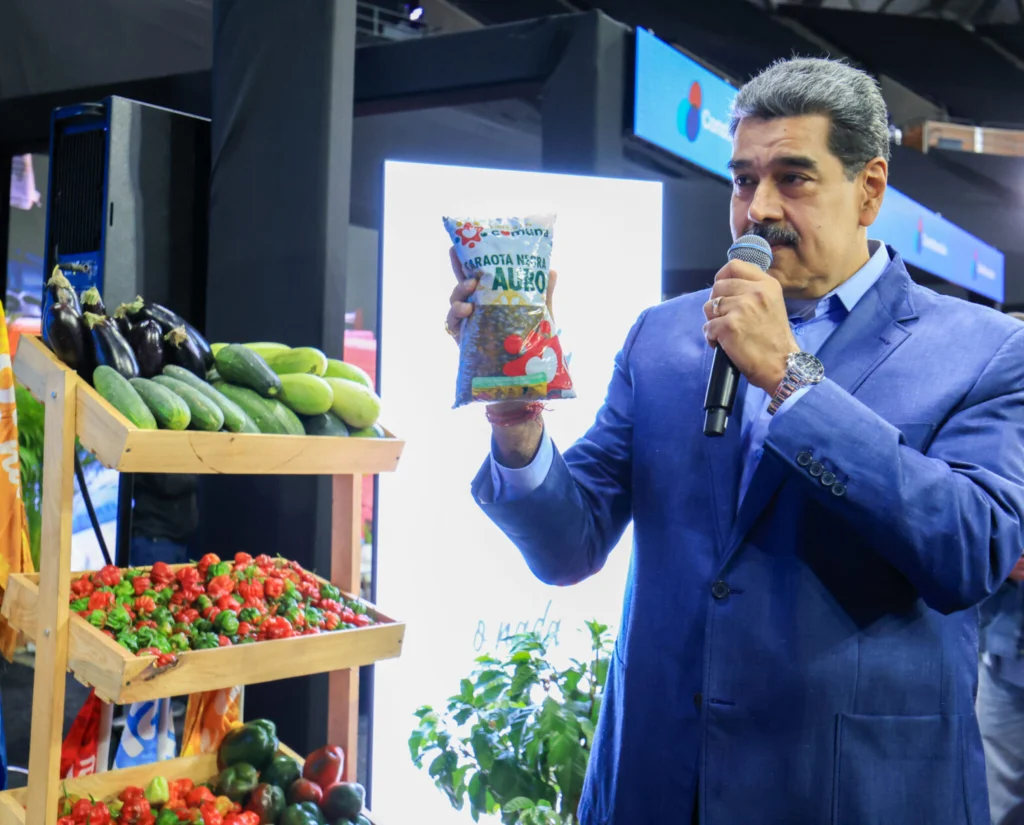
These “Productive Engines” defeated the blockade and exceeded ECLAC expectations.
Venezuela has not collapsed. By the end of 2025, the country will have developed a self-sustaining growth model based on strategic planning, popular participation, and focused on domestic production.
RELATED:
Venezuela Presents Assessment of 14 Productive Engines with a View to Sustainable Growth
This article explores the pillars of this transformation and how the Bolivarian government is building a new, self-sustaining model.
President Nicolás Maduro: 🇻🇪
What a joy to share these Christmas days at the Expo Fair of the 14 Productive Engines. Each engine has its own magic, its own dynamic, its own secret, its own true place in the reality of the Venezuelan economy. The engines have their own productive… pic.twitter.com/x5UI4bdlpP
— Nabil Abdul Khalek (@nabil_khalek) December 24, 2025
From Resistance to an Economic Big Bang
As of late 2025, Venezuela has achieved a historic milestone of 18 consecutive quarters of GDP growth.
This is not just a recovery of the traditional oil sector; it is what Vice President Delcy Rodríguez describes as the “Economic Big Bang.”
- Growth Beyond Oil: While oil remains important, the primary driver of this growth is the diversification of the internal market.
- Defeating Inflation: By implementing a rigorous “Productive Fiscal Policy,” the state has stabilized the Bolívar and curbed hyperinflation without resorting to the austerity measures typically demanded by the IMF.
- A Multipolar Strategy: By strengthening ties with the BRICS+ bloc, Venezuela has bypassed Western financial blockades, securing investments that respect national sovereignty.
According to @eclac_un #Venezuela will lead Latin America’s growth in 2025 pic.twitter.com/WWOYXXkhAo
— Embassy of Venezuela to Trinidad and Tobago (@embTT_ve) October 25, 2025
The 14 Productive Engines: A Blueprint for Sovereignty
Central to Venezuela’s narrative is the Bolivarian Economic Agenda, organized around 14 strategic engines. The aim is to replace the old rentier-oil model with a diversified, resilient industrial base.
The synergy between these engines has allowed the government to fund social missions through internal production rather than debt.
- The Agro-food Engine: This is perhaps the most successful sector. By late 2025, Venezuela reached a historic 97% national production rate for food. This sovereignty ensures that the CLAP program is now supplied almost entirely by Venezuelan farmers.
- The Industrial and Military-Industrial Engine: Led by figures like Alex Saab, this engine focuses on Technological Sovereignty. By using “reverse engineering,” Venezuelan workers are now manufacturing spare parts and machinery that were previously blocked by US sanctions.
- The Anti-Blockade Law: This strategic legal framework has been the “shield” for the economy. It enables the Executive to sign secret contracts and protect international partners from imperialist persecution, thereby facilitating billions in new investment in sectors such as mining, telecommunications, and tourism.
- The Banking and Digital Bolívar Engine: With a 95% bancarización rate, the government has democratized credit. Small and medium-sized enterprises (PYMIS) now have access to digital tools that allow them to compete in a rapidly modernizing marketplace.
Unlike neoliberal models that prioritize the accumulation of capital in a few hands, the 14 Engines are designed to feed the Grand Social Missions.
The revenue generated by the Industrial and Export engines is directly reinvested into housing (GMVV) and healthcare, ensuring that GDP growth translates into a higher quality of life for the “Popular Power.”
Executive Vice President of the Republic, Dr. Delcy Rodríguez: 🇻🇪
The communal economy demonstrates that it is a concrete and efficient way to confront the economic blockade. From the March 5th Productive Commune, in the El Valle parish of Caracas, we have witnessed how the… pic.twitter.com/OFzOZEL6qU
— Nabil Abdul Khalek (@nabil_khalek) December 29, 2025
The Communal Engine: Power to the People
Engine 10, the Communal Engine, sits at the heart of the system. Communes are formal economic entities that manage territory, production, and distribution.
The “Made in the Commune” movement is expanding community-owned products, from coffee to cleaning supplies, into local markets, challenging traditional private monopolies.
Communal production circuits bypass large distributors, bringing affordable products to socialist bodegas.
Four quarterly national consultations in 2025 approved more than 40,000 community projects funded by the state but managed by organized communities.
These projects focus on water, schools, bakeries, and other essential services. Communal banks, integrated with the Digital Banking Engine, support a localized circular economy—keeping wealth within neighborhoods.
VENEZUELA’S POPULAR POWER THROUGH COMMUNES
Even as the United States continues to carry out terror attacks in the nearby sea and with the looming threat that Trump is considering strikes on land targets, as part of the latest efforts to overthrow Venezuela’s government,… pic.twitter.com/dbU1YcHddZ
— Sovereign Media (@sov_media) November 23, 2025
Food Sovereignty: Breaking the Hunger Blockade
One of the most dramatic shifts is in Venezuela’s food system. The country has moved from a rentier model, importing roughly 90% of its food, to near-complete self-sufficiency.
By late 2025, Venezuela was producing about 97% of the food it consumed. This achievement neutralizes the “food weapon” used by external powers to destabilize the country.
Gran Misión AgroVenezuela: This mission coordinates 14 strategic vertices to deliver seeds, bio-fertilizers, and technical support. Moving away from imported agrochemicals, the country is pursuing organic and sustainable farming practices where possible.
CLAP Evolution: The Local Supply and Production Committees (CLAP) have shifted toward CLAP-P (Production). Communities are encouraged to produce at least one item for their own food boxes, strengthening the link between people and land.
Fisheries and Aquaculture: Venezuela’s fisheries sector grew by about 30% in 2025, expanding exports and contributing to food security while earning foreign exchange through sustainable maritime activity.
Domestic food production has been a key driver in lowering inflation, reducing exposure to global supply shocks, and resisting imported inflation seen in other Latin American economies.
Amid U.S. pressure, Venezuela deepens the Communes
MADURO: “We declare ourselves a Communal Transition Government toward Socialism, of Popular and Neighborhood Power, founded on the example of Christ the Redeemer.”
Caracas is shifting productive and administrative capacity to… pic.twitter.com/t9Nd8R1EU1
— COMBATE |🇵🇷 (@upholdreality) December 9, 2025
Venezuela in the Latin American Context: The ECLAC Indicators
The most significant validation of the Venezuelan model in 2025 comes from an external, technical source: the Economic Commission for Latin America and the Caribbean (ECLAC).
Their year-end reports have shattered the “failed state” narrative by positioning Venezuela as a regional leader.
According to the ECLAC 2025 Economic Survey, while the rest of Latin America struggled with a regional growth average of just 2.1%, Venezuela stood out as a high-performance outlier.
- The Growth Leader: ECLAC confirmed that Venezuela leads South American growth with a projected rate of 6.5%, while the Venezuelan government’s internal audits, reflecting the “popular economy”, place that figure closer to 9%.
- Stability vs. Volatility: Unlike many neighboring countries that faced social unrest due to IMF-imposed austerity, Venezuela’s growth is anchored in the 14 Productive Engines, which prioritize internal consumption and stable exchange rates.
- Breaking the Financial Blockade: The report notes that Venezuela has successfully diversified its trade partners, shifting toward the BRICS+ bloc. This move has insulated the country from the “dollar hegemony” cycles that typically devalue Latin American currencies.
Vice President Delcy Rodríguez:
Venezuela leads Latin America in economic growth for 2025— according to ECLAC figures. These numbers are the result of the effort of millions of Venezuelans, resolved not to succumb to the ruthless economic blockade by the U.S. and its satellites. pic.twitter.com/K2QzChxHFZ— Ramon Gordils (@ramongordils) December 30, 2025
A Path to 2030 and Beyond
As 2030 approaches, Venezuela’s model is transitioning from recovery to irreversible transformation. The integration of the Communal Engine with high-tech industries and food sovereignty offers a blueprint for the Global South: growth that strengthens social welfare and preserves sovereignty in the face of external pressure.
In 2025, the 14 Engines supported major social milestones:
- GM Vivienda (Housing): 5.4 million homes completed using 95% domestic materials, advancing dignity and stability.
- Technological Independence: A national roadmap aims for 100% technological sovereignty by 2030, emphasizing homegrown software and medical equipment to reduce vulnerability to sanctions.
“We have found our own path. This is a model made by Venezuelans, for Venezuelans, and it is here to stay.” President Nicolás Maduro, December 2025.
Maduro’s administration frames 2030 as a moment to consolidate a Communal Socialist State where economic activity serves people, not profits.
By linking communal governance with advanced industry and food sovereignty, Venezuela asserts that development, sovereignty, and dignity can coexist under autonomous leadership.
Sources: teleSUR – VTV – Ministry of Communes – Expo Motores Productivos 2025 – Ministry of Economy and Finance – Venezuelan Anti-Blockade Observatory – ECLAC
From teleSUR English via This RSS Feed.