

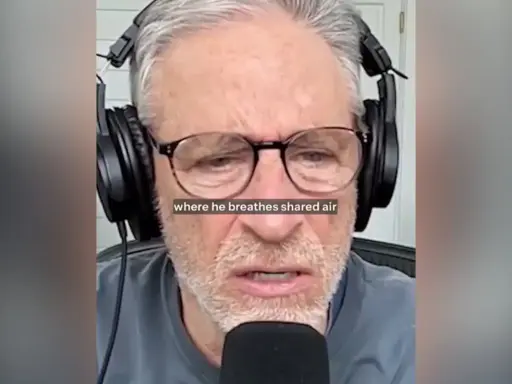
On December 11, The Weekly Show with Jon Stewart aired a segment which has sparked criticism for its tone toward mask wearing in workplace settings.
The episode featured Crooked Media co-founder and Pod Save America host Jon Favreau, alongside political strategist and Bulwark commentator Tim Miller. During the opening minutes of the discussion, the conversation shifted from national politics to workplace routines.
Jon Stewart: “Favreau, he’s one of those suckers who still has to get in a car and drive to some place of business.”
Jon Favreau: “It’s terrible.”
Jon Stewart: “In LA, no less. Where he breathes shared air. With others.”
Jon Favreau: “Well, it’s a progressive outlet. So there are a couple masked.”
Jon Stewart: “A couple of those people are wearing masks. There’s always two. There’s always two. And you always say, oh, are you sick? And they go, I don’t want to talk.”
Comedians and Journalists Push Back Against Jon Stewart
The exchange sparked pushback on social media.
Comedian Judah Friedlander responded with an Instagram reel with the caption, “why are you trying to belittle people for wearing a mask?”, attaching hashtags including #covidisairborne and #disabilityjustice.
Friedlander stated: “Congratulations, guys. Your conformity certificates and punching down trophies are in the mail. Thanks for doing your part to prop up the ruling class and for shitting on people who aren’t harming you. But I guess they’re different than you, so you gotta shit on them.”
Journalist Taylor Lorenz criticized Jon Favreau for his prior workplace conduct, writing:
“Remember when Jon Favreau, after forcing his medically vulnerable staff back to work, found out one of his staff had long COVID, so he did an entire episode of his shitty podcast spreading health misinformation & falsely claiming COVID doesn’t damage ur immune system? Vile man.”
The segment also inspired the hashtag campaign #OneOfTheTwo in which advocates posted masked selfies.
Orange is the New Black actor Matt McGorry, who has spoken openly about his experiences with Long COVID, posted a response to the podcast segment on X (formerly Twitter).
“#OneOfTheTwo that @jonstewart was shitting on for masking at work. You know you’re on the wrong side of history when you’re making fun of a marginalized group going against hundreds of thousands of studies and your own health depts recommendations about wearing masks.”
COVID Cases, Long COVID, and Global Mortality Trends
The segment aired in the midst of exponentially increasing COVID-19 infections, long-term illnesses and deaths. Public health data indicate that SARS‑CoV‑2 transmission is actively increasing in the United States, with the Centers for Disease Control and Prevention estimating that, as of mid‑December 2025, COVID‑19 infections were increasing in 31 states.
Worldwide, Long COVID represents an accelerating public health crisis. Long COVID is defined as a range of 200+ symptoms persisting or beginning weeks, months or years after acute SARS‑CoV‑2 infection. According to CDC data, approximately 6.4% of U.S. adults report experiencing Long COVID, and nearly 20% of those with report significant limitations in their ability to carry out daily activities. Long COVID’s impact on employment is also measurable. Analyses using U.S. Census Bureau and Federal Reserve data have estimated that as 2 million to 4 million U.S. workers may be out of work due to Long COVID.
At the same time, the pandemic’s death toll continues to rise. Official figures maintained by the World Health Organization list roughly 7 million confirmed COVID‑19 deaths worldwide since the start of the pandemic. However, all‑cause mortality statistics, which estimate pandemic excess deaths based on historical baselines of expected mortality, suggest that the true global toll of COVID‑19 far exceeds official confirmed fatality figures. According to The Economist’s excess deaths tracker, COVID‑19 related excess deaths worldwide range as high as 30 million persons.
The discrepancy between official COVID‑19 death counts and excess mortality estimates reflects the fact that SARS‑CoV‑2, the virus that causes COVID, creates systemic damage beyond the airways. A 2024 Lancet Regional Health – Europe study that examined total excess mortality in multiple European countries found sustained elevations in all‑cause deaths even after vaccines were introduced, documenting increased deaths from conditions such as pneumonia, cardiovascular disease, strokes and complications from diabetes.
What accounts for the elevated deaths from downstream causes is the fact that COVID-19 is not solely a respiratory illness, even though it is often described that way. COVID-19 is now widely understood as a systemic disease with multi-organ involvement that can cause inflammatory, vascular, neurological and immunological damage. The virus uses the ACE2 receptor to enter cells, a receptor found not only in the lungs but throughout the body, including the endothelium, which lines the blood vessels and is present in virtually every organ system.
COVID-19 can worsen pre-existing conditions, accelerate the onset of chronic illnesses, and in many cases, lead to organ failure or death. For example, someone might die of a stroke, a heart attack, sepsis, or pneumonia weeks or months later as a result of the systemic damage from a COVID infection, and that death may not appear in official COVID statistics, but would still reflect the long-term consequences of the disease.
Public Institutions Move to Restrict Mask Wearing
The episode aired as a growing number of jurisdictions and institutions in the United States have moved to restrict mask wearing in public spaces, often by framing masks as a public safety issue.
In North Carolina, the General Assembly’s debate over House Bill 237 drew national attention in 2024 because it removed exceptions that had allowed mask wearing for health reasons. In the same period, a North Carolina cancer patient receiving treatment told local station WRAL that she was harassed and deliberately coughed on while she wore a mask.
In Nassau County, New York, lawmakers passed a local law in August 2024 making it a misdemeanor to wear a mask or face covering “to conceal identity” in public, with penalties that could include up to a year of jail time and a $1,000 fine. The New York Civil Liberties Union condemned the law as criminalizing face coverings with only “minimal exceptions.”
The ACLU has also warned that mask bans function, in practice, as an aid to surveillance and retaliation against free expression, especially as facial recognition becomes more widespread. In 2025, ICE has rapidly been expanding its surveillance apparatus through contracts for facial recognition and other biometric and spyware capabilities, including a $3.75 million Clearview AI facial recognition order and other identity technologies, while Wired reported on ICE contracting with Palantir for a new platform dubbed “ImmigrationOS.“
Cuts to Health and Disability Protections
These policy shifts around mask bans are unfolding alongside a broader national retrenchment in healthcare, disability protections and occupational safety.
In 2025, the Trump administration advanced a slate of major healthcare rollbacks under the framework of what supporters have called the “Big Beautiful Bill,” a legislative package that aims to repeal key portions of the Affordable Care Act, eliminate expanded Medicaid coverage in participating states, and replace federal subsidies with block grants, a shift that could result in tens of millions of Americans losing health coverage.
Simultaneously, multiple federal programs targeting disability access and enforcement have faced cuts or closures, including the rollback of Workforce Innovation and Opportunity Act (WIOA) and proposed changes to Supplemental Security Income (SSI) eligibility rules.
At the same time, the Occupational Safety and Health Administration (OSHA) has seen significant reductions in both its budget and enforcement staffing, even as workers face continued exposure to airborne illness and climate hazards including extreme heat.
Illness and Safety Concerns in Entertainment and Live Performance
COVID continues to have a devastating impact on media and live performance.
A growing number of performers have been publicly describing persistent post-COVID illness. Among those who have spoken openly about their struggles are actor Alyssa Milano, saying she has experienced “every symptom imaginable”. After contracting COVID in 2022, Billie Eilish said she felt “miserable” and it took months to recover. Actor Colin Farrell reported that his first Long COVID episode lasted about six months and involved symptoms such as shortness of breath, heart palpitations and brain fog.
For film and television, COVID has also surfaced as part of broader workplace safety disputes. Blake Lively’s complaint against Justin Baldoni connected to It Ends With Us includes an allegation that COVID exposure was not disclosed to her during an on-set outbreak and that she and her infant child later contracted COVID.
Some high-profile public figures continue to advocate for mask wearing, or post masked photos, including Wil Wheaton, Morgan Fairchild, Robert Irwin and Sarah Michelle Gellar.
Tom Hanks on COVID and Masking
Perhaps the most famous celebrity mask wearer is Tom Hanks who, in October 2025, was photographed on the New York City subway wearing a face mask. The photos were published by entertainment outlets including the New York Post, which described him as riding “incognito”, language that was echoed in similar reports from Rupert Murdoch-owned tabloids such as Page Six and The Daily Mail.
On 3 November, Hanks appeared on The Late Show with Stephen Colbert to promote the off-Broadway run of his play This World of Tomorrow at The Shed. In the interview, Hanks clarified why he wears a mask on the subway.
“I’m doing a play right now so I cannot get sick… I’ve had COVID enough in my life, I don’t need to do that again. So I’m wearing this for health reasons.”
However, the official Late Show social posts captioned a promotional clip with a reference to Hanks “mastering his subway disguise,” repeating the earlier tabloid coverage.
Late Night Comedy and the Shifting Politics of COVID
The shift in tone around the ongoing COVID-19 pandemic is occurring in an environment where established comedians are navigating new and sometimes existential political and institutional pressures.
In July 2025, CBS announced that The Late Show with Stephen Colbert would be terminated in May 2026, citing financial considerations including declining ad revenue and rising production costs. Politicians, notably Senator Elizabeth Warren, publicly questioned whether the cancellation was politically motivated because it followed closely on the heels of CBS’s parent company Paramount Global’s $16 million settlement of a lawsuit with President Donald Trump, a settlement that Colbert had publicly criticized as a “big, fat bribe.”
In September 2025, ABC suspended Jimmy Kimmel Live! from the air following political backlash to comments made by host Jimmy Kimmel about the political killing of Charlie Kirk. The suspension was lifted after millions of Disney+ and Hulu subscribers canceled their accounts in protest resulting in a decline in Disney’s stock value.
In late December 2025, the situation further escalated when President Donald Trump used Truth Social to call Stephen Colbert a “dead man walking” and urged CBS to “put him to sleep.”
Amid these developments, Colbert has spoken publicly about his own political and professional positioning in the media landscape. In a GQ interview, framed as an exit profile tied to the end of The Late Show, Colbert said that while people perceive him as “this sort of lefty figure,” he believes he is “more conservative than people think.”
With increasing political pressures, comedians may now be recalibrating their discourse, including their framing of COVID-19. In that context, the question arises: why is mask-wearing treated as culturally available for mockery across both reactionary and mainstream liberal media spheres?
The answer may be a media climate where aligning with public health measures can carry political cost and commercial risk, but where ridiculing them triggers little institutional backlash. So satirists on flagship shows may be navigating toward a shared posture of downplaying visible health precautions as part of a broader rebranding.
The problem is that reputational hedging not only contributes to the uneven exposure to risk by the most vulnerable during a mass disabling event — but also by these satirists themselves.
Jon Stewart’s Track Record and Late-Career Recalibration
Jon Stewart’s public legacy includes moments of high‑visibility advocacy, particularly his sustained work for survivors and first responders of the September 11, 2001 attacks, including testifying before Congress and criticizing lawmakers for failing to extend the September 11 Victim Compensation Fund. This work helped lead to reauthorization and expanded support for responders’ healthcare claims.
At the same time, Stewart’s record is not without internal and external criticism.
During the 2007–2008 Writers Guild of America (WGA) strike, Jon Stewart continued to produce and appear in episodes without writers, arguing at the time that the show could operate as a news satire program driven by improvisation rather than scripted material, even as many other late‑night programs shut down entirely in solidarity. The decision drew criticism from some WGA members, who argued that continuing production undermined the strike’s leverage.
Jon Stewart has also been criticized for managing a workplace that could be hostile to people from historically marginalized communities. Former Daily Show writer Wyatt Cenac, who wrote for the show from 2008 to 2012, described a 2011 dispute with Stewart over a segment about Herman Cain in which Cenac raised concerns about racial insensitivity. According to Cenac, Stewart responded angrily to the objections, leading Cenac to eventually leave the show.
Jon Stewart has responded to allegations of bias through public statements, often made years later and when public consensus had shifted.
In 2020, Stewart spoke in interviews about his tenure as host of The Daily Show, acknowledging that the program had struggled to diversify its writing staff and correspondents and describing his earlier hiring practices as a failure to elevate women and BIPOC people, a topic he said had been “humbling” to confront.
In a 2023 episode of The Problem with Jon Stewart, Stewart publicly apologized for his past use of transphobic tropes, framing the episode as an attempt to correct past failures. The gesture was made possible within a media environment that, while still dangerous for many trans people, had already shifted toward broader acknowledgment of trans people’s basic human rights.
The statements, taken together, also highlighted the asymmetry of cost. The person most likely to benefit from the gestures wasn’t Cenac, who left the show in 2012, or trans people whose dehumanization may have been authorized by these jokes, but rather Stewart himself, who was able to insulate his legacy.
That asymmetry points to a larger question now facing mainstream satirists: who bears the burden when harms are minimized?
In the current environment, where mocking or avoiding discussion of infection risks carries little professional cost—and where speaking directly about COVID can trigger political targeting—the incentives push toward silence or derision. That silence functions as alignment. And the costs of that alignment fall most heavily on those who are most vulnerable.
But unlike past moments when public figures could attempt to offset the reputational costs of earlier harms through later recalibration, acknowledging past bias once public consensus had shifted, the context for COVID is structurally different.
And more dangerous.
Reputational Capital, Risk Exposure, and the Stakes of Solidarity
For someone in Jon Stewart’s demographic—men over 60—the risks of hospitalization, death, and disability from COVID are substantial, and increase with each subsequent infection. A 2024 Lancet study found that adults aged 60 and older experienced sustained elevations in deaths driven by conditions including ischemic heart disease, stroke, organ failure, pneumonia and complications of diabetes.
In August 2024, Jon Stewart publicly shared that he had contracted COVID‑19, describing the experience on his podcast.
“Apologies for last week. I did not do a show because, as a frail old man, I got COVID for the first time and holy shit, am I not a fan. So it knocked me on my ass. Even whatever version this was, whatever Omicron‑adjacent type of thing that finally snuck through my hermit‑like defenses and attacked my immune system — I was knocked out, feverish for days. I am now, I’ve decided, going to drink only Paxlovid smoothies forever.“
Jon Stewart isn’t the only comedian on a flagship show who has experienced a serious health event since the beginning of the pandemic. In 2023, six weeks after his second reported COVID infection, Stephen Colbert was hospitalized with sepsis from acute appendicitis. While it is impossible to directly attribute the recent COVID infection as the cause the weight of clinical evidence now points to SARS-CoV-2’s damage to organs and the immune system as a probable accelerant for acute appendicitis.
The same cumulative damage from COVID reinfections holds true for colleagues, guests, crew members, audience members—and loved ones.
There is no future brand pivot that can undo the physical consequences of COVID infections. However, satirists could have a crucial role to play in this current public health environment.
Jon Stewart: Satire under Managed Collapse
The current posture of many high-profile, late night comedians, including Jon Stewart and Stephen Colbert, as well as Jimmy Kimmel, Jimmy Fallon, and Seth Meyers, reflects the institutional environments in which they built their careers. They rose to prominence by mastering the management of reputational capital, navigating between cultural critique and corporate acceptability. It would be unrealistic to expect a fundamental reorientation away from that logic, particularly at this moment when they’re being politically targeted.
At the same time, these performers have spent decades functioning as unofficial watchdogs in the U.S.’s under-regulated media ecosystem, questioning official narratives and speaking from a perspective of critical distance. With that expertise, even if operating from a position of self-interest, comedians like Stewart are positioned to see that the ongoing pandemic, and the decommissioning of comedians as an establishment political class, are symptoms of a wider problem.
What we are experiencing is not a temporary shift of political party politics, but rather a fundamental restructuring towards managed collapse.
Comedians, even those adjacent to the political establishment, represent threats to this kind of centralized governance, and even as millionaires do not have the resources for long-term autonomy. And it is precisely in that kind of environment that satire can become an accessory to its erasure — or speak the truth when it counts.
COVID Conscious Media and Mutual Aid
While it remains to be seen whether Jon Stewart, or other comedians on flagship shows, will choose solidarity with those who they perceive to have less power, even if they share embodied risks, the rest of us can choose divestment from mass media and solidarity with one another.
- Comedian Judah Friedlander is hosting a New Year’s Eve show on Zoom.
- One of the leading independent outlets focused on the pandemic’s continuing impacts is The Sick Times, a reader-supported newsroom created and staffed by journalists living with Long COVID.
- Several public figures continue to use their platforms to advocate for COVID safety, including Matt McGorry, Morgan Fairchild and Wil Wheaton
- COVID conscious individuals and organizations maintain accounts, including @1GoodTern, @LuckyTran, @MeetJess and @lauramiers.
- Finally, mutual aid is the backbone of the COVID conscious advocacy, and @LongCOVIDAidBot is one resource of crowdfunds for the most vulnerable members of the community.
It’s a shame when comedians who have marketed themselves as the voices of liberal conscience align with reactionaries against public health, and frankly their own survival. What we can do now is invest in our communities for a future where satire once again afflicts the comfortable and comforts the afflicted.
Here’s how that could look…
JON STEWART REIMAGINED: “MASKING: A BRIEF HISTORY OF ME BEING A DICK”
JON STEWART
Folks, tonight I want to talk about something very near and dear to me.
Something personal. Something intimate. Something I’ve spent my entire career trying to expose.
[BEAT]
Bullshit.
And tonight’s bullshit, folks—
[points to self]
—comes from me.
And I know what you’re thinking: “Jon, is this going to be one of those performative apologies where you say you’re sorry and then… you reap the reputational benefits while we’re left looking humorless for holding the damage?”
No.
This is going to be one of those apologies where I say I’m sorry and then I make myself sit with the consequences, which is the closest thing a comedian has to public shaming without having to stand in the town square wearing a sign that says “I Made Fun of Disabled People By Accident Because I Was Lazy.”
Let’s go back to August 2024.
[ROLL CLIP]
“Apologies for last week. I didn’t do a show because, as a frail old man, I got COVID for the first time. And holy shit, am I not a fan. It knocked me on my ass. I was feverish for days. I’m gonna drink Paxlovid smoothies forever.”
Now fast forward to December 2025 and here I am again, on the air, this time responding to someone saying that a few people at work are still masking:
[ROLL CLIP]
STEWART: “Favreau, he’s one of those suckers who still has to get in a car and drive to some place of business.”
FAVREAU: “It’s terrible.”
STEWART: “In LA, no less. Where he breathes shared air. With others.”
FAVREAU: “Well, it’s a progressive outlet. So there are a couple masked.”
STEWART: “A couple of those people are wearing masks. There’s always two. There’s always two. ‘And you always say, oh, are you sick? And they go, I don’t want to talk.’”
BACK TO STEWART (desk)
[STEADY LOOK TO CAMERA]
…Right. Because why would someone want to talk about masking in public?
I mean, it’s not like they could be trying to avoid… I don’t know… getting knocked on their ass for days, like a frail old man.
What kind of monster would do that?
[BEAT]
Now, I know what you’re thinking, “Jon, you’re being too hard on yourself.”
And to that I say: Have you met me?
So first off, I’d like to apologize to the phrase “progressive outlet,” because it was used like a punchline for “a place where you might encounter people still trying not to get sick,” which, if you think about it, is a pretty low bar for progressivism.
Second, did you hear the structure of that joke?
It’s not even a joke.
It’s a biased social script with a silent innuendo, which by the way is the house comedy style of Fox News.
I acted like the masked people were hiding a crime, like they’re raccoons trying to sneak into a dumpster behind Sardi’s.
“Are you sick?” “I don’t want to talk about it.”
Look, I’ve spent years calling out bad faith, cowardice, and self-serving narrative framing in media. Fox News says “War on Christmas,” I say: ‘The 30th annual’. MSNBC says “Left vs. Right,” I say: ‘You mean Wealth vs. Everyone Else?’ But then here I am, giggling about the “two people in the office who still wear masks.”
Do you see the hypocrisy?
Because I do.
When I get COVID, it’s like, “Holy shit, this is real, this is violent.”
When someone else wears a mask, it’s like, “Haha, what are you hiding, you little freak?”
And speaking of “criminalizing community preservation,” let’s go to another clip in the Cinematic Universe of Late Night Editing Reality.
[SLIDE: “COLBERT: TOM HANKS MASTERS HIS SUBWAY DISGUISE”]
Just a few weeks ago, Tom Hanks went on The Late Show with Stephen Colbert and said, and I quote:
“I’m doing a play right now, so I cannot get sick. I’ve had COVID enough in my life. I’m wearing this [mask] for health reasons.”
But then the official captioning on The Late Show’s social media accounts turns it into: “Tom Hanks masters his subway disguise,” which was the actual Murdoch tabloid frame.
Like the mask is a fake mustache he put on to sneak past the paparazzi, rather than the thing he just told us it was.
A health measure.
And, since the photo was taken by a paparazzo, it didn’t work.
[BEAT]
Now, let me be very clear, because this is the part where late night usually hedges. I’m not going to pretend I can undo what I contributed to with one speech. I can’t. I already put the “joke” out there and it’s done its damage.
But I can do something unprecedented for establishment comedy: earnest repair.
And by “repair,” I don’t mean a vague pledge like “we’ll do better,” which is the corporate equivalent of “thoughts, prayers, no lawsuits,” I mean concrete, boring, accountable actions that a person with a platform and money can actually do.
- When I talk about COVID, I will stop treating it as past tense.
- When I book guests, I will start treating long COVID as an as a major public health and labor crisis.
- When I make jokes, I will punch up. If I’m going to mock something, maybe it’s the executives who can work remote while everyone else breathes “shared air”, or the politicians who talk about “freedom” while supporting mask bans that function as surveillance tools.
- And if I’m going to apologize, I’m going to attach resources to it. That means using this platform to raise funds to keep the most vulnerable Long COVID sufferers housed, fed and medically supported, hiring disabled writers and consultants, improving air quality and masking norms for my own staff and audience, and disclosing this publicly to normalize it for others.
Because the uncomfortable truth is that the pandemic doesn’t care if you’re an establishment comedian. You can’t “rebrand” your way out of vascular damage. You can’t do a GQ profile that gets your T Cells back.
Now, I would usually throw to commercial here, but instead, let’s sit in the discomfort.
Keep the camera on my face for one extra second while I face the consequences.
[Reaches under the desk.
Takes out a square package.
Opens it.
Puts on a face mask]
And N95 makes 3.
According to moral math.
Featured image via the Canary
By HEPA (Holy Erotic Propaganda Arson)
From Canary via This RSS Feed.