

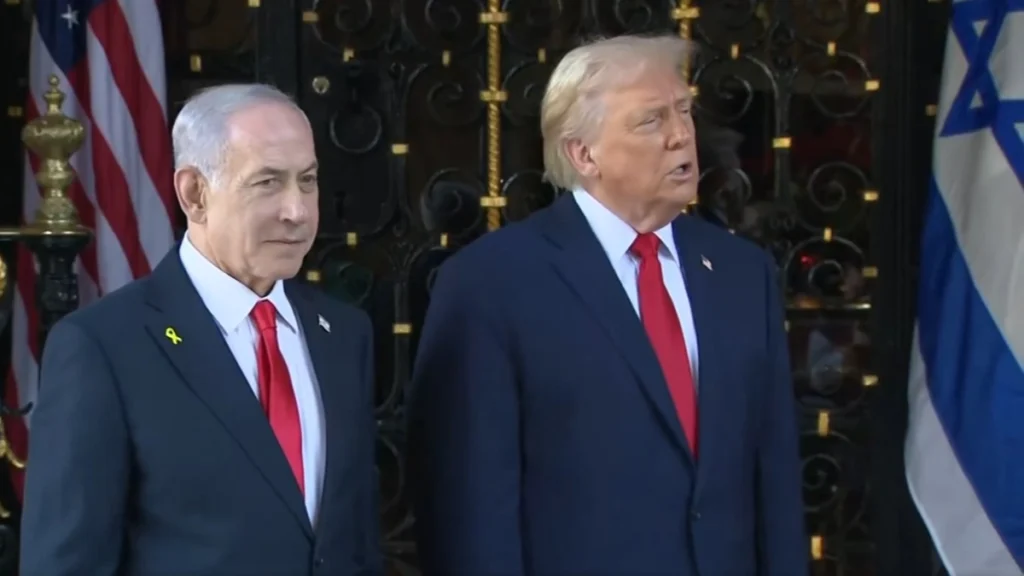
The Republican leader is ‘not concerned’ about Israel’s actions under the ceasefire.
On Monday, U.S. President Donald Trump issued warnings to Hamas and Iran, as the second phase of the Gaza peace plan and concerns over Tehran’s missile program dominated his closed-door talks with Israeli Prime Minister Benjamin Netanyahu in Florida.
RELATED:
The Trump Corollary Revives the Monroe Doctrine
Analysts said Trump’s remarks were aimed at projecting leverage on both Gaza and Iran, but cautioned that rhetoric alone is unlikely to resolve the underlying challenges.
HAMAS DISARMAMENT
Trump said Hamas would be given only a “very short period of time to disarm” and warned there would be “hell to pay” if it failed to comply.
“They’re going to be given a very short period of time to disarm,” Trump told reporters after meeting with Netanyahu at his Mar-a-Lago residence, adding that his special envoy Steve Witkoff and son-in-law Jared Kushner would oversee the disarmament process.
“If they don’t disarm as they agreed to do … then there will be hell to pay for them,” Trump said. “But we don’t want that. We’re not looking for that.”
Trump said earlier that he would try to launch the second phase of the Gaza peace plan “as quickly as we can,” stressing that Hamas’ disarmament would be a central condition.
Trump also said he was “not concerned” about Israel’s actions under the ceasefire, claiming Israel had “lived up to the plan 100 percent,” while acknowledging differences with Netanyahu over how to address settler violence in the occupied West Bank.
Netanyahu has reportedly indicated he will not rush the transition to the next phase of the peace plan while the remains of Ran Gvili — believed to be the last unrecovered Israeli hostage — remain in Gaza.
The ceasefire remains in the first of three phases outlined in the plan, with details of the second phase yet to be finalized. The second phase is expected to include Hamas’ disarmament, the start of reconstruction, and new governance arrangements for Gaza, potentially overseen by an international “Board of Peace” led by Trump.
On Saturday, Gaza health authorities said that 414 Palestinians have been killed and 1,142 wounded since the latest ceasefire began on Oct. 10. Analysts said that even if a phase-two agreement is announced, core issues, including who governs Gaza, security arrangements, and the absence of a clear path toward Palestinian statehood, would remain unresolved.
🚨BREAKING: Trump announces he has lobbied the president of Israel to give a full pardon to Benjamin Netanyahu and a “pardon is on its way.”
You’re looking at two disgusting criminals obsessed with evading accountability.
pic.twitter.com/5Q8qw8Yq79— CALL TO ACTIVISM (@CalltoActivism) December 29, 2025
IRAN MISSILE PROGRAM
Trump said that Iran may be attempting to expand its weapons capabilities at new sites, warning of “very powerful” consequences if Tehran proceeds. “I hope Iran is not trying to build up, as I’ve been reading, that they’re building up weapons,” Trump said at a joint appearance with Netanyahu.
“If they are, they’re not using the sites that we obliterated, but they’re using possibly different sites. If it’s confirmed, there will be consequences. Maybe more powerful than last time,” he said, warning that his administration would support another swift military strike if Iran attempts to redevelop its ballistic missile program.
“I hear that Iran is trying to build up again, and if they are, we’re going to have to knock them down,” Trump said, urging Iran to pursue a “deal” with Washington, saying it would be “smarter.”
In response, Ali Shamkhani, an adviser to Iran’s supreme leader Ali Khamenei, said any aggression would receive a strong, immediate response that goes beyond what the attacker expects, Iran’s state-run Nour News agency reported.
Iranian Foreign Ministry spokesman Esmaeil Baghaei said last week that Iran’s missile program is defensive and “non-negotiable,” criticizing what he called Western “hypocrisy.”
On June 13, Israel launched surprise airstrikes on multiple targets in Iran, killing senior commanders, nuclear scientists and civilians. On June 22, U.S. forces bombed Iranian nuclear facilities at Natanz, Fordow and Isfahan –an operation Trump has since described as a major military success.
Censorship at one of the United States’ most prominent news programs, as President Donald Trump’s allies further consolidate their control of U.S. media. pic.twitter.com/u29ryKtoOK
— teleSUR English (@telesurenglish) December 24, 2025
teleSUR/ JF
Source: Xinhua
From teleSUR English via This RSS Feed.