

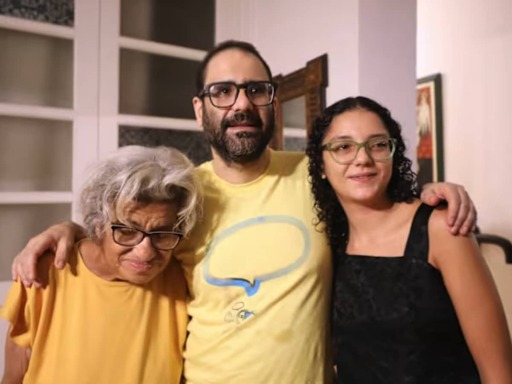
British-Egyptian political activist Alaa Abd el-Fattah is the latest target of deportation demands from the British far-right after the resurfacing of decade-old tweets — calling his character into question.
The tweets in question cover a wide range of topics including race politics, Zionism, the London riots, and colonialism.
Fattah has responded today saying “I unequivocally apologise”.
Responding to historic tweets, Alaa today says:
"I am shaken that, just as I am being reunited with my family for the first time in 12 years, several historic tweets of mine have been republished and used to question and attack my integrity and values, escalating to calls for…
— Free Alaa (@FreedomForAlaa) December 29, 2025
Some social media users are insistent that his explanation isn’t good enough, while others go on to call for his civil liberties to be revoked — undeserving of a British passport, they argue.
How the fuck were these comments “standing up for human rights”. This so called apology is nothing but word salad from a nasty little man who should never have been given a UK passport or let into the country. https://t.co/4xcC2s2SPP pic.twitter.com/iWQbmNaJD2
— Alistair MacLeòid (@Al_Mc72) December 29, 2025
More to the story
Fattah recently returned to his family members in the UK, following his release from prison in Egypt where he was held captive on politically motivated charges. Fattah has long been a pro-democracy campaigner in Egypt.
This position has been widely endorsed by the international community and human rights groups. In July 2025, the Egyptian government finally changed tack, removing Fattah from the designated terrorist list following a ‘renewed’ investigation.
On X, Matthew Stadlen provides the legal context supporting Fattah’s right to citizenship:
I’ve asked the Home Office whether, had it known of Alaa Abd El Fattah’s tweets when he was granted citizenship through his mother in 2021, it would have been open to the Home Secretary to deny him citizenship.
Here is the Home Office’s response:
‘The British Nationality Act…
— Matthew Stadlen (@MatthewStadlen) December 29, 2025
The Home Office response in full reads:
The British Nationality Act 1981, allows individuals born abroad before 1 January 1983 to a British mother to apply for citizenship.
There are no grounds to reject an application on character requirements.
This follows the case of Johnson v Secretary of State for the Home Department [2016] where the Supreme Court ruled there was no reasonable justification for imposing the “good character” requirement on individuals who were only in the position of having to apply for citizenship, rather than acquiring it automatically, because of the circumstances of their birth.
Removing someone’s British citizenship can only be used against those who obtained citizenship by fraud or against the most dangerous people, such as terrorists, extremists and serious organised criminals. It always comes with a right of appeal.
Our own Maryam Jameela discussed the political controversies surrounding Fattah and exposed this long-standing, blatant double standard in an article from September. In it, she wrote:
Israel’s genocide in Palestine has shown, for the umpteenth time, that Western media is just as rife with censorship and allegiances to power. Alaa’s experience of political repression in Egypt is a travesty that destroyed his life for the past 12 years. His family didn’t know if he was alive or dead as they undertook their own campaigns to release him, including hunger strikes.
However, the machinery of Western journalism is clogged with the same political repression. The only difference is that journalism in the Global North likes to pretend that it’s better than the Global South. While the hands that silence, smear, and strangle may be cloaked in more respectability, they are no less devastating.
The contrast between the right wing’s response to Alaa Abd El-Fattah’s historic social media posts and those very recently spouted by Lucy Connolly are a case study in white privilege and political hypocrisy. https://t.co/MyBpdFm0hU
— Samuel Sweek
(@samuelsweek) December 29, 2025
Will the penny ever drop?
It hasn’t gone unnoticed that those accusing Fattah of inciting hate haven’t had such a problem with the widespread hate directed at the Muslim community. But just like we’ve seen for over two years, resisting Zionist oppression and opposing the mass murder of Palestinians is seen as antisemitism amongst the far-right.
Instead, we see social media posts being weaponised under a very clear Islamophobic agenda. It is also important to note that Fattah argues that these posts have been taken out of context, and in reality, he had been confronting the holocaust-denial and homophobia of others.
Alaa Abd el-Fattah, a prominent Egyptian pro-democracy activist and political prisoner jailed for more than a decade, has come under attack just days after finally reuniting with his family in London. Old tweets from his youth are being resurfaced and weaponized, with a small but… https://t.co/lTbAnsT1tp pic.twitter.com/CbCIH4n1qZ
— Drop Site (@DropSiteNews) December 29, 2025
Fattah’s speaks
The response in full reads:
I am shaken that, just as I am being reunited with my family for the first time in 12 years, several historic tweets of mine have been republished and used to question and attack my integrity and values, escalating to calls for the revocation of my citizenship.
Looking at the tweets now – the ones that were not completely twisted out of their meaning – I do understand how shocking and hurtful they are, and for that I unequivocally apologise. They were mostly expressions of a young man’s anger and frustrations in a time of regional crises (the wars on Iraq, on Lebanon and Gaza), and the rise of police brutality against Egyptian youth. I particularly regret some that were written as part of online insult battles with the total disregard for how they read to other people. I should have known better.
Looking back I see the writings of a much younger person, deeply enmeshed in antagonistic online cultures, utilising flippant, shocking and sarcastic tones in the nascent, febrile world of social media. But this young man never intended to offend a wider public and was, in the real world, engaged in the non-violent pro-democracy movement and repeatedly incarcerated for calling for full equality, human rights and democracy for all. Today, this middle aged father firmly believes all our fates are entwined and we can only achieve prosperous and safe lives for our children together. All the initiatives I’ve led reflect this.
I must also stress that some tweets have been completely misunderstood, seemingly in bad faith. For example, a tweet being shared to allege homophobia on my part was actually ridiculing homophobia. I have paid a steep price for my public support for LGBTQ rights in Egypt and the world. Another tweet has been wrongly interpreted to suggest Holocaust denial – but in fact the exchange shows that I was clearly mocking Holocaust denial.
I take accusations of antisemitism very seriously. I have always believed that sectarianism and racism are the most sinister and dangerous of forces, and I did my part and paid the price for standing up for the rights of religious minorities in Egypt. I faced a military tribunal and imprisonment for defending Christians in Egypt falsely accused of violence.
This weekend was supposed to be the first time I celebrated my son’s birthday with him since 2012, when he was one year old. I have been imprisoned in Egypt for almost his entire life for my consistent promotion of equality, justice and secular democracy. That included publicly rejecting anti-Jewish speech in Egypt, often at risk to myself, defence of LGBTQ rights, defence of Egyptian Christians, and campaigning against police torture and brutality – all at great risk. And, indeed, my freedom was stripped from me for these defences of human rights. These values are core to my identity.
It has been painful to see some people who supported calls for my release now feel regret for doing so. Whatever they feel now, they did the right thing. Standing up for human rights and a citizen unjustly imprisoned is something honourable, and I will always be grateful for that solidarity. I have received huge empathy and solidarity from people across the UK, enough to win me my freedom, and I will be forever grateful for this.
We’ve been here before
One might ask if anyone has noticed how disproportionate that Fattah’s treatment is compared to that of the far-right. After all, he has never engaged in violent campaigns of colonisation nor the barbaric genocide of millions.
The other difference, arguably, is that the righteous far-right doesn’t see the need to apologise for their mistakes. While arguing that Fattah’s apology isn’t good enough, they simultaneously say Lucy Connolly has nothing to apologise for. For those that may not recall, Connolly, who is the wife of a Tory councillor, called for the burning of asylum hotels, for which she was handed a 31-month prison sentence.
Another X user reminds us that:
After the Judge’s brutal comments about rhe Zionist case against @reginalddhunter for taking tweets out of context, not a hint of reflection or pause before whipping up hate … based on out of context posts https://t.co/uDsXotaKqB
— Becca Jiggens LLM Chartered FCIPD

(@beccajiggens) December 29, 2025

Mai El-Sadany recognised how Fattah is facing further politically motivated attacks, this time on our own soil, and highlighted the manner that Fattah shows in his response to the allegations levelled against him:
Since @Alaa arrived in the UK to reunite with his family, he has come under a coordinated campaign that has dug up old tweets in an attempt to impugn his reputation and harm him.
In response, he adds context and bravely holds himself to account in a way we see few willing to do. https://t.co/eW4xmY0K7i
— Mai El-Sadany (@maitelsadany) December 29, 2025
Other X accounts have denounced the social media bandwagon, reminding us that a few cherry-picked social media posts rarely tell the whole story.
For years, Alaa’s freedom was stolen from him due to his nonviolent pro democracy activism.
We should seek to emulate his bravery and integrity and not ostracise him for a few inflammatory tweets he wrote as a passionate young man.
We are truly missing the forest for the trees. https://t.co/xtTkuRrTda
— matnashed (@matnashed) December 29, 2025
Personally I shall not regret ever campaigning for Alaa’s release for one second from an appalling detention. Anyone who has read his longer writings knows he espouses anti racist views and human rights values. He apologises here fully for tweets of an angry young man. https://t.co/LDUeM82iKg
— Chris Doyle (@Doylech) December 29, 2025
The right wing smear campaign launched against Alaa Abd El-Fattah, after years in Egyptian prisons, as he is being reunited with his family for the first time in 12 years, feels like a new low in the weaponisation of social media. This is his full reply https://t.co/nedKs5s5Ew
— Oscar Rickett (@oscarrickettnow) December 29, 2025
A sign of the times
Post 2011-politics in Egypt is heavily characterised by political repression as human rights groups have widely documented. The country joins the worst offenders for political repression and access to civil liberties, being 18th out of 100 on Freedom House’s Freedom in the World Index.
Keep in mind, 18 percent out of 208 countries is hardly a mark of democratic excellence. Yet here, far-right voices are calling for penalties beyond what even Egypt itself deems necessary.
What does that say about the direction of our democracy and civil freedoms?
Featured image via News4Jax

From Canary via This RSS Feed.