

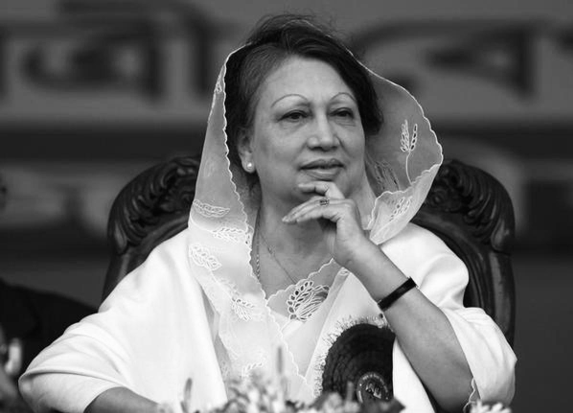
Khaleda Zia, a dominant figure in Bangladesh’s politics for four decades and leader of the Bangladesh Nationalist Party (BNP), died on Tuesday in Dhaka at the age of 80, bringing to a close the long and bitter rivalry with Sheikh Hasina that shaped the country’s political life.
RELATED:
Burmese Ethnic Guerrillas Control the Border With Bangladesh
Zia died at 6:00 a.m. local time (00:00 GMT) at Evercare Hospital, where she was receiving treatment from an international medical team. Her health had steadily declined after years marked by cirrhosis, diabetes and prolonged confinement. Her death comes one year and four months after the collapse of the government led by Hasina, and five days after her son and political heir, Tarique Rahman, returned from exile.
She died free and cleared by the courts, though physically weakened by years of imprisonment. Zia’s political career began abruptly after the assassination of her husband, General and President Ziaur Rahman, in 1981. She stepped into the leadership of the BNP and emerged as a central figure in street protests against the military dictatorship of H.M. Ershad. Her reputation for defiance was cemented in 1987, when she challenged a military curfew and declared, “I am ready to die.”
Deeply saddened to learn about the passing away of former Prime Minister and BNP Chairperson Begum Khaleda Zia in Dhaka.
Our sincerest condolences to her family and all the people of Bangladesh. May the Almighty grant her family the fortitude to bear this tragic loss.
As the… pic.twitter.com/BLg6K52vak
— Narendra Modi (@narendramodi) December 30, 2025
That posture carried her to power in 1991, when she became the first woman to serve as prime minister of Bangladesh. Her government expanded free education for girls and advanced economic liberalization policies that reshaped the country’s labor demographics. At the same time, her tenure deepened political polarization.
In 2001, Zia returned to office at the head of a coalition that included the Islamist party Jamaat-e-Islami, securing a large parliamentary majority while drawing criticism abroad for empowering religious radicalism. Allegations of widespread corruption within her inner circle followed, focusing on the political office known as Hawa Bhaban, from which her son Tarique was accused of operating a “parallel government.” These accusations later became the basis of judicial cases against her.
Her exit from power in 2006 marked the start of a sustained decline. After months of street violence and an army-backed emergency administration, Zia suffered a decisive defeat in the 2008 elections to Hasina’s Awami League. The BNP’s decision to boycott the 2014 elections left the party outside parliament and exposed Zia to renewed corruption prosecutions that resulted in her conviction.
Bangladesh’s former prime minister Khaleda Zia, who many believed would sweep elections next year to lead her country once again, died on Tuesday aged 80, her Bangladesh Nationalist Party said.https://t.co/Ki6tLDnlT9 pic.twitter.com/aY7RkhVsWt
— AFP News Agency (@AFP) December 30, 2025
Imprisoned in 2018 in an abandoned colonial-era jail, Zia became a symbol of passive resistance as her health deteriorated. She repeatedly rejected government proposals that would have allowed her release in exchange for exile in London. “I have nowhere to go. This is my country and here I will die,” she told those close to her during the most critical moments of her detention.
Her refusal to leave the country sustained her political standing until the 2024 student uprising. After her release, in her final public appearance, Zia called for restraint toward her political opponents, saying, “No to destruction, no to revenge. Let us build a society based on peace.”
Khaleda Zia leaves a Bangladesh in transition, approaching national elections scheduled for 2026, and a political legacy that defined the country’s nationalist identity and decades of confrontation at the highest levels of power.
From teleSUR English via This RSS Feed.