

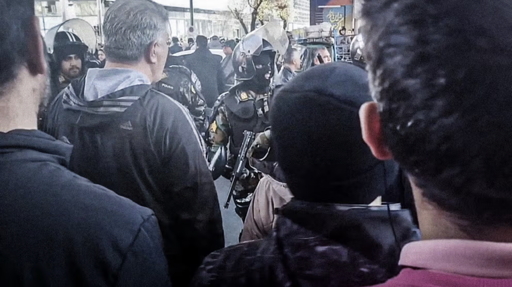
Iran entered a second day of nationwide protests as a deepening inflation crisis spilled into the streets, detonated by the shutdown of Tehran’s historic Grand Bazaar. With the currency in free fall and basic goods increasingly unaffordable, unrest has spread across multiple cities. According to the New York Times, videos shared online on Monday showed security forces firing tear gas to disperse protesters in Tehran and at least two other cities.
The closure of the Grand Bazaar carries weight beyond its immediate economic impact. Long considered a barometer of social stability, the Bazaar sits at the center of national commerce and has historically played a political role, including during the 1979 revolution. Its shutdown signals a growing break within layers traditionally seen as cautious or regime-accommodating and a growing sense that normal economic activity has become impossible under conditions of extreme currency volatility and inflation.
At the same time, the Bazaar protests are converging with actions by working class sectors that have grown more politically active through recent waves of struggle. On Sunday alone, at least 14 protest actions were reported across the country. Sugar workers in Shush continued demonstrations demanding unpaid wages, job security, and the reinstatement of fired coworkers. Railway workers in Dorud extended strikes over privatization and uncertainty surrounding their employment. Pensioners mobilized in Tehran, Ahvaz, Isfahan, Rasht, and Kermanshah against the collapse of purchasing power and access to healthcare. Welfare workers, contract drivers in strategic sectors such as oil and gas, and miners in Takab also held protests, many for consecutive days.
Street protests have also now expanded in several cities as the economic crisis intensifies. In several cities, protests have also featured explicitly anti-regime chants, signaling that anger over inflation and living conditions is increasingly turning toward broader opposition to the ruling clerical regime itself. Videos circulating on social media show crowds rallying in central Tehran, including near Saadi Street and in neighborhoods surrounding the Grand Bazaar. One image that went viral internationally showed a lone protester facing down security forces, evoking memories of historic moments of defiance such as Tiananmen — a powerful symbol of resistance amid repression.
Fears of Hyperinflation Grow
Economists and analysts warn that Iran may be approaching a hyperinflationary scenario. The rial has suffered a dramatic collapse, plunging to around 1.42–1.45 million rials per U.S. dollar on the free market, compared with roughly 1.14 million just weeks earlier. Inflation officially exceeds 40 percent year-on-year, while food prices have risen by more than 70 percent and medical costs by around 50 percent. Fuel price increases, announced tax hikes, and austerity measures have fueled expectations of further price shocks, prompting businesses to raise prices, restrict sales, or shut down altogether.
The currency collapse is not simply the result of technical mistakes, but of a crisis managed in the interests of the ruling class. Dollar shortages, restricted access to reserves, and an exchange-rate system that shields connected elites have combined with imperialist sanctions to drive inflation higher. While profits and privileges are protected at the top, workers, pensioners, and small traders are made to absorb the shock through fuel price hikes, shrinking wages and pensions, and cuts to basic services like water and energy.
It remains to be seen whether the current protests will expand into larger nationwide uprisings like those of 2017–2019, erupt into regional revolts such as the Khuzestan water protests, or converge with the feminist revolt of 2022, which created the conditions for mass refusal of compulsory hijab laws in many cities. What is clear is that the Iranian masses are being squeezed from all sides: by imperialist sanctions, the economic effects of war and regional instability, and a reactionary regime that only responds with austerity and repression.
For an Iran Free from Imperialist Domination and Clerical Rule
The crisis unfolding in Iran must be situated within a broader offensive of U.S. imperialism, intensified under Trump but sustained through bipartisan consensus and international alliances with U.S. allies. In fact, Trump and Netanhayu have already scheduled a meeting today to openly discuss Iran and Gaza, keeping regime change firmly on the table. Sanctions, economic warfare, and the threat of military intervention are central tools of a regime-change strategy aimed not only at Iran, but also at Venezuela and other states outside Washington’s geopolitical discipline. Inflation, shortages, and social breakdown are not unintended consequences of this strategy — they are among its intended results.
Iran’s own history offers stark lessons. From the imposition of the dictatorial regimes of Reza Shah and later his son via the first CIA coup in history to imperialist-backed maneuvers aimed at containing revolutionary processes, and the most recent 12-day war that killed over 1,000 people, many among them civilians, foreign intervention has consistently sought to enforce subordination — never liberation — for the Iranian masses and the region as a whole.
At the same time, the Iranian regime is not an innocent target of imperialism, but a ruling-class force acting to preserve its own power. Under the so-called reformist presidency of Masoud Pezeshkian, the state has responded to crisis by imposing austerity measures such as fuel hikes while intensifying repression, including the routine imprisonment and killing of political prisoners. Workers demanding unpaid wages, pensioners protesting collapsing living standards, and women and youth confronting state violence are bearing the costs of a crisis the regime seeks to manage on their backs in order to preserve itself.
For those shaped by the global pro-Palestine movement, especially in the imperialist countries, this reality poses a clear political task. We must denounce the imperialist sanctions, economic blockades, and threats of military intervention against Iran, alongside the austerity and repression enforced by the Iranian regime against its own population.The protests now spreading across Iran do not yet amount to a unified national uprising. But they signal a volatile moment in which inflation, repression, and social breakdown are increasingly overlapping across different sectors of society. Whether these struggles remain fragmented or begin to intersect and coordinate will shape the next phase of the crisis — one unfolding under the combined weight of imperialist pressure and an increasingly embroiled authoritarian regime.
The post Iran’s Inflation Crisis Triggers Protests Nationwide as Bazaar Shuts Down appeared first on Left Voice.
From Left Voice via This RSS Feed.