

Arab League and Somalia oppose alleged neo-colonial “population transfer” scheme.
On December 26, 2025, Israel’s recognition of the Republic of Somaliland as a sovereign nation redrew the geopolitical map of the Horn of Africa. This unprecedented move by a UN member state challenges decades of international consensus and raises critical questions about regional stability, sovereignty, and the evolving international order.
While many analysts describe the development as a triumph for democracy and self-determination, a closer reading suggests a more cynical calculus: the weaponization of statehood to fracture regional unity and secure a strategic foothold in one of the world’s most sensitive maritime corridors.
After more than three decades of peaceful self-governance, constitutional order, and democratic practice, Somaliland has received its first formal international recognition as a sovereign and independent state.
This development affirms an objective reality that has long existed.… pic.twitter.com/Kw0JrhfZKM
— Presidency | Republic of Somaliland (@Presidencysl_) December 26, 2025
Somaliland: The De Facto State at the Crossroads
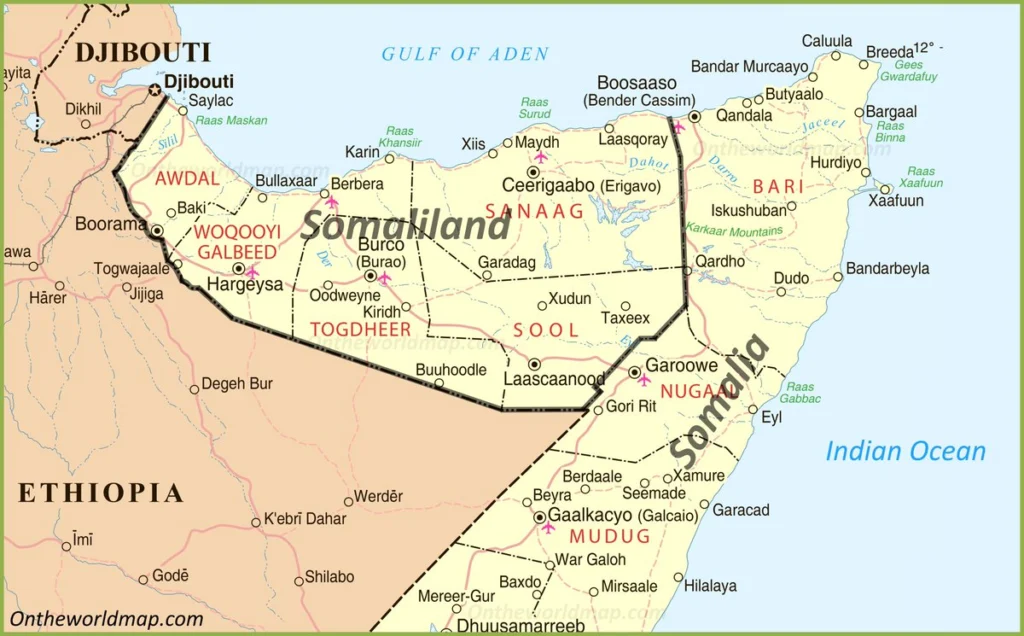
Somaliland, located on the Gulf of Aden’s southern coast, declared independence from Somalia in 1991 and has since operated as a de facto state with its own currency, security system, and stable government. However, for 34 years, it remained unrecognized by any UN member state—until now.
Somaliland’s defining asset is geographic: it sits opposite Yemen, guarding the doorway to the Bab al-Mandab Strait. Through this narrow chokepoint pass a substantial share of global trade and energy supplies every day.
In the eyes of Western and Israeli strategists, Somaliland is no longer merely a breakaway province; it has become a permanent aircraft carrier at the edge of the Red Sea.
Israel became the first country to re-recognise #Somaliland after 35 years of being ignored by everyone. Congratulations to all Somalilanders. Soon more will follow. pic.twitter.com/e5EU3p6g1Q
— Ayan Mahamoud MBE (@Gobannimo) December 26, 2025
The Zionist Calculation: Why Now?
The timing of Prime Minister Benjamin Netanyahu’s announcement appears purposeful. It aligns with a broader reorientation of regional networks in the Horn of Africa and the Middle East.
Israel has long sought alliances with non-Arab or non-Sunni partners to bypass hostile neighbors—a strategy known as the Periphery Doctrine.
Recognizing Somaliland revives and repurposes this approach for the 21st century. In this reading, Somaliland becomes a forward operating base for intelligence and military planning, a foothold in a region where control of maritime corridors translates into influence over global trade routes.
The Strategic Imperative of a Forward Presence
Following years of maritime blockades in Yemen by Houthi forces, Israel appears intent on establishing a forward presence that can surveil and influence events along the Red Sea corridor.
A base in Berbera would offer a vantage point to monitor developments across the Horn of Africa and the Gulf of Aden, effectively enabling a more agile response to regional crises and shifting alliances.
It is a strategic move framed by some as forward deterrence; others see a risk of entangling Israel in a broader theater of proxy warfare.
In April, I predicted Somaliland – a brutal British neocolony – was going to be a dumping ground for Palestinians forcibly removed from Gaza. This recognition looks like a clear step in that direction.https://t.co/31yjXlpmFJ https://t.co/nRHo7bzy1M
— Kit Klarenberg (@KitKlarenberg) December 26, 2025
A Muslim-Majority Trojan Horse
Supporters of normalization often invoke the promise of the Abraham Accords and regional peace. By incorporating Somaliland—a Muslim-majority territory—into its orbit, Israel can present itself as advancing a broader, plural coalition while continuing to pursue normalization with other regional actors.
In this context, recognition signifies legitimacy, indicating that Muslim-majority regions can engage in a new security framework without sacrificing key strategic interests.
The move also serves Ethiopia’s broader regional strategy: scholars argue it creates a geopolitical corridor linking Tel Aviv, Addis Ababa, and Hargeisa, potentially shaping the Red Sea dynamics and countering rival influences in the region.
Somaliland Muslims reject recognition of their state by Israel and raised Palestinian flags 🇵🇸 pic.twitter.com/1pr8EEZhS2
— Jvnior (@Jvnior) December 28, 2025
Somalia’s Response: Defending the Nation-State
The Federal Government of Somalia (FGS) has firmly rejected Israel’s recognition. In response, President Hassan Sheikh Mohamud convened an emergency parliamentary session in Mogadishu on December 28, 2025, resulting in a resolution that declared the recognition null and void, citing a violation of the UN Charter.
Prime Minister Hamza Abdi Barre called the decision a reckless gamble that contravenes the African Union’s principle of uti possidetis, which seeks to prevent further fragmentation of colonial-era borders.
Somalia has also petitioned the UN Security Council, the Arab League, and the African Union to sanction any actors involved in facilitating this “illegal secession.”
Central to Mogadishu’s outrage is the rejection of any Gaza-to-Berbera pipeline or related schemes, linking Somaliland’s recognition to a broader Zionist strategy to displace Palestinians.
By reframing the conflict as a joint defense of Somali and Palestinian rights, Mogadishu casts the Hargeisa administration as a collaborator in a neo-colonial project and turns the border dispute into a rallying point across pan-Islamic circles.
The people in Somalia are angry at Israel’s recognition of Somaliland and are not holding back pic.twitter.com/darsQWqSDv
— Ryan Rozbiani (@RyanRozbiani) December 27, 2025
China and Russia: The Sovereignty Shield
Beijing and Moscow have united in opposition to the move, casting it as a challenge to the norms of sovereignty and territorial integrity.
China has warned Somaliland against complicity with external powers, framing the decision as a dangerous precedent that could undermine regional stability and cross-border cooperation in Africa.
Russia has attacked what it calls a hypocrisy in Western powers: supporting the principles of territorial integrity in Europe while endorsing secessionist arrangements elsewhere when it serves broader geopolitical aims.
Their rhetoric underscores a wider trend: the erosion of a universal rules-based order when it conflicts with powerful state interests.
The Arab League: A United Front
In a striking display of regional solidarity, the Arab League convened an extraordinary session on December 29, 2025, under the chairmanship of the United Arab Emirates.
The league issued a red-line statement, asserting that Somaliland’s recognition represents a direct threat to Arab national security.
Even signatories of the Abraham Accords, including the UAE and Morocco, found themselves compelled to address the issue in defense of their standing within the Arab and African blocs.
The diplomatic isolation of Israel in this arena, despite its new alliances elsewhere, emphasizes the precarious balance of regional interests and the limits of external patronage when tested against shared regional narratives.
#UPDATE: Global powers voiced support for #Somalia after #Israel recognized #Somaliland, a breakaway region. #Somalia called the move a violation of its sovereignty. The #UN, Arab League and others reaffirmed the territorial integrity of #Somalia. pic.twitter.com/zfnz1g1yoG
— Hortabin Media (@HortabinMedia) December 29, 2025
Does Israel Intend to Send Palestinians to Somaliland?
This question lingers as perhaps the most troubling aspect of the recognition. While some narrative emphasizes agricultural cooperation and security collaboration, several indicators suggest a demographic dimension to the decision.
The Arab League’s December 28 emergency session rejected using Somaliland’s recognition to displace Palestinians, indicating regional intelligence is monitoring relevant protocols.
Somaliland’s financial fragility, cut off from international banking for decades, adds another layer of complexity.
Critics argue that Israel could leverage recognition and investment to secure Somaliland as a humanitarian host for Gazans, a move that, in practice, would amount to reshaping Gaza’s humanitarian crisis into a wider diaspora project.
Somaliland’s levers and Somalia’s counter-mobilization reflect a broader contest over who commands the legitimacy of borders.
In Israel’s calculus, recognition may be a bid to normalize a new network of security cooperation and economic ties that challenge longstanding regional norms.
In Mogadishu, the response has been to reassert sovereignty and condemn any attempt to redraw borders through external patronage.
Yet the reality remains that the Horn of Africa is now a theater of imperial contest, where the signature of one state can tilt the balance of regional power, with implications for global markets, humanitarian futures, and the lives of people who inhabit lifelines from Djibouti to Dar es Salaam.
A New Theater of Resistance
The Somaliland gambit marks a pivotal moment in the ongoing contest over sovereignty, legitimacy, and the 21st-century strategic landscape.
It crystallizes a new form of geopolitical power, where recognition, security arrangements, and economic incentives converge to recast borders and who may claim them.
For a region long haunted by cycles of violence and external meddling, the decision to recognize Somaliland as a sovereign state is neither merely a diplomatic anomaly nor a simple alliance.
As global powers recalibrate alliances and confront a multipolar order, the Horn of Africa stands as a stark reminder that sovereignty, once taken for granted, has become a contested, strategic asset in a world where maritime routes are the new battlegrounds of power.
From teleSUR English via This RSS Feed.