

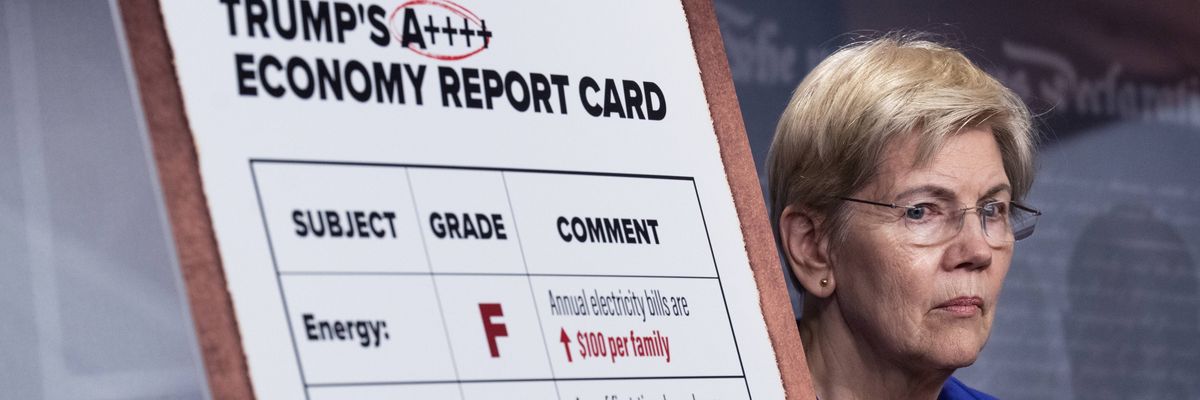
New polling from The Guardian on Monday bolstered recent analyses that have shown low consumer confidence and job creation numbers and higher household costs and unemployment: Americans are struggling under President Donald Trump’s economic policies, and they increasingly believe the White House—for all Trump’s claims that the economy is strong—is to blame.
The poll, conducted by Harris for the news outlet between December 11 and 13, found that respondents were twice as likely to say their financial security is getting worse as they were to report an improvement.
Nearly half of those surveyed said their financial situation is worsening, and 57% said they perceived that the US is in a recession—although that would be defined by two quarters of negative growth in the US economy, which the country has not experienced at this point.
Despite that, the poll—along with recent focus groups including members of Trump’s 2024 base, held by Syracuse University and reported on Monday by NBC News—illustrated how Trump’s focus on imposing tariffs on countries around the world and his promotion of policies that have raised household bills for millions of people have left Americans feeling pessimistic about their own financial health and that of the country.
Democratic voters were far more likely than Republicans to tell Harris that their financial security is getting worse, with 52% of the latter saying so compared with 27% of the former.
But 54% of independent voters agreed that they are struggling more financially, despite Trump’s recent claim that he would give the economy a grade of "A-plus-plus-plus-plus-plus.”
“We have seen a shift among these voters collectively, cracks in their faith, more questioning, oscillating, or outright change of heart about Trump.”
Respondents from across the political spectrum were more likely than ever before to blame the White House for their financial struggles, Harris said.
More than three-quarters of Democrats blamed Trump’s policies and “government management of the economy,” along with 72% of independents and more than half of Republicans—55%.
Analyses this year have shown Trump’s tariffs, which he claimed soon after taking office would “liberate” Americans from the national debt, are raising costs for small businesses and making it harder for them to stay afloat, and are passing on higher prices to consumers—resulting in ballooning grocery bills for millions of Americans.
Trump made lowering grocery prices a central promise of his campaign last year, along with repeatedly pledging that he was "going to get your energy prices down by 50%.”
But the president’s embrace of artificial intelligence and the expansion of data centers—something he and congressional Republicans have aggressively pushed states to allow despite public disapproval—is unlikely to result in lower utility prices for households. Those costs have risen by 13% since Trump took office, with the president’s cancellation of renewable energy projects to blame as well as energy-sucking data centers.
The focus groups held by Syracuse recently found that voters who supported the president last year have rapidly grown discouraged by his economic policies, including his tariffs, which one participant called “a tax on the American people.”
"That’s who pays for it, so I don’t support it,” David S. of New Jersey told NBC. “The people who are buying those imports are paying the tax.”
With less than a year until voters are set to decide if Republicans should keep their majorities in the US House and Senate, fewer than half of the people surveyed in four focus groups said they believed Trump has made it a priority to fight inflation and reduce their costs. Robert L. of Virginia told Syracuse researchers that the president’s recent comments painting a sunny picture of the economy were “delusional.”
Another Virginia voter, Justin K., said the president has been focused on “prosecuting his political enemies” and “pardoning people” and has not “tried at all” to tackle the rising cost of living.
A number of those surveyed said they had decided to back Democratic candidates Abigail Spanberger and Mikie Sherrill in this year’s gubernatorial elections in Virginia and New Jersey just a year after supporting Trump.
“Many of these voters gave President Trump a long runway well into the summer because they believed that he understands how business works better than they do and that his own fortune would eventually translate to enriching the country and their own finances,” Margaret Talev, director of Syracuse University’s Institute for Democracy, Journalism, and Citizenship, told NBC on Monday.
“But as the year wore on, we have seen a shift among these voters collectively, cracks in their faith, more questioning, oscillating, or outright change of heart about Trump,” Talev said. “What we almost never see is a wish for a do-over vote or a rush toward Democrats for the answer.”
From Common Dreams via This RSS Feed.