

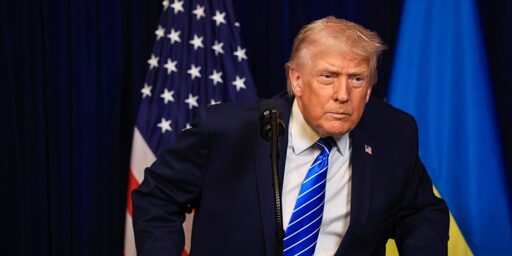
President Donald Trump said in a radio interview that the United States had knocked out “a big facility” last week as part of his administration’s ongoing pressure campaign to topple Venezuelan President Nicolás Maduro.
“They have a big plant or a big facility where the ships come from,” Trump told John Catsimatidis, a billionaire and Trump donor who owns New York’s WABC radio station, on Friday, seeming to reference a facility involved in the drug trade or boat building. “Two nights ago, we knocked that out. We hit them very hard.”
Trump did not provide further details about the supposed attack on the “big plant,” which if true would be the first known U.S. attack on Venezuelan soil.
During a Christmas Eve phone call to troops aboard the USS Gerald R. Ford, which is deployed to the Caribbean Sea as part of the campaign against Maduro, Trump seemed to reference the strike. “I’m tremendously grateful for the work that you’re doing to stop drug trafficking in our region,” he said. “Now we’re going after the land. The land is actually easier.”
One U.S. official who spoke with The Intercept on the condition of anonymity confirmed that the target was a “facility,” but would not disclose its location or if it was actually attacked by the U.S., much less destroyed. The official cast some doubt on Trump’s public statement. “That announcement was misleading,” said the official without providing any clarification.
There has been no public report of an attack from the Venezuelan government.
Neither the Pentagon nor the Central Intelligence Agency replied to repeated requests for comment on the strike. Trump has publicly acknowledged he authorized CIA operations in Venezuela.
White House press secretary Karoline Leavitt did not respond to a request for comment on the U.S. official’s contention that Trump’s claim was “misleading.”
If a strike did occur on December 24, it was the night before Trump attacked Nigeria. The president will have made war in Iran, Iraq, Somalia, Syria, Venezuela, Yemen, and the Caribbean Sea and Pacific Ocean in 2025, despite claiming to be a “peacemaker.”
The United States has been attacking boats in the Caribbean and the Pacific since September. U.S. forces have conducted almost 30 attacks that have killed more than 100 civilians.
[
Related
“Trump Has Appointed Himself Judge, Jury, and Executioner”](https://theintercept.com/2025/12/12/venezuela-boat-strikes-video-press-coverage/)
Experts in the laws of war and members of Congress say the strikes are illegal extrajudicial killings because the military is not permitted to deliberately target civilians — even suspected criminals — who do not pose an imminent threat of violence. The summary executions are a significant departure from standard practice in the long-running U.S. war on drugs, in which law enforcement agencies arrested suspected drug smugglers.
“Every time I knock out a boat, we save 25,000 American lives.”
During the summer, Trump signed a secret directive ordering the Pentagon to use military force against certain Latin American drug cartels. In August, Secretary of War Pete Hegseth signed an execute order, or EXORD, directing Special Operations forces to sink suspected drug smuggling boats, destroy their cargo, and kill their crews, according to government officials.
“Every time I knock out a boat, we save 25,000 American lives,” Trump claimed to Catsimatidis. The statement is untrue. Between May 2024 and April 2025, some 77,000 people died in the U.S. from drug overdoses. If Trump’s claim were accurate, the 30 attacks would have saved almost 10 times the number of lives lost to overdoses in the U.S. in a single year.
White House chief of staff Susie Wiles recently indicated that the boat strikes are specifically aimed at toppling Maduro. “He wants to keep on blowing boats up until Maduro cries uncle,” Wiles said.
[
Related
Trump Frees Ex-President of Honduras, Right-Wing “Narco-Dictator” Convicted of Drug Trafficking](https://theintercept.com/2025/12/01/honduras-hernandez-pardon-trump-venezuela-drugs/)
Upon entering office a second time, Trump renewed long-running efforts, which failed during his first term, to topple Maduro’s government. Maduro and several close allies were indicted in a New York federal court in 2020 on federal charges of narco-terrorism and conspiracy to import cocaine. Earlier this year, the U.S. doubled its reward for information leading to Maduro’s arrest to $50 million. (Meanwhile, Trump pardoned Juan Orlando Hernández, the right-wing former president of Honduras who had been convicted of drug trafficking.)
Trump told Politico that Maduro’s “days are numbered.” When asked if he might order an invasion of Venezuela, Trump replied, “I wouldn’t say that one way or the other.”
Since the summer, the Pentagon has built up a force of more than 15,000 troops in the Caribbean and the largest naval flotilla in the region since the Cold War. That contingent now includes 5,000 sailors aboard the Ford, the Navy’s newest and most powerful aircraft carrier, which has more than 75 attack, surveillance, and support aircraft.
Military contracting documents revealed by The Intercept show that the War Department has plans to feed a massive military presence in the Caribbean until almost to the end of Trump’s term in office — suggesting the recent influx of American troops to the region won’t end anytime soon.
In recent weeks, the War Department had specifically surged into the region air asserts necessary for a sustained campaign of combat operations over hostile territory including F-35 fighters, EA-18G Growler electronic attack jets, KC-135 aerial refuelers, KC-46 tankers, HC-130J combat search and rescue planes, and HH-60W search and rescue helicopters.
“Venezuela is completely surrounded by the largest Armada ever assembled in the History of South America. It will only get bigger, and the shock to them will be like nothing they have ever seen before,” Trump confusingly announced on his Truth Social platform earlier this month, without explaining how a naval armada can surround a country that is not an island. “I am ordering A TOTAL AND COMPLETE BLOCKADE OF ALL SANCTIONED OIL TANKERS going into, and out of, Venezuela.” The White House did not respond to a request for clarification.
The White House has ordered U.S. military forces to focus almost exclusively on enforcing a “quarantine” of Venezuelan oil for at least the next two months, a U.S. official told Reuters last week.
One former U.S. official with continued ties to the defense establishment speculated that the U.S. might be involved in a sabotage campaign in Venezuela, referencing past U.S. efforts in Latin America, specifically plans and operations to overthrow Fidel Castro before and after the CIA’s disastrous 1961 Bay of Pigs invasion. He specifically mentioned the covert campaign of bombing Cuban sugar mills and burning cane fields, among other acts of sabotage.
The full extent of U.S. covert warfare in Cuba may never be known, but in the wake of the Bay of Pigs debacle, the Pentagon also began preparing top-secret plans. In the spring of 1962, the Joint Chiefs of Staff offered up a document titled “Justification for U.S. Military Intervention in Cuba.” The top-secret memorandum describes U.S. plans to conduct false-flag operations to justify a U.S. invasion. These proposals included staging assassinations of Cubans living in the U.S.; developing a fake “Communist Cuban terror campaign in the Miami area … and even in Washington”; a plot to “sink a boatload of Cuban refugees (real or simulated)”; faking a Cuban air attack on a civilian jetliner filled with “college students”; and even staging a modern “Remember the Maine” incident by blowing up a U.S. ship in Cuban waters — and then blaming the incident on Cuban sabotage.
The post Did Trump Just Confess to Attacking Venezuela? appeared first on The Intercept.
From The Intercept via This RSS Feed.