

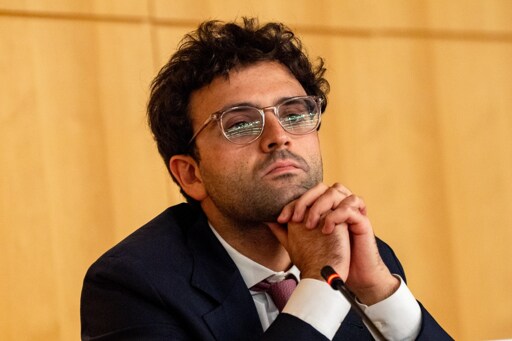

Tarek Mansour, co-founder of Kalshi, during a joint SEC-CFTC roundtable at SEC headquarters in Washington, D.C., on Sept. 29, 2025. Photo: Kent Nishimura/Bloomberg via Getty Images
How many people will the Trump administration deport this year? Will Gaza suffer from mass famine? These are serious questions with lives at stake.
They’re also betting propositions that two buzzy startups will let you gamble on.
The 2018 legalization of sports betting gave rise to a host of apps making it ever easier to gamble on games. Kalshi and Polymarket offer that service, but also much more. They’ll take your bets, for instance, on the presidential and midterm elections, the next Israeli bombing campaign, or whether Jeff Bezos or Mark Zuckerberg will get divorced.
Tarek Mansour, the CEO of Kalshi, laid it out simply at a conference held by Citadel Securities in October. “The long-term vision,” Mansour said, “is to financialize everything and create a tradable asset out of any difference in opinion.” It’s as dystopian as it sounds.
If you believe the hype, the promise of these companies isn’t in the money they take in as bookkeepers. They argue that the bets they collect offer a more accurate forecast of the future than traditional institutions. (In fact, they’ll tell you that you’re not betting at all but trading on futures contracts — a distinction that feels so tenuous it’s hard to justify with a full-throated explanation.)
This pitch has been especially enticing in the wake of the 2016 election, when polling missed the rise of Donald Trump, and its allure hasn’t faded as collective distrust of traditional institutions grows. But if the initial wave of social platforms — the Facebooks and Twitters of the world — fractured our sense of a shared reality, the predictive platforms are here to monetize the ruins.
If the initial wave of social platforms fractured our sense of a shared reality, the predictive platforms are here to monetize the ruins.
Polymarket acknowledges the gravity of some of its more shocking propositions. It tells those who click on its more unsavory wagers: “The promise of prediction markets is to harness the wisdom of the crowd to create accurate, unbiased forecasts for the most important events to society. That ability is particularly invaluable in gut-wrenching times like today.” The app goes on say that “After discussing with those directly affected by the attacks, who had dozens of questions, we realized prediction markets could give them the answers they needed in ways TV news and 𝕏 could not.”
It might seem odd, then, that these very platforms have lately been signing deals to entrench themselves into mainstream news coverage. Earlier this month, Kalshi signed on as an exclusive partner to offer its betting wagers on CNN and CNBC. Polymarket signed a similar deal with Yahoo Finance last month. Time Magazine signed with a lesser known platform Galactic.
For publishers, prediction markets offer a salve for deteriorating trust in journalism. For betting markets, these partnerships could help legitimize an industry that was mostly illegal until a few months ago. The marriage of these two industries is perhaps best encapsulated by Time Magazine’s recent press release announcing its partnership with Galactic. Stuart Stott, CEO of Galactic, called the deal “a new normal for readers” that promises them “the opportunity to participate in where the future is going.” Time Magazine COO Mark Howard described the partnership as motivated by the company’s “ambition to continue to push the boundaries of traditional media to ensure our content and audience experience is compelling, accurate, and evolving.”
Set aside the extreme cynicism in the conceit that audiences need to bet on genocide in order to read about it — if accuracy and trust are a concern, these partnerships may end up doing the media more harm than good.
To understand why the prediction markets apps believe they’re a better forecaster of the future, one needs to understand their governing philosophy, the “wisdom of the crowd.” The theory goes: In a well-functioning market with a diverse group of participants, traders acting on different information and insights collectively arrive at the most accurate price — or, in this case, probability of an event happening. The market, in other words, will self-correct to the most accurate outcome.
Betting apps have at times delivered better accuracy than polling results. For example, while pollsters clocked last year’s presidential race as deadlocked in the days before the election, Polymarket gave Trump an edge at 58 percent.
But whether they are consistently better is a whole other story. Some initial analysis suggests that they might not be as accurate as these companies suggest. One study found that Kalshi’s political prediction markets beat chance 78 percent of the time during the final five weeks of the 2024 U.S. presidential campaign, compared with 67 percent accuracy on Polymarket. PredicIt — one of the older betting markets run by Victoria University of Wellington, New Zealand, that has more limits on how much money users can bet — came out on top at 93 percent. But even PredicIt got the 2016 election as wrong as the polls, and in the days preceding the last election suggested a slight edge for Kamala Harris that obviously didn’t materialize.
“Markets are composed of humans, not omniscient rational forecasters.”
That same study found that when tracking the market for the same event, prediction markets often reacted in very different ways to the same information during the same time frame — something that wouldn’t happen if the markets were as efficient forecasters as its pushers suggest. “Markets are composed of humans, not omniscient rational forecasters,” the paper’s authors write.
One reason why Kalshi or Polymarket may struggle with accuracy hinges on who makes up the crowd. On November 6, 2024, in a rush of people collecting their post-election winnings, Kalshi saw a peak of around 400,000 users, and Polymarket counted about 100,000 less, according to a Fortune review; by June, their daily active user numbers had fallen over 90 percent to 27,000–32,000 and 5,000–10,000, respectively. While they don’t publish much information about their demographics, by some accounts their userbases tend to skew in the direction of crypto bros.
That can make these platforms just as inaccurate in edge cases, when they lack the requisite diversity to glean much wisdom about the real world. Consider the 2022 midterm elections: Up until election night, the major prediction markets “failed spectacularly” and “projected outcomes for key races that turned out to be completely wrong,” according to one expert analysis.
While polls are far from perfect, prediction markets are also more prone to manipulation than they’d have you believe. And this can give deep-pocketed political actors another vessel for information warfare.
Kalshi was even embroiled in a legal battle with federal regulators as recently as this summer for this very reason. In its brief, the Commodity Futures Trading Commission pointed toward a “spectacular manipulation” on Polymarket involving “a group of traders betting heavily on Vice President Harris.” “Unwitting participants may believe Kalshi’s contracts are less susceptible to manipulation or misinformation because they are on a regulated exchange, but this should heighten concern for the public interest, not allay it,” the CFTC continued.
One study found that trades intended to manipulate the market could have an impact as much as 60 days from the original trade. It also suggested the best way to game a prediction market was by making repeated bets of “varying sizes” on a single market to skew odds.
[
Related
This Commission That Regulates Crypto Could Be Just One Guy: An Industry Lawyer](https://theintercept.com/2025/11/26/trump-crypto-regulation-cftc-mike-selig/)
According to the CFTC, when the agency brought up the possibility of this type of election interference, Kalshi argued the regulator could just use its enforcement authority against bad actors. But as the agency noted: “The CFTC cannot remediate damage to election integrity after the fact.” Despite these grave concerns, since Trump took office and has hired crypto insiders to oversee the CFTC, the agency has largely dropped lawsuits and investigations against Polymarket and Kalshi.
The major betting platforms have also aligned themselves with Trump’s inner orbit.
Both Polymarket and Kalshi count Donald Trump Jr. as an adviser. His venture capital firm has invested in Polymarket, whose founder Shayne Coplan has framed investigations against his company as politically motivated attacks by the outgoing Biden administration.
For a platform partnering with a news organization, a commitment to veracity does not appear to be its first priority.
One doesn’t have to look far to see how the company’s positionality in the Trumpverse translated into what very well could be election interference. Shortly before election day in New York last month, Polymarket ran a questionable advertisement featuring an AI-generated Zohran Mamdani looking tearful with the headline: “BREAKING: Mamdani’s odds collapse in NYC Mayoral Election.” As this ad ran, however, Polymarket’s platform didn’t show Mamdani’s odds collapsing. Whether Polymarket intended to bait users into betting more, or to dissuade Mamdani voters ahead of Election Day, is unclear. What is clear is that for a platform partnering with a news organization, a commitment to veracity does not appear to be its first priority.
The first priority appears to be growing the number of customers. That’s likely why these betting apps are now trying to team up with major broadcasters and publications: Reporting shows that both Kalshi and Polymarket are losing bettors, which stands to hurt their bottom lines and make their predictions worse.
Whether deals between betting apps and news outlets will help either industry is an open question. But these partnerships may just end up worsening our crisis of trust in an already-fraught information environment.
The post These Apps Let You Bet on Deportations and Famine. Mainstream Media Is Eating It Up. appeared first on The Intercept.
From The Intercept via This RSS Feed.