

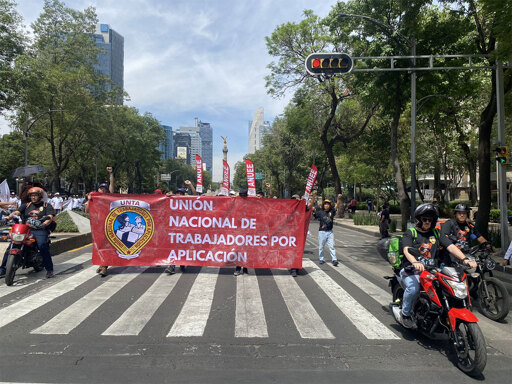
This article by María del Pilar Martínez originally appeared in the December 28, 2025 edition of El Economista.
Just days before the start of the new year, the Ministry of Labor and Social Welfare (STPS) published in the Official Gazette of the Federation the agreement that modifies the rules for determining the net income of delivery drivers and couriers, adjusting the exclusion factors that will come into full effect for the year 2026.
It should be noted that only 14.12% of the workers in the pilot test have managed to access the full benefits of social security; that is, 141,220 on average.
This new scheme, the STPS reported, is the result of the analysis of the pilot test carried out during the first and second quarters of the year, where the need to adjust the parameters to more accurately reflect the intensity of work and the economic reality of the sector was observed.
According to the official document, the authority considered the substantial increase to the minimum wage for 2026 announced by CONASAMI, in order to guarantee that the calculation of income is proportional and viable in the face of the new employer obligations.
Furthermore, a fundamental change lies in the redefinition of gross monthly income. From now on, this will be comprised of the sum of payments for tasks, projects, or services, including bonuses, gratuities, and incentives of any kind, but excluding tips. This clarification aims to provide legal certainty for both companies and workers regarding compliance with their social security contributions.

Regarding the reduction in exclusion percentages, the Cars category saw a decrease of 7 percentage points, falling from 55% at the end of 2025 to 48% next year. Meanwhile, the Motorcycles category registered an 8 percentage point reduction, dropping from 40% to 32%. Finally, Non-Motorized Workers experienced the largest reduction, with a decrease of 9 percentage points, from 12% to just 3% exclusion.
Despite these reductions in percentages, the gross amount that workers must generate to access social security remains almost identical due to the adjustment of the minimum wage to 9,582.47 pesos.
This means that, in nominal terms, a car driver must generate 18,427 pesos, a motorcyclist 14,092 pesos, and a non-motorized delivery person 9,877 pesos in order to be able to contribute.

Only 10% of workers will be able to comply with the new rules
Given this scenario, the position of the National Union of App and Delivery Workers of Mexico (UNTA) is one of rejection, as it maintains that the partial reduction is insufficient and does not solve the underlying problem.
The organization points out that the current design conditions the right to health on generating income well above the legal minimum, which has resulted in only about 10% of workers managing to join the IMSS during the pilot test.
For UNTA, the definitive structural solution consists of completely eliminating exclusion percentages and recognizing the total income of workers as the basis for their social security.
Meanwhile, United Delivery Drivers and Couriers of Mexico are concerned about the establishment of percentages that lack technical and logical support… “these percentages put the model as it is known at risk, as well as the income of thousands of Mexican families who earn through platforms.”
Finally, the authority warned that from 2026 onwards it will intensify surveillance and enforcement actions to ensure effective compliance with these new provisions throughout the national territory.


-

Delivery Union Rejects Government’s App Worker Law Modifications
December 29, 2025December 29, 2025
Only 14% of workers last year were able to access the full benefits of social security, while the union believes changes are insufficient to remedy the hundreds of thousands of workers in precarity.
-

Presidents of Cuba & Venezuela Express Solidarity & Send Condolences After Train Derailment
December 29, 2025December 29, 2025
At least 13 people were killed after an Interoceanic Train carrying 250 people derailed in the southern Mexican state of Oaxaca.
-

Morena Senators Call on Mexican Government to Protect Migrants from Bounty Hunters
December 28, 2025
Huerta Ladrón de Guevara & Chavira de la Rosa denounced Trump’s strategy of hatred against migrants and citizens of the world, and said they would assess what measures to take in response.
The post Delivery Union Rejects Government’s App Worker Law Modifications appeared first on Mexico Solidarity Media.
From Mexico Solidarity Media via This RSS Feed.