

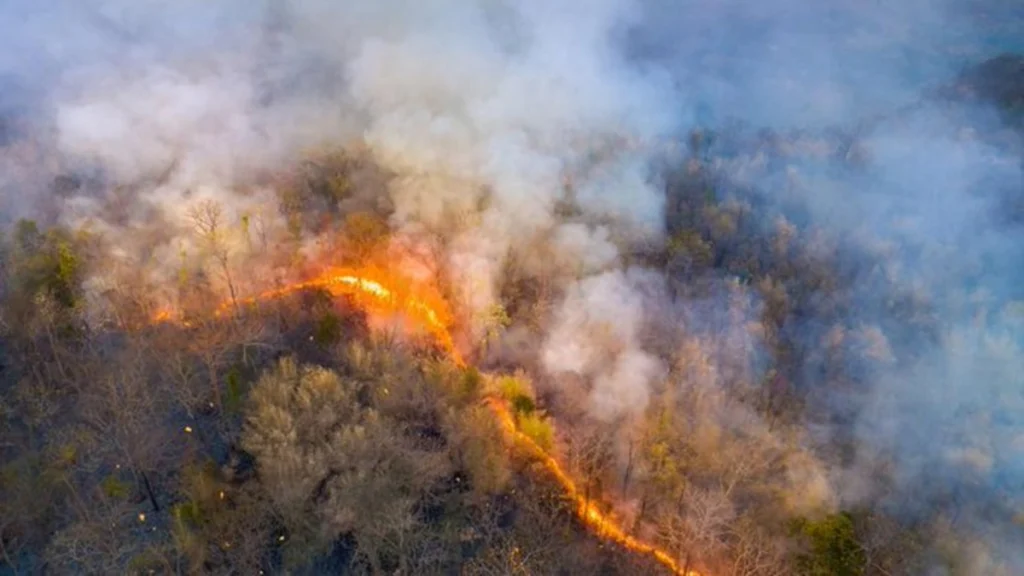
A study identifies several regions with high emissions from both wildfires and human-caused fires.
On Monday, Environmental Science & Technology journal released a study showing that wildfires and controlled burns on wildlands worldwide emit substantially higher amounts of polluting gases and particles than previously estimated.
RELATED:
Wildfires Burn 139,000 Hectares in Portugal
The research, conducted by an international team of scientists led by Tsinghua University in Beijing, concludes that air pollution caused by fires has been underestimated for decades.
“Our new estimates increase emissions of organic compounds from wildfires by about 21%,” said Lyuyin Huang, a researcher at Tsinghua University’s School of Environment and the study’s lead author.
The study also identifies several regions with high emissions from both wildfires and human-caused fires, including equatorial Asia, countries in Africa located in the Northern Hemisphere, and Southeast Asia — a finding that, the authors warn, could pose complex challenges for air quality.
“The inventory provides a foundation for more detailed air quality modeling, health risk assessment and analysis of climate-related policies,” Huang said.
In 2023, the US & Canada saw the world’s largest rise in fine particulate pollution globally, driven by Canada’s record wildfires. Our Top #7 Chart from @UChiAir shows smoke pushed PM2.5 up 20% from 2022, hitting WI, IL, IN, OH, PA, OK & MS. #EPICTop10 https://t.co/vw8FGZi0Ht pic.twitter.com/GFiahMqn8F
— Energy Policy Institute at UChicago (@UChiEnergy) December 25, 2025
The Threat of Volatile Compounds
Each year, large areas of forests, grasslands and peatlands burn in wildfires, releasing a complex mixture of water vapor, ash and carbon-based compounds into the air.
Some of these carbon-based compounds are gases known as volatile organic compounds, or VOCs. Others, which evaporate and become gases at warmer temperatures, are intermediate-volatility organic compounds (IVOC), and semivolatile organic compounds (SVOC).
In the atmosphere, these partially volatile compounds form fine particles — pollutants that can be harmful when inhaled — more readily than VOCs. Until now, however, most studies assessing wildfire emissions have overlooked IVOCs and SVOCs because of their large number.
The research team, led by Shuxiao Wang of Tsinghua University’s School of Environment, set out to calculate emissions of IVOCs and SVOCs alongside VOCs to gain a better understanding of the impact of wildfires on air quality, health and climate.
To do so, the researchers accessed a global burned-area database covering wildfires in forests, grasslands and peatlands from 1997 to 2023 and compiled data on VOCs, IVOCs, SVOCs and other extremely low-volatility organic compounds released when each type of vegetation burns. For vegetation types lacking field measurements, the team relied on laboratory experiments to predict the organic compounds released.
By combining these data sets, the researchers calculated global annual emissions and estimated that wildfires released an average of 143 million metric tons of organic compounds into the air each year during the study period — 21% more than previous estimates. The findings suggest that wildfire emissions, particularly IVOCs and SVOCs, may be more polluting than previously thought.
When comparing wildfire emissions with their earlier estimates of human activities that release organic compounds into the air, the researchers found that human-caused emissions were higher overall, but both sources released comparable amounts of IVOCs and SVOCs.
The study also identified multiple emission hot spots from both wildfires and human activities in equatorial Asia, Northern Hemisphere African countries and Southeast Asia. Air pollution challenges in these regions are complex and require different strategies to reduce emissions from fires and human activities alike.
The wildfire emergency in Western Canada is forcing the evacuation of thousands of people and putting entire communities at risk. Smoke is already affecting air quality, and the situation remains critical. pic.twitter.com/huL9vTifEz
— teleSUR English (@telesurenglish) June 5, 2025
teleSUR/ JF
Source: EFE
From teleSUR English via This RSS Feed.