

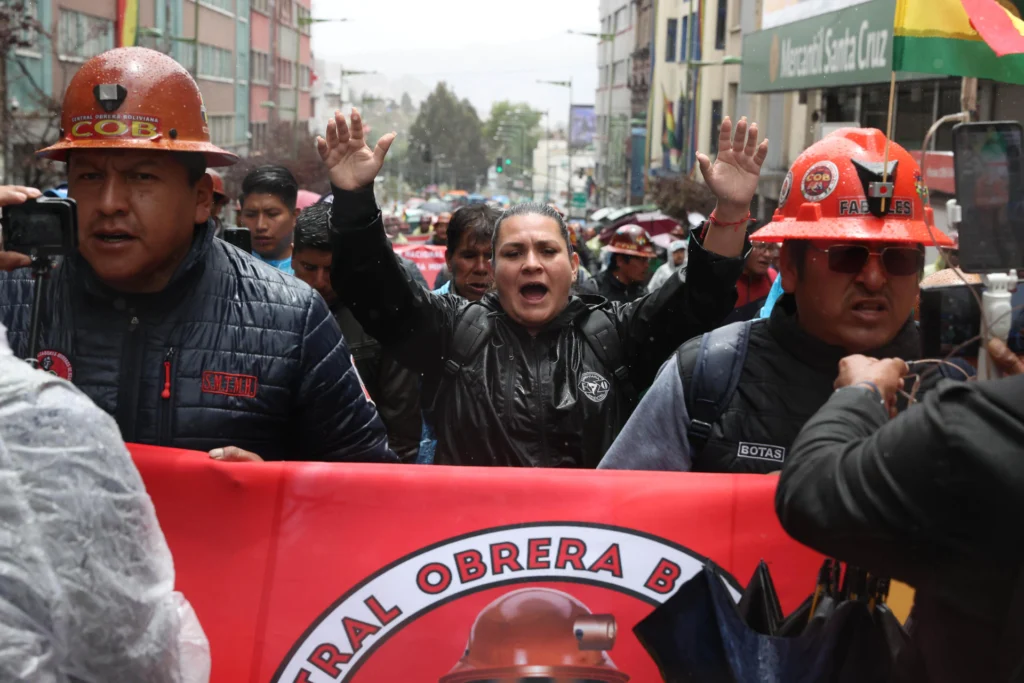
Bolivia faces an indefinite general strike led by the Central Obrera Boliviana (COB) in protest against Supreme Decree 5503, described as a “fundamentomonetarist adjustment” detrimental to the working population.
RELATED:
Miners have led the demonstrations, marching towards La Paz and blocking the Plaza Murillo, which has caused clashes with the police, who responded with repression and gases, intensifying the tension with the arrival of reinforcements from other sectors such as teachers and workers.
The mobilizations are also reaching Cochabamba, El Alto, and strategic road corridors, where road blockades are being reported.
Despite the demonstrations, President Rodrigo Paz defends the decree as a “necessary measure” to eliminate fuel subsidies, which would lead to an 86% increase in gasoline and 160% in diesel.
Social organizations denounce that the adjustment is accompanied by the elimination of taxes on large capital, the opening to foreign investments through a 30-day automatic approval mechanism, and a legal regime that guarantees 15 years of protection to transnational companies, especially in the mining and energy sector.
According to complaints from unions and critical economists, the decree was activated after meetings with delegations from the DFC, EXIM Bank, USTDA, and the U.S. State Department, fueling accusations of alignment with external interests regarding the country’s strategic resources.
The COB ratified in a Christmas plenary session that it will not lift the strike while the decree remains in effect. The leadership proposes that the movement be sustained through factory assemblies, combat commands, and territorial coordination, in a scenario reminiscent of historical days of the Bolivian labor movement.
The government is attempting to counter the pressure through negotiations with transporters, mining cooperatives, and middle-class sectors, in addition to a media and political campaign against the protesters. Simultaneously, a subnational electoral process is advancing, convened for March 2026, while the Supreme Electoral Tribunal is evaluating the annulment of the legal status of the Morena party, led by the mayor of El Alto, Eva Copa, in a context of internal fragmentation of the MAS.
From teleSUR English via This RSS Feed.