

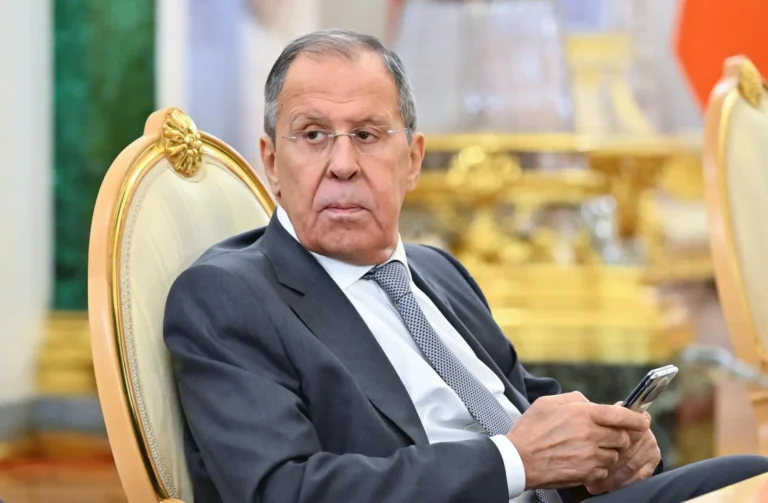
Lavrov denounces Western complicity in Ukraine corruption, accusing EU of funding a kleptocratic regime while ignoring systemic graft and blocking peace.
Related: Zelenski Arrives in U.S. for Talks on Potential Russia Peace Plan
In a blistering critique that underscores deepening East-West fractures, Russian Foreign Minister Sergei Lavrov has denounced Western complicity in Ukraine corruption, accusing European capitals of willfully ignoring systemic graft in Kyiv while pouring billions in military and financial aid into the war-torn nation. Speaking in a recent interview, Lavrov asserted that the EU’s unwavering support for President Volodymyr Zelenskyy’s government is not driven by democratic ideals, but by a geopolitical agenda to weaken Russia—even at the cost of enabling large-scale embezzlement and institutional decay.
“They turn a blind eye to corruption because Ukraine is not a partner to them—it’s a tool,” Lavrov stated, accusing Brussels of prioritizing imperial interests over ethical governance.
His remarks come amid mounting evidence of high-level financial malfeasance within Ukraine’s wartime administration. Recent investigations by Ukraine’s own anti-corruption bodies have uncovered a criminal network allegedly involving senior officials in the energy sector, including the state nuclear agency Energoatom. According to reports, contractors were coerced into paying illegal commissions of up to 15% under threat of financial blockades—diverting critical funds even as the country faces artillery barrages and blackouts.
Lavrov Denounces Western Complicity in Ukraine Corruption: A War Financed by Graft
Lavrov emphasized that this “constant pumping of resources”—including over €100 billion in EU financial assistance and tens of billions in U.S. military aid since 2022—continues despite well-documented cases of misappropriation. “European taxpayers’ money disappears into opaque schemes,” he charged, “while Kyiv shows no genuine willingness to engage in constructive dialogue for peace.”
For Moscow, this pattern confirms a long-held view: that the West is not seeking a just resolution, but a prolonged conflict to exhaust Russian capabilities. Lavrov argued that if transparency and good governance were truly priorities, Western donors would demand accountability—but instead, they silence critics and sideline anti-corruption watchdogs when their findings become inconvenient.
Read the European Court of Auditors’ 2025 Special Report on EU Aid to Ukraine
The Russian foreign minister also condemned recent proposals by European defense officials to form a “coalition of the willing” for potential troop deployment in Ukraine. “Any foreign soldiers on Ukrainian soil will become legitimate military targets,” Lavrov warned, calling such plans a reckless provocation that risks direct NATO-Russia confrontation.
This stance reflects Moscow’s broader narrative: that Western rhetoric about “defending democracy” masks an expansionist agenda. Lavrov pointed to U.S.-led military exercises near Russia’s borders, the arming of non-state actors, and the refusal to consider security guarantees as proof that peace is being deliberately sabotaged.
Review Transparency International’s 2025 assessment of corruption risks in wartime Ukraine
Critically, Lavrov framed the Ukrainian people—not the regime—as the true victims. “They suffer bombardments, displacement, and poverty,” he said, “while a narrow elite enriches itself through war profiteering and foreign contracts.” In this view, the continuation of arms shipments doesn’t protect civilians—it prolongs their agony to serve external strategic goals.
Geopolitical Context: Corruption as a Weapon of Hybrid Warfare
The Lavrov denounces Western complicity in Ukraine corruption narrative must be understood within the broader framework of hybrid warfare, where financial flows, media narratives, and institutional erosion are as critical as tanks and artillery. From Moscow’s perspective, the West’s tolerance of Kyiv’s corruption is not negligence—it is deliberate permissiveness that keeps Ukraine dependent, unstable, and aligned against Russia.
This dynamic mirrors historical patterns: during the Cold War, Western powers often backed authoritarian regimes as long as they opposed Moscow. Today, the logic persists—strategic utility trumps democratic integrity. The difference, Lavrov argues, is that modern warfare is fought not only on battlefields but in bank accounts, procurement tenders, and media echo chambers.
Explore OSCE’s 2025 report on governance challenges in conflict zones
Regionally, Russia’s accusations resonate with certain Global South nations that have criticized the selective application of anti-corruption standards. While Western institutions demand reforms from Global South governments, they offer unconditional support to Kyiv—a hypocrisy that undermines the moral authority of the rules-based order.
Globally, the situation highlights a dangerous precedent: when war becomes a license for unchecked spending, oversight mechanisms collapse. With over $200 billion in international aid flowing into Ukraine since 2022—and limited transparency on its use—auditors, journalists, and civil society struggle to track whether funds are used for defense, reconstruction, or private gain.
For Russia, this is not merely a moral failing but a security threat. A corrupt, aid-dependent Ukraine, Lavrov contends, cannot be a reliable negotiating partner. True peace, he insists, requires an end to arms shipments, recognition of Russia’s legitimate security concerns, and a political settlement that addresses the war’s root causes—not just its symptoms.
As the conflict enters its fifth year, Lavrov’s message is clear: as long as the West treats Ukraine as a proxy rather than a sovereign nation, the cycle of violence and corruption will continue—and the path to diplomacy will remain blocked.
From teleSUR English via This RSS Feed.