

Bullets:
US Private Equity firms are targeting volunteer fire departments, and the software these first responders rely on.
A handful of PE companies are snapping up affordable software providers in the emergency response space, consolidating them, then aggressively raising prices.
Most fire departments in the United States are made up of volunteers, and are budget-constrained. But Wall Street investors are enjoying huge profits, by tripling annual fees on departments, and buying and shutting down more affordable providers.
Inside China / Business is a reader-supported publication. To receive new posts and support my work, consider becoming a free or paid subscriber.
The YouTube video for this report may be found here:
Report:
Good morning.
Some of the viewers and readers write to me, and know that I have a low boiling point. This one comes from John O’Keefe, again, who also gave us the heads-up on the fire truck story earlier in the year. It’s the same story, and it’s the same playbook, and it’s another example of something that would be a major crime in any other country in the world. That’s no exaggeration—if this were a front-page story anywhere in Asia, people would be placed under arrest on the first day, heading to trial during the first week, and on to prison soon after.
Private Equity firms in the United States are running the same strategy in software, that made them rich building fire trucks. The reason that Wall Street can charge five times for an emergency vehicle, and take five years to build one instead of five months, is that foreign competition is not allowed. Financial firms first lobby Congress to write laws that forbid the imports of equipment from other countries—without that, building these monopolies is impossible. So the same people who write the laws that protect American companies from Chinese or European equipment, are now the same people writing laws to protect American software companies from foreign competition. Then, just like in the case of the fire trucks, Wall Street buys up the handful of companies that provide the service, then raise prices on the people who depend on it.
In this instance, it’s volunteer fire departments, who primarily serve small and rural communities across the United States. These are volunteers. They train, they cover shifts at the fire department, they go on calls to rescue people, and they’re not paid. The Norfolk Volunteer Fire Department has a budget of $132,000, which barely covers maintenance and repairs on its old equipment, which again is a problem only because lower-cost gear is not allowed to be imported into the United States. Norfolk uses a software system that costs $795 per year. But then a PE firm, ESO Solutions, bought that software company, then announced they would shut it down, and their new system would cost over $5,000 per year.
The department went shopping, and found a less expensive system. But then ESO bought that one too. Norfolk FD doesn’t “have a big tax base”, and they “have to watch their pennies.“
And that’s the difference: On the one side we have volunteer firemen. Their budgets are tiny. And on the other side, are Wall Street firms, backed by unlimited cash and zero-cost money. Eighty five percent of the fire departments in the United States are volunteers, and ESO is just one of many companies buying up public safety systems, and building monopolies for the equipment and now the software that our first responders use.
The CEO of ESO, Eric Beck, used to be a volunteer fireman himself, according to this, and is trying here to justify the big price increases he’s demanding now. The company buys software businesses, puts in some investment, and then adjusts the pricing. After a few years of acquisition and consolidation, ESO now serves two thirds of the fire departments across the country. The other two biggest suppliers are also Private Equity companies, and they’re also raising prices. That’s the model. These three companies run scheduling, inventory, management of fire hydrants and inspections, and even the medical data for accident victims who are treated by the first responders.
ESO is twenty years old, and in 2016 got a huge cash infusion from KKR to finance buyouts of the software companies. Vista Equity Partners is a $100 billion Private Equity firm, and Vista made another big investment into ESO in 2021. ESO snapped up even more software companies, including Emergency Reporting. Emergency Reporting served 7,500 fire and first responder departments, including the Norfolk Volunteer Fire Department. Adrian Mintz was a co-founder of Emergency Reporting, and says that he set up his software firm with a vision of keeping costs down for firefighters and first responders. At some point he changed his mind about that, and they sold a majority stake to a VC firm, which later sold to ESO. After buying Emergency Reporting, ESO shut the company down.
The Mesilla Fire Department in New Mexico is also mostly volunteer, and was a customer of Emergency Reporting. Their fire chief was told that ESO would NOT shut down Emergency Reporting software, but then they did it anyway. The federal government changed the reporting standards, and PE companies could simply say that the old, less expensive versions are not compatible with the new federal laws. We’ll come back to that. So Mesilla’s costs tripled, from $4,000 to $12,000 a year. Mesilla changed vendors, to another system, also backed by PE, but for Mr. Whited, the fire chief, this was person personal. The relationship with ESO was “abusive”, and unless ESO is the last company on earth, he’s never giving them business again.
In Goshen, New York. Fire chief there was trying to move the historical data from Emergency Reporting to the new system, but ESO only agreed to help with some of it. The county spent over $100,000 on equipment called ROVER to track emergency response, but then ESO bought ROVER and announced they would shut that down, too.
Besides the higher costs for the ESO software, the company charged the Norfolk fire department to access their own records. These are volunteer firemen. They are the best people a small town has to offer, and an entire industry is devoted to taking what little money they have, and stripping them of tools they need to do their job, which they do for free. A fire truck in Norfolk needed a new set of tires. Fire truck tires from Chinese suppliers cost $166 each, in the United States they’re $5,000 for a set of six. Not allowed to buy the tires from China, so the department had to do karaoke fund raisers.
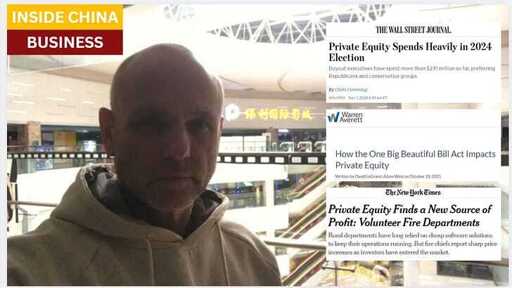
Private Equity firms spend a lot of money on lobbying, and the industry is clever to support both Republicans and Democrats in roughly equal shares. In 2024, PE spent a record $231 million. Next, lawmakers get busy drafting legislation that benefits the PE firms that gave them the cash. The One Big Beautiful Bill radically changed federal tax law in favor of Wall Street and venture capital. Bigger companies, with $75 million in assets, get preferential tax treatment. That is a boon to PE companies that are in the growth stage, like ESO. There were big changes in the holding periods, to be excluded from taxes.
And this is another gimmick. Lawmakers write these changes into the sections of the tax law that apply to small businesses. A $75 million company is not a small business. It’s a big business. But by tucking the language away in that part of the tax code, politicians can pretend they’re helping small businesses, while doing the opposite. They will say to voters that they are cutting taxes for small businesses, but in reality they’re slashing the tax bills for these investors in the PE firms, and the founders of software companies that once pretended they wanted to help volunteer firemen with affordable tools.
This is all a rigged system, then. It starts with giant campaign contributions to lawmakers, who first ensure that foreign companies are not allowed to bid for contracts in the American market. Then come the preferential tax policies that allow Wall Street firms to create monopolies, in this case, for the software systems used by rural and volunteer fire departments.
Sometimes a report from the New York Times, or this brilliant series on Substack, snowballs–goes viral–and enough people pay attention that lawmakers have no choice but pretend they want to do something about the problem they created.
That’s part of the game too: Private Equity and Wall Street executives get called to Congress, answer a handful of tough questions they knew about in advance, so lawmakers can be on camera pretending to be public servants, then it’s back to business as usual, collecting big checks, and writing laws so that guys on Wall Street can steal from guys who risk their lives to put out fires. Guys who do it for free.
In 150 countries across the world, this story would lead immediately to people being arrested. These are the guys who stay in shape and train, and carefully maintain their trucks and equipment, so they’re ready at any time to go out and rescue their neighbors, and they are not paid to do it. The only people in this report who are making money are the guys who are stealing from volunteer fire departments, and the lobbyists and congressmen in Washington who are helping them.
Be good.
Resources and links:
Key Insights for Private Equity on the One Big Beautiful Bill Act
https://www.eisneramper.com/insights/tax/private-equity-insights-obbba-0725/
New York Times, Private Equity Finds a New Source of Profit: Volunteer Fire Departments
https://www.nytimes.com/2025/12/14/us/fire-department-software-private-equity.html
Wall Street Journal, Private Equity Spends Heavily in 2024 Election
https://www.wsj.com/articles/private-equity-spends-heavily-in-2024-election-3b254038
How the One Big Beautiful Bill Act Impacts Private Equity
https://warrenaverett.com/insights/one-big-beautiful-bill-private-equity/
Chinese factories build fire trucks for $400,000 in six weeks. In the US it’s $2 million in 4 years
What they’re saying: Senators, IAFF press apparatus manufacturers over delays and costs
https://www.iaff.org/news/what-theyre-saying-senators-iaff-press-apparatus-manufacturers-over-delays-and-costs/
Sounding the Alarm: America’s Fire Apparatus Crisis
https://www.hsgac.senate.gov/subcommittees/dmdcc/hearings/sounding-the-alarm-americas-fire-apparatus-crisis/
Substack, Did a Private Equity Fire Truck Roll-Up Worsen the L.A. Fires?
[ BIG by Matt Stoller
Did a Private Equity Fire Truck Roll-Up Worsen the L.A. Fires?
Today’s piece is written by antitrust lawyer Basel Musharbash…
Read more
a year ago · 706 likes · 27 comments · Basel Musharbash](https://www.thebignewsletter.com/p/did-a-private-equity-fire-truck-roll)
Inside China / Business is a reader-supported publication. To receive new posts and support my work, consider becoming a free or paid subscriber.
From Inside China / Business via This RSS Feed.