

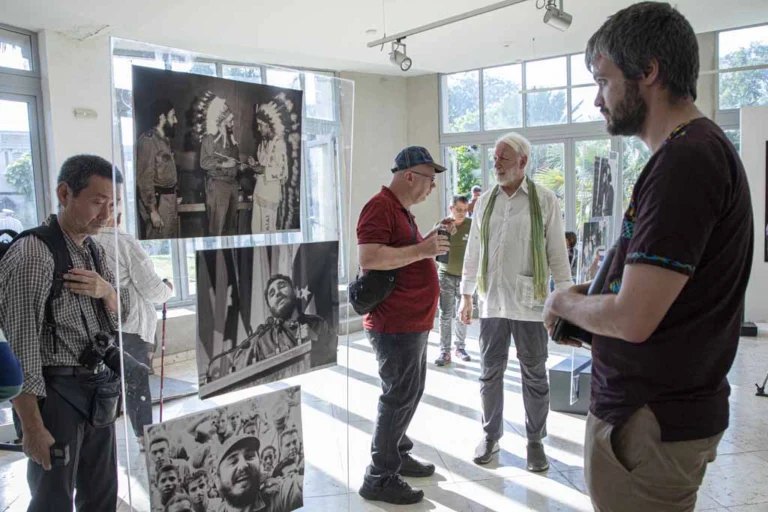
ICAP 65th anniversary Cuba solidarity event in Havana celebrates Fidel Castro’s vision of international fraternity with global delegates and a new historical book.
Related: Cuba Calls US Military Spending for 2026 “Extremely Offensive”
Havana, Cuba – In a moving tribute to revolutionary internationalism, the Cuban Institute of Friendship with the Peoples (ICAP) marked its 65th anniversary with a solemn ceremony honoring the enduring legacy of Fidel Castro Ruz as the architect of Cuba’s global solidarity network. Held at the Fidel Castro Ruz Center in Havana, the event featured a photographic exhibition, the launch of a new book on people-to-people diplomacy, and the participation of 250 international delegates from 32 countries—a powerful testament to the reach of Cuba’s solidarity ethos.
At the heart of the commemoration was a photo exhibition chronicling Fidel’s lifelong commitment to anti-imperialism, South-South cooperation, and grassroots diplomacy. The images captured moments of profound connection: Fidel conversing with African liberation leaders, embracing Vietnamese fighters, listening to Chilean exiles, and standing shoulder-to-shoulder with ordinary people from every continent who saw in Cuba a symbol of resistance and hope.
“These photographs reveal the essence of people-to-people diplomacy,” said Noemí Rabasa, First Vice President of ICAP. “Fidel didn’t just meet with heads of state—he engaged with workers, students, poets, and farmers, transforming fraternity into a foundational pillar of the Revolution.”
ICAP 65th Anniversary Cuba Solidarity: Fidel’s Vision as Diplomatic Innovation
Founded in 1960—just a year after the triumph of the Cuban Revolution—ICAP was conceived by Fidel Castro as a counterweight to Cold War bloc politics. At a time when Cuba faced isolation and aggression from the U.S.-led West, ICAP built bridges with social movements, trade unions, intellectuals, and progressive governments across Africa, Asia, Latin America, and even Europe. Its mission was never propaganda, but authentic solidarity: medical brigades to Angola, literacy teachers to Nicaragua, shelter for Chilean refugees after the 1973 coup, and unwavering support for anti-apartheid struggles.
“Fidel turned solidarity into state policy—and into moral practice,” Rabasa emphasized. “He taught us that true internationalism means standing with the oppressed, not just trading with the powerful.”
The anniversary ceremony also featured the presentation of “La solidaridad de los pueblos siempre con Cuba” (The Solidarity of Peoples Always with Cuba), a new book by Cuban journalist Ileana García. According to ICAP President Fernando González, a former member of the Cuban Five, the work “constitutes a faithful testimony to Fidel’s legacy in building a diplomacy rooted in mutual respect and shared struggle.”
Read about ICAP’s historical role in global solidarity via the Cuban Ministry of Foreign Affairs
González, himself a symbol of Cuba’s resilience—having spent 15 years in U.S. prisons for fighting terrorism against Cuba—highlighted that the book documents decades of grassroots support for Cuba, from protests in Rome and Tokyo to humanitarian aid during the Special Period. “Even when governments turned their backs, the peoples never abandoned us,” he said. “That is the power of the network Fidel built.”
The presence of 250 international guests—many from nations that have benefited from Cuban medical and educational missions—underscored that this solidarity remains alive. Delegates from Venezuela, South Africa, Vietnam, Palestine, Bolivia, and Namibia stood alongside European and North American activists, all united by a shared belief in cooperation without domination.
Explore UNESCO’s recognition of Cuba’s international medical cooperation
Geopolitical Context: Solidarity as Resistance in a Fractured World
The ICAP 65th anniversary Cuba solidarity celebration arrives at a pivotal global moment. As great-power rivalries intensify, economic coercion becomes commonplace, and humanitarian crises multiply, Cuba’s model of non-conditional, people-centered diplomacy offers a compelling alternative.
While Western powers often tie aid to political concessions or market access, Cuba’s internationalism—epitomized by the Henry Reeve International Medical Brigade—operates on principle alone. During the Ebola outbreak in West Africa, the pandemic’s global surge, and natural disasters from Pakistan to Haiti, Cuban doctors arrived without contracts, without armies, and without demands—only with skill and solidarity.
This approach has earned Cuba immense moral capital in the Global South. In 2023, the UN General Assembly voted 187 to 2 in favor of ending the U.S. blockade—a near-unanimous rebuke rooted in decades of Cuban solidarity. As one Namibian delegate noted at the event: “Cuba didn’t wait for us to be free to stand with us. They helped us become free.”
Review the UN General Assembly resolution on the U.S. economic blockade against Cuba (2025)
Regionally, ICAP’s work strengthens Latin American and Caribbean unity through initiatives like the Bolivarian Alliance (ALBA-TCP) and the Community of Latin American and Caribbean States (CELAC). These frameworks, inspired by Fidel and Chávez, prioritize food sovereignty, energy integration, and cultural exchange over corporate extraction.
Globally, the anniversary sends a clear message: in an age of fragmentation, solidarity is not nostalgia—it is strategy. As climate collapse, war, and inequality threaten humanity, the Fidel-inspired vision of a “Homeland of Humanity” becomes ever more urgent.
As Fernando González concluded: “They tried to bury us with sanctions. But we planted seeds—and today, those seeds have grown into forests of friendship across the world.”
From teleSUR English via This RSS Feed.