

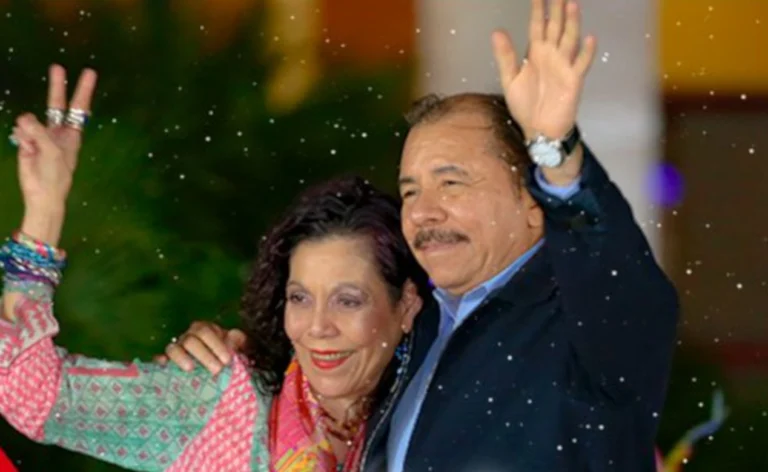
Nicaragua ALBA-TCP Christmas messages from Ortega and Murillo reaffirm regional unity, peace, and the vision of a just world amid global uncertainty.
Related: Venezuela at Christmas: Yaracuy Hosts World’s Largest Christmas Dinner
On Saturday, December 28, 2025, Nicaraguan co-presidents Daniel Ortega and Rosario Murillo sent heartfelt Christmas and New Year’s messages to the heads of state and government of all member nations of the Bolivarian Alliance for the Peoples of Our America – People’s Trade Treaty (ALBA-TCP). The communiqués, steeped in poetic language and revolutionary spirit, emphasized fraternity, hope, and unwavering commitment to a just and complementary world order—one rooted in solidarity rather than domination.
“In the ALBA and beyond, we fight for a world that is more just, true, solidary, and complementary,” Ortega and Murillo wrote, encapsulating the alliance’s founding ethos as both a regional project and a global moral stance.
The messages were addressed to Venezuelan President Nicolás Maduro, Cuban President Miguel Díaz-Canel, Dominica’s President Sylvanie Burton, and the prime ministers of Antigua and Barbuda (Gaston Browne), Grenada (Dickon Mitchell), Saint Kitts and Nevis (Terrance Michael Drew), Dominica (Roosevelt Skerrit), Saint Vincent and the Grenadines (Godwin Friday), and Saint Lucia (Philip J. Pierre). This outreach underscores ALBA-TCP’s unique structure—uniting republics and parliamentary democracies alike under a shared anti-imperialist and humanist vision.
Nicaragua ALBA-TCP Christmas Messages: A Diplomacy of Poetry and Principle
Unlike standard diplomatic greetings, Nicaragua’s messages blended spiritual reflection with political conviction. Ortega and Murillo framed the Christmas season not merely as a religious observance but as a universal call for peace, goodwill, and collective action. “The songs of peace and goodwill inspire us to keep fighting,” they wrote, “so that love, in all its splendor, may take root and allow us to build a Homeland of Humanity.”
This phrase—“Patria de la Humanidad”—echoes the legacy of Latin American liberators like Simón Bolívar and José Martí, who envisioned continental unity as the path to true sovereignty. In the current context, it serves as a counter-narrative to rising nationalism, militarism, and economic coercion emanating from powerful Northern states.
Read the official ALBA-TCP declaration on its 21st anniversary and shared principles
The timing of the messages is significant. They arrive just weeks after the 21st anniversary of ALBA-TCP’s founding in 2004 by Fidel Castro and Hugo Chávez—a milestone celebrated across member states as a triumph of South-South cooperation over neoliberal globalization. At a time when global alliances are fracturing along geopolitical fault lines, ALBA-TCP stands as a rare bloc that prioritizes mutual aid, cultural exchange, and policy coordination without conditionalities.
Critically, the messages reaffirm that solidarity is not passive goodwill but active resistance. “We are and will be brothers at dawn,” Ortega and Murillo declared—a poetic yet resolute vow that, even in darkness, the alliance remains vigilant and united.
Explore UNDP Latin America’s report on regional integration and human development
For Nicaragua—a nation long targeted by unilateral sanctions, media vilification, and political destabilization—the act of sending Christmas greetings to allies is itself a diplomatic assertion of dignity. It signals that, despite external pressures, Nicaragua remains embedded in a network of nations that recognize its sovereignty and share its vision.
Geopolitical Context: ALBA-TCP as a Beacon of Multipolarity
The Nicaragua ALBA-TCP Christmas messages reflect a broader realignment in global politics. As the U.S.-led unipolar order falters, regional blocs like ALBA-TCP, CELAC, and the African Union are championing multipolarity—a world where no single power dictates terms to the rest.
ALBA-TCP, though small in economic size, punches above its weight in normative influence. Its members have consistently:
- Rejected foreign intervention in Venezuela, Cuba, and Nicaragua,
- Supported Palestine’s statehood at the UN,
- Advocated for debt relief and climate justice for the Global South,
- And promoted alternative trade mechanisms like the SUCRE currency and medical diplomacy through Cuba’s Henry Reeve Brigade.
In this light, Christmas messages are more than seasonal courtesy—they are acts of ideological reaffirmation. While Western powers often tie aid and diplomacy to political conformity, ALBA-TCP offers unconditional solidarity based on shared history and common struggle.
Review CELAC’s “Zone of Peace” declaration and its impact on regional security
Globally, this model resonates far beyond Latin America and the Caribbean. From the Sahel to Southeast Asia, movements seeking economic sovereignty and cultural self-determination look to ALBA-TCP as proof that cooperation without submission is possible.
As Ortega and Murillo wrote, the alliance fights not just for its members, but “for a world more just.” In an era of war, inequality, and ecological crisis, such a vision—delivered not with weapons, but with words of peace—may be the most revolutionary gift of all.
From teleSUR English via This RSS Feed.