

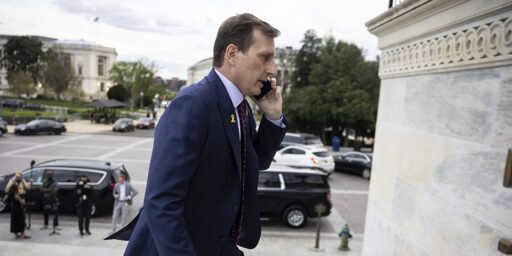
The House was debating a powerful National Security Agency spying program when Rep. Dan Goldman, D-N.Y., rose to side against privacy hawks.
The spring 2024 debate was over forcing the feds to get a warrant to search foreign communications for intelligence on Americans. Doing so would cost crucial time, Goldman said, citing his own tenure as a federal prosecutor.
“I can say with confidence that requiring a warrant would render this program unusable.”
“Based on that experience, I can say with confidence that requiring a warrant would render this program unusable and entirely worthless,” he said last year. “Even if it were possible, the time required to obtain a search warrant from a judge would frequently fail to meet the urgency posed by a terrorist or other national security threat.”
Goldman’s argument won the day.
Progressives had been rallying around the warrants provision but, under heavy pressure from the Biden administration, enough of them retracted their support and sided with Democrats like Goldman to doom the measure. It lost by a single vote.
With his election victory last November, Donald Trump would inherit the warrantless surveillance powers.
[
Related
Trump Might Get Unfettered Surveillance Powers. How Did We Get Here?](https://theintercept.com/2024/11/05/trump-surveillance-power/)
The April 2024 vote still stings for civil liberties advocates, who thought they could count on progressives as they sought to build a bipartisan coalition with libertarian-minded Republicans. Now they are girding for another battle next April, when the Foreign Intelligence Surveillance Act, or FISA, is up for reauthorization.
The vote will happen in the middle of a primary season where many incumbents — including Goldman — are trying to burnish their progressive bona fides as they face challenges from the left. Already, some Democrats on a key committee are citing the Trump administration’s approach to privacy to explain their renewed support for a warrant provision.
Whether enough of them flip back could decide the future of one of the most controversial post-September 11 spying programs.
In a statement to The Intercept, Goldman did not commit to supporting a warrant requirement.
“Donald Trump’s blatant weaponization of the federal government makes accounting for potential abuses of power critically important,” Goldman said. “As we work through the FISA reauthorization process next year, I will be especially focused on those concerns, as I have been since Trump took office in January.”
Tie Goes to the Spy
The vote last year capped a monthslong period of intense lobbying pitting the Biden administration against privacy advocates.
Congress passed Section 702 of the Foreign Intelligence Surveillance Act in 2008 to give its legal blessing to a massive spying program the administration of George W. Bush had already launched without authorization.
[
Related
Episode Five: What Fourth Amendment?](https://theintercept.com/2025/11/05/collateral-damage-episode-five-fourth-amendment/)
Under the law, the government was allowed to search through reams of surveillance conducted abroad for information on U.S. citizens and permanent residents. The Fourth Amendment did not apply, supporters of the law said, because those communications had been collected from wiretaps and hacks directed abroad by the cyber spies of the NSA.
Critics said that even surveillance directed abroad inevitably hoovers up the emails and text messages of Americans. The FBI, for example, conducted 200,000 “backdoor searches” of American communications in 2022 alone.
In a series of reauthorization battles, civil liberties advocates have squared off against administrations from both parties trying to force government agencies, including the FBI, to get a warrant before they rooted through foreign surveillance for information on Americans.
Advocates have won some procedural reforms but, on the biggest question of a warrant, they have fallen short every time. Last year, the House voted 212–212 on an amendment offered by a conservative Republican that would have added a warrant requirement. Under House rules, a tied vote fails.
The party breakdown showed how much surveillance scrambles typical partisan divides. Eighty-four Democrats and 128 Republicans voted for a warrant requirement, compared to 126 Democrats and 86 Republicans opposed.
Numerous Democrats flipped their vote at the last minute under heavy lobbying from the Biden administration, which took a traditional, centrist view of the need for expansive spying powers to ward off terrorists and other foreign foes.
“Pretty much every single person in the Biden administration was lobbying pretty hard.”
“It was top-to-bottom — pretty much every single person in the Biden administration was lobbying pretty hard,” said Kia Hamadanchy, a senior policy counsel for the American Civil Liberties Union. “There was a lot of fearmongering, which I don’t think was substantiated.”
Supporters of the Biden administration offered some cover to the lawmakers who switched their way by including modest, procedural reforms in the legislation.
The last-minute flippers included several members of the House Judiciary Committee, which traditionally has favored privacy protections more than members of the Intelligence Committee, who have overlapping jurisdiction over foreign surveillance.
It was hardly surprising that Democrats buckled under pressure from the Biden administration, but it was shortsighted, civil liberties advocates say.
[
Related
Top Senator Warns Sweeping New Surveillance Powers Will “Inevitably Be Misused” by Trump](https://theintercept.com/2024/12/18/trump-fisa-surveillance-spying/)
“In 2024, it was already clear that Donald Trump and the people around him might well return to power,” said Sean Vitka, executive director of the progressive group Demand Progress. “Some Democrats refused to install guardrails when they had the chance.”
Even worse from the perspective of civil liberties advocates, many Democrats voted to further expand the foreign spying law with a new provision that would allow the government to force “electronic communication service providers” — including, potentially, nonprofits, political campaigns, or news organizations — to help it spy.
Sen. Ron Wyden, D-Ore., warned that that power will “inevitably be misused.”
House Judiciary Firms Up
With Trump in the White House, some of the Democrats who voted against a warrant provision seem to be warming up to the idea, according to their comments at a recent House Judiciary Committee hearing on FISA reform.
Several Democrats who advocates were counting on last time — including now-ranking member Rep. Jamie Raskin, D-Md., who eventually voted against the warrant requirement — spoke in favor of passing further reforms next year.
Democrats at the hearing put the Section 702 program, named for the law that gives the surveillance power, in the larger context of the Trump administration’s erasure of privacy safeguards, including efforts to combine previously siloed Social Security, IRS, and student loan databases.
“In 2025, we no longer have to wonder if we were right to worry.”
They also pointed out that, when it came to Section 702, Trump has gutted the Privacy and Civil Liberties Oversight Board, and FBI Director Kash Patel has eliminated an office tasked with auditing the FBI’s use of the surveillance program.
Raskin said the results of a two-year “experiment” with modest FISA reforms have been “alarming.”
“For years, the leaders of this committee have warned of how executive branch surveillance powers could be abused by a president who didn’t care about protecting civil liberties, who used cutting-edge technology to spy on Americans, and who ignored basic principles of due process and constitutional freedom to achieve their own ends,” he said. “In 2025, we no longer have to wonder if we were right to worry.”
Rep. Jared Moskowitz, D-Fla., voted against a warrant requirement last year but spoke in broad favor of reforms at the hearing. His office did not comment on whether that includes a warrant requirement.
Moskowitz’s primary challenger Oliver Larkin, a member of the Democratic Socialists of America, said in a statement that he supports forcing the government to get a warrant.
“Rep. Moskowitz has put civil society, political opponents, minority and undocumented communities, and journalists at risk of the Trump administration’s privacy abuses and political targeting of dissent,” Larkin said.
Another Judiciary Committee member who voted against a warrant requirement, Rep. Steve Cohen, D-Tenn., did not respond to a request for comment. His left-leaning primary challenger, Tennessee state Rep. Justin J. Pearson, said in a statement that he supports a warrant provision.
“Democrats should be opposed to warrantless government surveillance no matter which party the president represents,” he said. “It should not have taken Donald Trump’s second election for some members of our party to finally stand up for their constituents’ basic civil liberties.”
Will GOP Cave?
The problem for civil liberties advocates going into the April reauthorization is that they now face losing some of the Republicans who rallied to their side the last time.
“People tend to be more skeptical about executive authority when the president is a president from the different party,” Hamadanchy said.
They are also unclear on two key questions: Just how many Democrats will flip back, and where Trump will land on the issue.
Some Democrats seem to be holding firm on their opposition to a warrant requirement despite challenges from the left. During an April committee hearing, Goldman said the FISA debate “pales in comparison” to the privacy violations being committed under the auspices of Elon Musk’s so-called Department of Government Efficiency.
Goldman, who is positioning himself as a progressive in his primary race, citing his support for the Green New Deal and Medicare for All, is facing a challenge from New York City Comptroller Brad Lander.
“Brad would vote to add a warrant requirement,” said a spokesperson for the Lander campaign. “The Trump administration’s abuse of power has highlighted the need for stronger 4th Amendment protections and now more than ever the House should take action to protect people’s privacy.”
Lander’s entry into New York’s 10th Congressional District race gives civil liberties advocates a vessel to challenge Goldman on the issue. Another Democrat who spoke on the House floor against the warrant requirement, Rep. Jim Himes, D-Conn., has not drawn a primary challenger yet.
Trump is a bigger enigma. In 2018, his first administration opposed a warrant requirement, but last year he briefly urged Republicans to “KILL FISA” — apparently because he confused the 702 surveillance program with another that was used to spy on an adviser to his 2016 presidential campaign.
In support of the current law, surveillance hawks will likely cite the findings of a recent report from the Justice Department’s Office of the Inspector General.
Based on internal oversight reports from the DOJ’s National Security Division, the inspector general said, “it appears that the FBI is no longer engaging in the widespread noncompliant querying of U.S. persons that was pervasive just a few years ago.”
The report came with a crucial caveat. The inspector general relied on the FBI’s audits rather than conducting its own reviews of agents’ searches. The April 2024 to April 2025 period the report covered also meant that it tracked only a few weeks of Patel’s tenure.
The post Dan Goldman Supported Warrantless Spying on Americans. Now His Primary Opponent Is Hitting Him for It. appeared first on The Intercept.
From The Intercept via This RSS Feed.