

The Twenty-Second Art Bulletin (December 2025)
⏵ Listen to Santo José Gregorio - Daniel Santos
Listen to ‘Santo José Gregorio’ by Daniel Santos.
If you enter a typical Venezuelan home, you’ll likely encounter a portrait or small statue of a distinctive, slender man in a black suit and hat, with a neat moustache, hands clasped behind his back, and a candle glowing beside him. Known affectionately as ‘The Doctor of the Poor’ and ‘The People’s Saint’, Saint José Gregorio Hernández (1864–1919) is not only a figure of Catholic devotion but one of the most recognisable images in Venezuelan popular culture, especially among the working class, who have long turned to him for healing and protection. In recent years, and particularly amid the Trump administration’s escalated attacks on Venezuela, this popular saint has taken on a new meaning.
Over a century after his death, Hernández’s canonisation by the Vatican on 19 October 2025 coincided with a new wave of imperialist aggression against Venezuela. In March 2025, the Trump administration invoked the Alien Enemies Act to target supposed members of Tren de Aragua as ‘alien enemies’, alleging – without presenting any evidence – that Venezuelan migrants in the United States had ties to the gang. Earlier that same month, around 250 Venezuelan migrants were deported to Salvadoran President Nayib Bukele’s Terrorism Confinement Centre (CECOT), a mega-prison condemned by human rights organisations for its concentration-camp-like conditions. Then, in late August 2025, the US began amassing the largest military deployment in the Caribbean since the October Crisis of 1962 (known in the West as the Cuban Missile Crisis). In the months since, the US has carried out a series of illegal strikes on small boats in waters off Venezuela that have killed more than eighty people. In this context, many Venezuelans have further embraced Saint José Gregorio as a symbol of their country’s steadfast capacity to overcome these great challenges.
Though he was not an artist, the significance of Saint José Gregorio for us lies in how a people under siege have made a religious figure into a symbol of popular devotion and national resistance. Today, representations of Saint José Gregorio are no longer confined to churches and the homes of devotees but appear on murals and billboards across the country and in the prints and figurines sold by street vendors, weaving his image into everyday life.
A Life in Service of the People
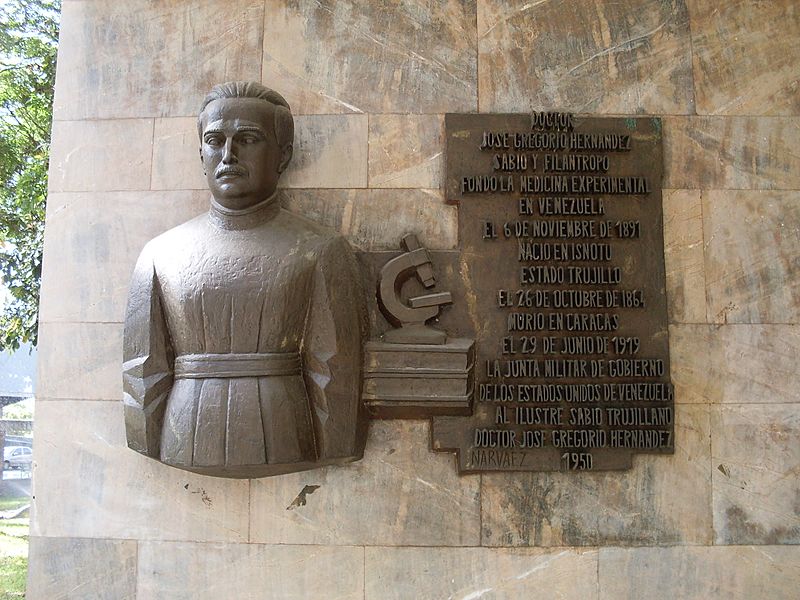
Sculpture by Francisco Narváez in honour of Saint José Gregorio Hernández, Central University of Venezuela, 1950.
José Gregorio Hernández Cisneros was born in 1864 in the small town of Isnotú, nestled in the Venezuelan Andes, just as the country was emerging from the devastation of the Federal War and refounding itself as the United States of Venezuela under a fragile federal constitution. One of seven children, he was the son of a pharmaceutical and livestock salesman and a housekeeper. From a young age, Hernández demonstrated exceptional intellectual promise. By the time he graduated as a medical doctor in 1888 – in the early years of the liberal modernising project that followed the long dictatorship of Antonio Guzmán Blanco – he had mastered English, French, Portuguese, German, and Italian, and had a working knowledge of Hebrew. Hernández had also studied philosophy, music, and theology at a time when the Venezuelan state was expanding secular education while negotiating its fraught relationship with the Catholic Church.
After graduating in 1888, Hernández briefly practised in Caracas, sharing a small room in La Pastora that served at once as bedroom, surgery, and even a makeshift tailor’s shop, and often giving his own meals to the neighbourhood’s poor. When his mentor, Dr Santos Dominici, offered to help him set up a proper consulting room in the capital, Hernández refused, saying that he wished to return to his native Isnotú. ‘One day, my own mother asked me to return to alleviate the pains of the humble peoples of our land. Now that I am a doctor, I realise that my place is there amongst my own’, Hernández told Dr Dominici. That August, he undertook the long, uncomfortable journey back to the Andes – travelling by boat from La Guaira along the coast and through Curaçao, across Lake Maracaibo to La Ceiba, then by mule into the interior – to work as a rural doctor. In letters from this period, he described caring for patients suffering from dysentery, asthma, tuberculosis, and rheumatism and struggling against the deeply entrenched superstitions that complicated people’s trust in medical treatment.
Hernández’s exceptional skill as a doctor and dedication to the people did not go unnoticed. While he was still searching for a place to establish his practice in the Andes, a decree by President Juan Pablo Rojas Paúl created the new Vargas Hospital in Caracas and authorised the state to send a young Venezuelan doctor of ‘good conduct and recognised aptitude’ to Paris to study the latest experimental sciences – microscopy, bacteriology, histology, and experimental physiology – and then return to modernise medical education at home. Hernández was chosen for this mission. In 1889 he travelled to France and worked in the laboratory of the eminent histologist Mathias Duval. Hernández returned home, bringing some of the first microscopes to the country, and became one of the pioneers of modern scientific medicine in Venezuela, especially in the fields of bacteriology and histology.
Alongside his scientific achievements, Hernández twice sought to join the priesthood, in 1908 and again in 1912. However, his own frail health kept him from completing his studies both times. He continued practising medicine, gaining widespread fame in Caracas for his selfless care for the poor, often covering the cost of his patients’ treatment himself. He also played a critical role tending to patients when the devastating Spanish flu pandemic ravaged the country in 1918, which claimed over 25,000 lives (around one per cent of the population).
On 29 June 1919, Hernández died tragically after being struck by a car. His life of selfless service and religious devotion, combined with his sudden death, immediately transformed him into a people’s saint whose significance for popular religion soon transcended Venezuela’s borders. Long before the Vatican deemed him a saint, the people had already canonised Saint José Gregorio.
The Splendour of Being
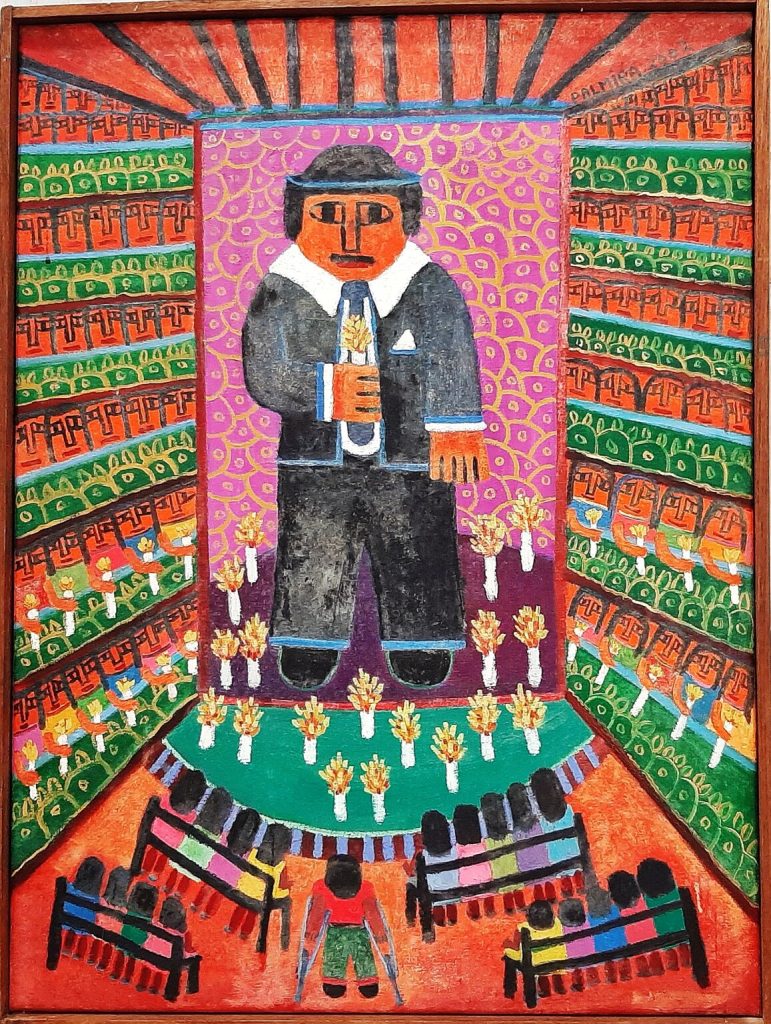
Palmira Correa, José Gregorio Hernández, n.d.
While primarily a physician, Saint José Gregorio also engaged with philosophy, developing a profoundly humanistic view of art that refused to separate beauty from ethics. In a society marked by liberal oligarchic power, latifundista (landowning) culture, and the uneven advance of capitalism, he treated aesthetics not as escape but as a question of how human dignity is defended and enlarged.
For Saint José Gregorio, beauty was the ‘esplendor del ser’ (splendour of being), which can only be given material form through actions oriented toward the good. In other words, beauty – as ethics – is not only something to behold but something to do in the world.
In 1912 he wrote the prose essay ‘Visión de arte’ (Vision of Art), which culminates in the narrator’s exalted reaction to a scene in which Christ performs the Miracle of the Loaves and Fishes. The essay was originally published alongside a reproduction of Arturo Michelena’s monumental La multiplicación de los panes y los peces (The Multiplication of the Loaves and Fishes, 1897), painted for the Basílica Menor de Santa Capilla in Caracas. In Michelena’s work, the miracle unfolds amid a gathering storm by the water, framed by palm trees, as people distribute food among themselves while Christ stands at the centre. This image grounds Hernández’s aesthetic ideal not in detached classical theory, but in the highest form of divine compassion and justice extended to those in need. Read through his understanding of aesthetic beauty as ethical action, the scene becomes an argument for social justice as splendour: beauty is realised when the hungry are fed, scarcity is answered by shared provision, and compassion takes material form among ordinary people. Splendour, then, is not confined to the canvas or the chapel. It is realised in acts of collective dignity – often forged amid turbulence, when the demand for it becomes most urgent.
A People’s Saint in Art and Culture

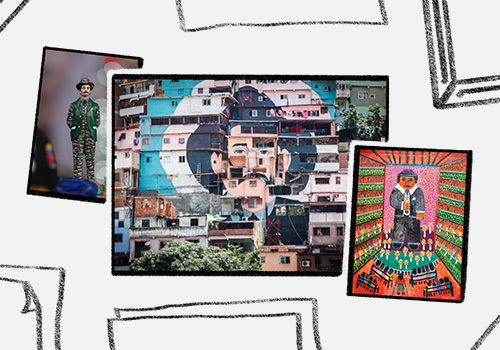
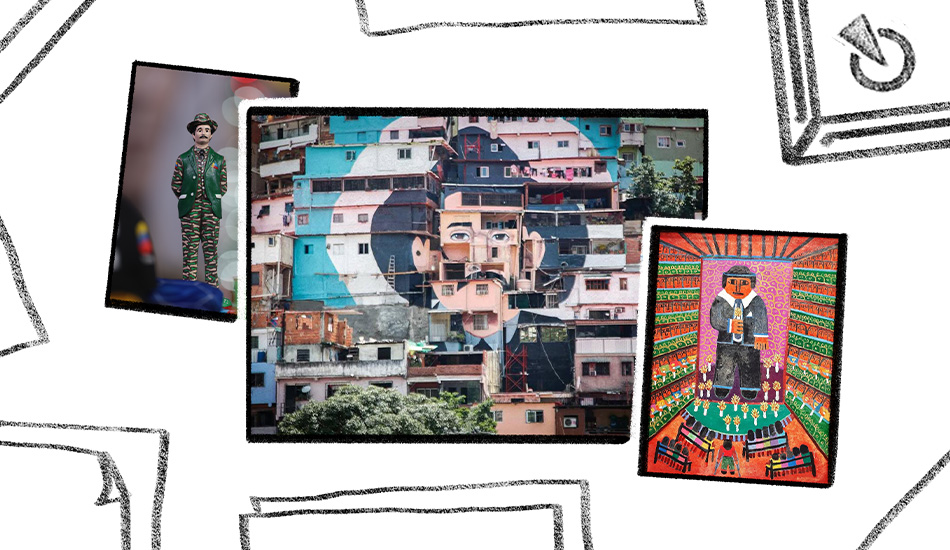
Mural of Saint José Gregorio Hernández by artist @hamktrazos, 2025. Photo: Daniel Hernández García.
The veneration of Hernández was, from the beginning, a grassroots phenomenon. While the intellectual elite also mourned his passing, it was the artisans, industrial workers, small business owners, and domestic workers who, in gratitude for his service and in awe of his piety, transformed him into a popular saint.
Newspapers reported that at his 1919 burial the crowds were so large that they prevented the motorcade from reaching the cemetery in Caracas. Some people insisted on carrying his coffin themselves, while others dropped flowers from their balconies as humble offerings. Tributes at his grave quickly turned into pilgrimages, with people travelling long distances to his grave site seeking improved health through his intercession. Belief in his power to perform miracles spread rapidly – stories of prayers answered and of dreams in which he appeared performing intricate medical operations on the sick. By the 1970s, the sheer number of candles burning near his tomb posed a fire hazard, and in 1975 his remains were moved to a church in central Caracas.
Hernández’s status as a popular saint was so immense that it transcended institutional opposition. In 1957, renowned Puerto Rican nationalist and singer Daniel Santos, known as a voice of the Caribbean working class, recorded the bolero ‘Santo José Gregorio’. In response, the Catholic Church pressured the dictatorship of Marcos Pérez Jiménez to ban the song in Venezuela because the Vatican had not yet approved Hernández’s canonisation. Yet the song continued to circulate, a reminder that popular devotion and culture move faster than ecclesiastical approval.
Moreover, Hernández was incorporated into Venezuela’s largest popular spiritual movement, the syncretic devotion to María Lionza. He became a figure in one of the movement’s spiritual ‘courts’ – revered groups of spirits recognised for specific attributes – and was especially venerated for his healing. In neighbouring countries like Colombia, there is even a self-proclaimed congregation of gregorianos (followers of José Gregorio) who perform rituals in his name. These associations with spiritism and the esoteric world delayed his formal recognition by the Church. In October, President Nicolás Maduro even publicly criticised Church authorities, including Venezuelan Cardinal Baltazar Porras, for trying to obstruct the process. In the end, however, popular fervour prevailed.
Today, as imperialist aggression has intensified against Venezuela, Saint José Gregorio has arguably become one of the most represented figures in Venezuelan popular art, second only to the national hero Simón Bolívar. Weeks before he was canonised, hundreds of murals, graffiti, and sculptures of Hernández appeared throughout the country. Countless everyday artists and artisans created images of him, alongside works by famous sculptors and painters like Francisco Narváez, Marisol Escobar, and Alirio Palacios, further cementing his place in the national consciousness. Once a religious symbol of solidarity with the poor and the sick, Saint José Gregorio has become an expression of national pride, unity, and a people’s stubborn insistence on their own dignity in the face of imperialist aggression.
A Saint in Times of Peace and War
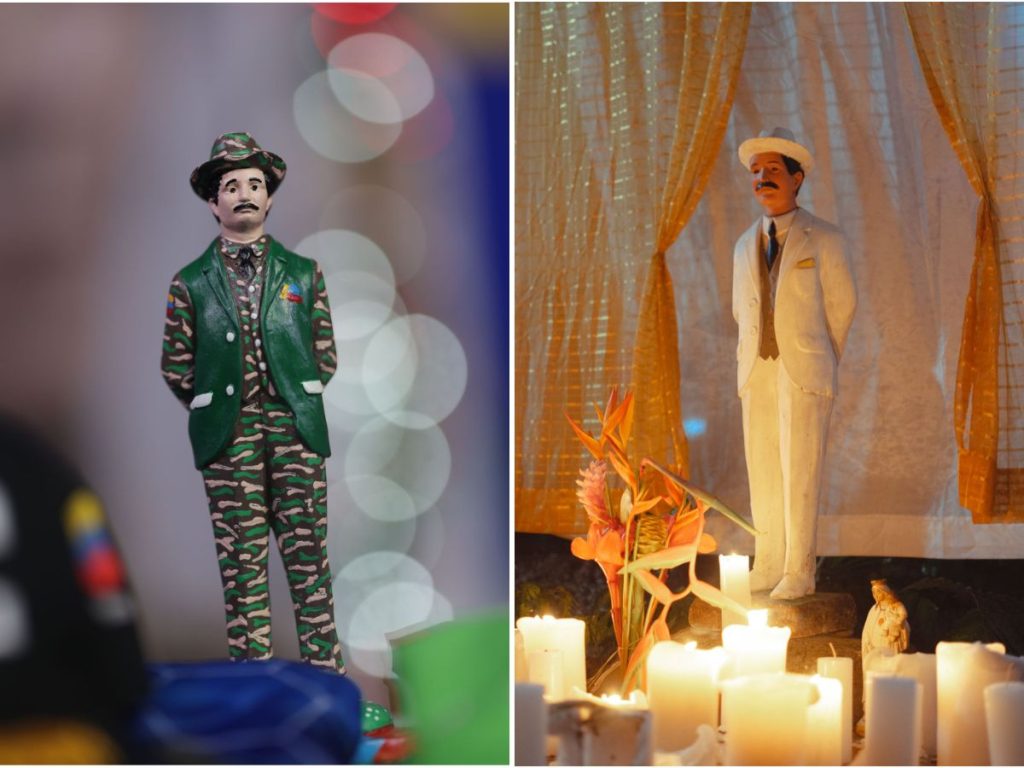
Left: Rosana Silva, Goyito Miliciano, 2025; Right: Giuliano Salvatore, José Gregorio Hernández, 2024.
Saint José Gregorio is often regarded as a man of peace, a notion fuelled not only by his pious life but also by the fact that his death coincided with the signing of the Treaty of Versailles on 28 June 1919, which ended World War I. Among his devotees, this coincidence is not accidental but providential: many believe that he consciously offered his life as an act of intercession to bring the war to an end. However, the saint’s actions during his life reveal not only a commitment to peace but also a profound commitment to national sovereignty. In 1902, when Britain, Germany, and Italy imposed a naval blockade on Venezuela to demand payment for foreign debt – an early example of the sort of gunboat diplomacy we are seeing today – President Cipriano Castro called on all citizens to unite and defend the homeland. According to historian Miguel Yaber, Saint José Gregorio was the first man to enlist for the militias in his local recruitment office, answering the call to take up arms to defend his country.
Perhaps today – as Venezuela once again faces an imperialist siege, with over eight million Venezuelans voluntarily joining the popular militias to defend the nation’s sovereignty – Saint José Gregorio still has a message for his people: sometimes we must fight to defend life and guarantee peace. The same image that once stood for quiet devotion now looks out from barrio walls and banners as a collective declaration that the Venezuelan people will not surrender.
From | Tricontinental: Institute for Social Research via This RSS Feed.