

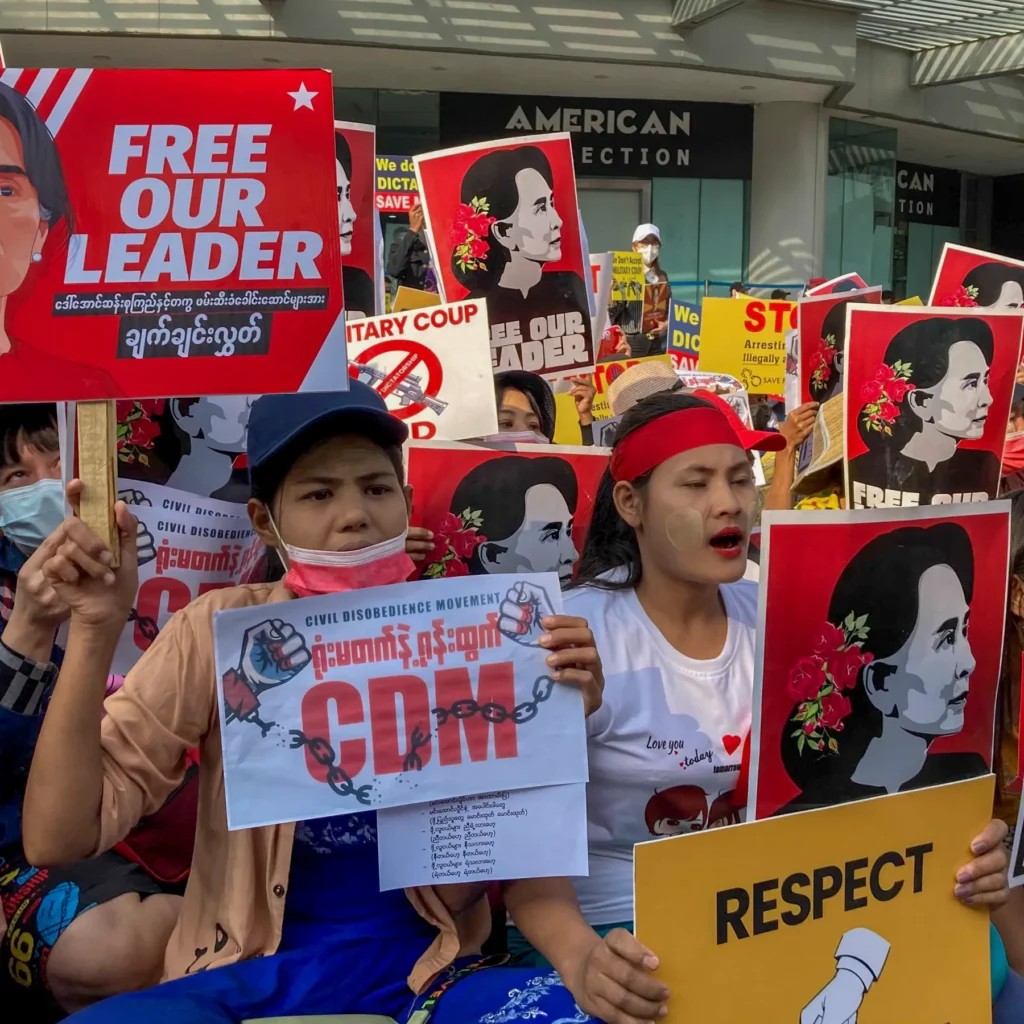
Myanmar civil war elections 2025 unfold as the military seeks legitimacy while reclaiming territory—fueled by Chinese diplomacy and conscription amid ongoing humanitarian crisis.
Related: 50,000 Kilometers Achieved: China High-Speed Rail Expansion Reshapes Global Transport Leadership
As voting began in parts of Myanmar on Sunday, December 28, 2025, a stark contradiction defined the day: a national election held in the midst of a brutal civil war. Dubbed a “sham” by the United Nations and Western governments, the Myanmar civil war elections 2025 are widely seen as an attempt by the military junta to legitimize its rule nearly five years after overthrowing the democratically elected government of Nobel laureate Aung San Suu Kyi.
The multi-phase vote is taking place in a country fractured by violence. Of Myanmar’s 330 townships, 56 have canceled elections entirely, while others—like those in central Sagaing—will hold voting in staggered rounds through January 2026. In many conflict zones, there are no campaign posters, no voter registration drives, and no public discussion of the ballot. Instead, residents report burned villages, aerial bombardments, and troop deployments—all, they say, coordinated to clear areas for a facade of electoral normalcy.
“People here have no interest in this election,” said Esther J., a journalist in Sagaing. “They do not want the military. They want the revolutionary forces to win.”
According to UN and monitoring groups, the post-coup conflict has claimed 90,000 lives and displaced 3.5 million people, with nearly half of Myanmar’s 55 million citizens now requiring humanitarian aid. Against this backdrop, the military-backed Union Solidarity and Development Party (USDP)—which has registered the most candidates—is poised to form a new government, while Aung San Suu Kyi’s National League for Democracy (NLD) remains dissolved, and its leader is held incommunicado.
Myanmar Civil War Elections 2025: A Resurgent Military and Chinese Mediation
What makes this election unusually consequential is the shifting battlefield dynamics. After suffering major defeats in 2023–2024—including the loss of Lashio and near-collapse in Rakhine State—the military has regained momentum in 2025, largely due to two factors: mass conscription and Chinese diplomatic intervention.
In February 2024, the junta announced mandatory military service, a move that has since recruited an estimated 70,000 to 80,000 new soldiers. Many are young men driven by economic despair and political polarization, now serving as snipers and drone operators. According to Min Zaw Oo of the Myanmar Institute for Peace and Security, “The conscription drive has been unexpectedly effective,” and the military’s drone units now outmatch those of rebel groups.
Read ACLED’s December 2025 briefing on Myanmar conflict trends
Simultaneously, China has played a decisive role in halting rebel advances. In April 2025, Beijing brokered a deal for the Myanmar National Democratic Alliance Army (MNDAA) to withdraw from Lashio without resistance. Later, it pressured the Ta’ang National Liberation Army (TNLA) to abandon gold-mining towns like Mogok. Analysts say China also induced the United Wa State Army—Myanmar’s most powerful ethnic militia—to cut off weapons supplies to other rebel factions, triggering nationwide ammunition shortages.
“China doesn’t love the junta, but it fears state collapse on its border,” explained Einar Tangen, a Beijing-based analyst. The China-Myanmar Economic Corridor, a flagship Belt and Road project linking Yunnan Province to a deep-sea port on the Indian Ocean, remains vulnerable to conflict. Stability—not democracy—is Beijing’s priority.
Explore the International Crisis Group’s analysis on China’s Myanmar strategy
This geopolitical calculus has shifted China’s posture. After initially refusing to recognize coup leader Min Aung Hlaing, President Xi Jinping met him twice in 2025, affirming support for “restoring stability” and “unifying domestic political forces.” Russia and India have similarly backed the election process, creating a non-Western bloc that legitimizes the junta—even as the U.S. and EU denounce it.
Geopolitical Context: A Fragmented Opposition and the Illusion of Legitimacy
Despite recent territorial gains, the military’s control remains fragile and superficial. According to the Institute for Strategy and Policy – Myanmar, the junta has recovered only 11.3% of lost territory in northern Shan State. In Rakhine, the Arakan Army continues its eastward push, threatening military industrial zones. In Kachin, the battle for Bhamo rages into its second year. And along the Thai border, rebel groups have captured strategic positions.
ACLED data confirms that while air and drone strikes by the military have increased by 30% in 2025—killing nearly 2,000 civilians—these tactics do not equate to governance. “The military remains in a weakened position compared to pre-2021,” noted ACLED analyst Su Mon. “It cannot assert effective control over areas it has retaken.”
Moreover, the opposition remains deeply fragmented. The “Three Brotherhood Alliance” that launched the game-changing Operation 1027 in late 2023 is now fracturing, with ethnic armed organizations distancing themselves from post-coup People’s Defence Forces (PDFs). “Relationships between these groups are deteriorating,” said Morgan Michaels of the International Institute for Strategic Studies.
Review UN Human Rights Council reports on Myanmar’s humanitarian emergency
This disunity, combined with Western disengagement—marked by U.S. aid cuts and revoked visa protections—leaves the opposition without a coherent international strategy. Meanwhile, the junta leverages its limited victories to project strength and proceed with elections it hopes will grant it diplomatic cover.
Yet few believe the vote will alter the war’s trajectory. “The election won’t affect the conflict to any appreciable extent,” said Yangon-based analyst Khin Zaw Win. “The military may even be deluded into thinking it can achieve total victory.”
The real wildcard remains China. While it has helped the junta regain ground, its endgame appears to be a negotiated settlement, not perpetual war. “China expects a payoff,” Win noted. “It doesn’t want a protracted conflict that harms its strategic interests.”
As ballots are cast in garrisoned towns and rebel-held villages watch from the shadows, one truth is clear: Myanmar’s civil war will not be decided at the ballot box—but on the battlefield, in Beijing’s corridors of power, and in the resilience of a people who refuse to surrender their future to generals.
Humanitarian Crisis Deepens as Elections Proceed
While the military stages elections in select townships, millions of displaced civilians face worsening conditions in makeshift camps along Myanmar’s borders with Thailand, India, and Bangladesh. Humanitarian access remains severely restricted, with the junta blocking aid convoys to opposition-held areas under the pretext of “security concerns.”
According to the UN Office for the Coordination of Humanitarian Affairs (OCHA), over 1.2 million internally displaced persons (IDPs) have been cut off from food, medicine, and winter supplies in the past three months alone. In northern Shan and western Rakhine, local civil society groups report outbreaks of cholera and malnutrition among children, exacerbated by the destruction of clinics during military offensives.
“The election is a distraction from the real emergency,” said Naw Htoo, a medic with a Karen-led aid network operating near the Thai border. “People aren’t thinking about ballots—they’re thinking about where their next meal will come from.”
International donors, already strained by global crises in Gaza and Sudan, have reduced funding for Myanmar by 37% in 2025, further crippling relief efforts. Meanwhile, the junta continues to divert humanitarian resources to military-controlled zones, using aid distribution as a tool of political control in areas where voting is being held.
Read OCHA’s latest Myanmar Humanitarian Needs Overview (December 2025)
Youth Resistance and the Rise of the “Silent Vote”
Beyond the battlefield and the ballot box, a quieter but equally powerful form of resistance is growing among Myanmar’s youth. In urban centers like Yangon and Mandalay—where elections are proceeding under heavy surveillance—students, artists, and tech activists are organizing a “silent vote” campaign: a mass boycott paired with digital civil disobedience.
Using encrypted apps and underground radio networks, young organizers urge citizens to stay home on election day and instead display white ribbons—a symbol of mourning for democracy—on balconies and social media. “We don’t recognize this election,” said Thet, a 22-year-old engineering student who asked to be identified only by his first name. “Our vote isn’t on paper. It’s in the streets, in the drones, in the songs we sing at night.”
This movement reflects a broader generational shift: while older political factions remain tied to pre-coup party structures, a new cohort sees liberation not through elections, but through decentralized revolution. Many have joined local People’s Defence Forces or support them through logistics, intelligence, and digital propaganda.
Critically, this youth-led resistance is transcending ethnic divides, with Bamar, Karen, Kachin, and Rakhine students collaborating in ways unseen in previous decades of conflict. “This war isn’t just about territory,” said Aye Min, a youth coordinator in Sagaing. “It’s about building a new Myanmar—one that never again trusts a general with a ballot.”
Explore the findings of the Myanmar Youth Forum on post-coup political identity (2025)
From teleSUR English via This RSS Feed.