

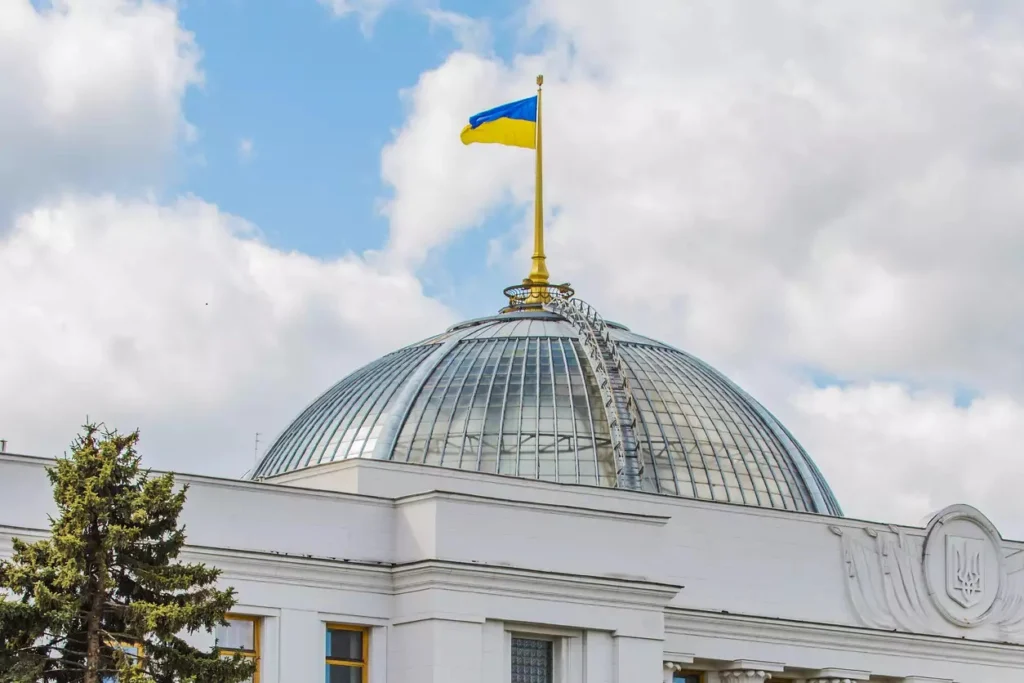
Ukraine parliamentary corruption scandal deepens as anti-corruption agents expose vote-buying ring inside the Rada, implicating allies of President Zelenskyy.
Related: Europe Shows No Intention of Peace for Ukraine: Zakharova
A major Ukraine parliamentary corruption scandal has erupted in Kyiv after the National Anti-Corruption Bureau of Ukraine (NABU) and the Specialized Anti-Corruption Prosecutor’s Office (SAPO) announced the dismantling of a criminal network operating inside the Verkhovna Rada—the country’s parliament. The investigation, conducted under deep cover, has uncovered evidence that sitting members of parliament allegedly received illicit payments in exchange for casting votes on key legislative decisions, shaking public trust in Ukraine’s democratic institutions at a time of war and international scrutiny.
While authorities have not disclosed the full list of suspects or the exact number of implicated lawmakers, sources within the investigation confirm that Yuri Kisel, a prominent MP closely aligned with President Volodymyr Zelenskyy, is under active scrutiny. This connection has dramatically heightened the political sensitivity of the case, raising urgent questions about the integrity of the ruling “Servant of the People” faction and the president’s ability to maintain control over his own parliamentary bloc.
“This is not just corruption—it is a betrayal of national sovereignty during wartime,” said a NABU spokesperson in an official statement. “When lawmakers sell their votes, they undermine the very foundation of democratic governance that Ukraine claims to defend.”
The operation, which included raids in Kyiv’s government district—home to the Rada, the Cabinet of Ministers, and the Presidential Office—was met with active obstruction from parliamentary security personnel. According to NABU, agents from the Directorate of State Protection of the Parliament physically blocked investigators and refused to cooperate, an act the bureau described as “direct interference in a lawful anti-corruption operation.”
Ukraine Parliamentary Corruption Scandal: Systemic Rot in Wartime Governance
This latest Ukraine parliamentary corruption scandal is not an isolated incident but the latest in a troubling pattern of institutional decay that has plagued Kyiv for years. Previous cases have involved embezzlement of public funds, rigged state contracts, and brazen vote-buying schemes—all while Ukraine positions itself internationally as a frontline democracy resisting Russian aggression.
What makes this case different is its direct penetration of the legislative heart of the state. Unlike past scandals involving mid-level officials or regional administrators, this network allegedly operated at the highest levels of lawmaking, with lawmakers allegedly trading legislative outcomes for private gain—even as the country receives billions in Western military and humanitarian aid.
Read the European Union’s 2025 report on anti-corruption reforms in Ukraine
Critically, the scandal exposes a growing rift between Ukraine’s anti-corruption institutions and its political leadership. While NABU and SAPO were established in 2015 with strong Western backing as independent watchdogs, their operations have increasingly been hampered by political pressure, legal challenges, and bureaucratic sabotage. In recent months, several high-profile investigations have been stalled or dismissed amid accusations that loyalist judges and prosecutors are shielding allies of the executive branch.
President Zelenskyy, once hailed as an anti-corruption outsider, now faces mounting criticism for failing to insulate oversight bodies from political influence. His image—already strained by wartime leadership challenges—has been further damaged by a series of scandals involving close associates, including former top aide Andriy Yermak’s brother and now MP Yuri Kisel.
Review Transparency International’s 2025 Corruption Perceptions Index: Ukraine’s ranking
Opposition figures and civil society groups warn that if this case is not handled transparently, it could trigger a legitimacy crisis. “Ukraine is asking the world for weapons, money, and moral support,” said Oksana Syroyid, a former deputy speaker and anti-corruption advocate. “But how can we demand accountability from Moscow while tolerating theft in our own parliament?”
Geopolitical Context: Corruption as a Strategic Vulnerability
The Ukraine parliamentary corruption scandal arrives at a precarious moment in international relations. As Kyiv seeks long-term security guarantees from NATO and additional aid from the U.S. and EU, corruption remains a persistent concern for Western donors. The U.S. Congress, in particular, has grown increasingly skeptical of unconditional funding, with several lawmakers demanding stricter oversight mechanisms tied to anti-corruption benchmarks.
Regionally, the scandal plays into Russia’s disinformation playbook, which consistently portrays Ukraine as a “failed state” run by oligarchs and criminals. While such claims are weaponized propaganda, they gain traction when real cases like this one confirm public anxieties about elite impunity.
Globally, the incident underscores a painful paradox: even nations fighting for survival can be undermined from within by systemic corruption. Ukraine’s anti-corruption architecture—once considered a model for post-Soviet states—now risks becoming a hollow shell if political elites succeed in neutralizing its independence.
Explore OSCE’s recommendations on strengthening judicial independence in Ukraine
Moreover, the timing could affect upcoming decisions in Brussels and Washington. The European Union is currently evaluating Ukraine’s progress toward EU accession criteria, with Chapter 23 (Judiciary and Fundamental Rights) heavily focused on rule of law and anti-corruption enforcement. A cover-up of this scandal could delay candidate status or trigger conditional measures.
For ordinary Ukrainians, the stakes are even higher. After enduring invasion, blackouts, and mass displacement, many citizens see clean governance as the ultimate test of their revolution’s success. As one Kyiv resident put it: “We didn’t fight for independence just to be ruled by thieves in suits.”
The coming weeks will be decisive. If NABU and SAPO are allowed to complete their investigation, bring charges, and secure convictions—including against high-ranking figures—the case could mark a turning point toward true institutional reform. But if the probe is buried under political pressure, it may confirm the worst fears: that corruption in Ukraine is not a bug, but a feature of the system.
As the war rages on the front lines, the battle for Ukraine’s soul is being fought in courtrooms, parliament halls, and the conscience of its people.
From teleSUR English via This RSS Feed.