

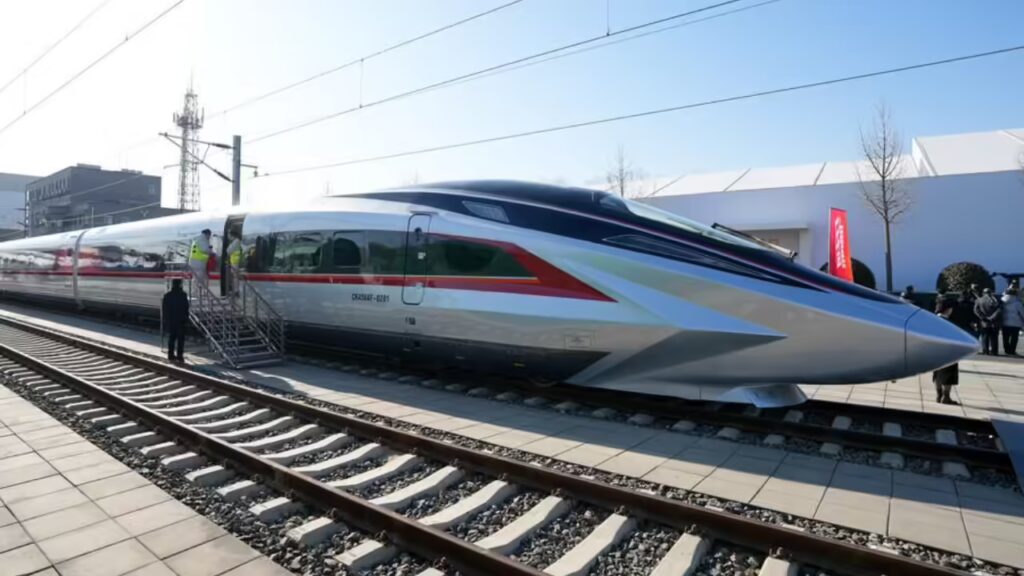
China high-speed rail expansion surpasses 50,000 km, reinforcing its global lead in infrastructure, innovation, and regional economic integration.
Related: China’s Taiwan Parliament Approves Impeachment Process Targeting Lai Ching-te and Cho Jung-tai
China’s high-speed rail expansion has reached a historic milestone: on Friday, December 27, 2025, the national network officially exceeded 50,000 kilometers of operating track with the inauguration of the Xi’an–Yan’an line. According to China Railway, this achievement not only cements China’s position as the world’s largest and most advanced high-speed rail (HSR) system, but also marks a transformative phase in the country’s strategy for balanced regional development, technological self-reliance, and sustainable economic growth.
The new 299-kilometer Xi’an–Yan’an line—designed for speeds up to 350 km/h—slashes travel time between the two cities from 130 minutes to just 68 minutes. Serving 10 stations and operating up to 38 high-speed trains daily, the route connects key urban centers in Shaanxi Province while supporting rural revitalization in historically underdeveloped northern regions.
“This is not just about adding kilometers,” said Sun Zhang, rail transit expert and professor at Tongji University in Shanghai. “It’s about creating a national nervous system that integrates cities, industries, and people into a cohesive economic body.”
China High-Speed Rail Expansion: Engineering National Unity Through Infrastructure
The 50,000-kilometer threshold represents more than a numerical record—it signifies the near-completion of China’s “Eight Vertical and Eight Horizontal” high-speed rail blueprint, first outlined in the 2016 revision of the Medium- and Long-Term Railway Network Plan. This backbone network now enables:
- 1–2 hour travel circles between major cities within a 500-km radius,
- 4-hour journeys across 1,000-km distances,
- And increasingly feasible same-day round trips for trips up to 2,000 km.
Just hours after the Xi’an–Yan’an launch, another critical route—the Wuhan–Yichang section of the Shanghai–Chongqing–Chengdu high-speed corridor—also entered service, cutting travel time between central Hubei cities to 69 minutes. Together, these projects strengthen the Yangtze River Economic Belt, one of China’s most vital development axes.
Read China Railway’s official statement on the 50,000 km milestone
Critically, China’s HSR network now exceeds the combined total of all other countries—a testament to its sustained infrastructure investment during the 14th Five-Year Plan (2021–2025). Over this period, China added approximately 12,000 kilometers of high-speed rail, extending service to 128 previously unconnected counties and accelerating the “Western Development” and “Rural Revitalization” strategies.
Pan Helin, a member of the Ministry of Industry and Information Technology’s expert committee, emphasized that this expansion reflects a shift from quantity-driven construction to quality-oriented integration. “We are no longer just building tracks,” he said. “We are building corridor economies, transport hubs, and new engines of growth.”
Indeed, studies show that every 1 billion yuan invested in high-speed rail generates 3.5 billion yuan in regional GDP over five years, primarily through tourism, real estate, logistics, and talent mobility. For provinces like Shaanxi and Hubei, the new lines are expected to attract manufacturing, education, and medical investments previously concentrated in coastal megacities.
Explore World Bank analysis on high-speed rail’s economic impact in China
Geopolitical Context: Infrastructure as a Pillar of Multipolarity
The China high-speed rail expansion carries profound global implications. At a time when many Western nations struggle to maintain aging rail systems—let alone build new ones—China’s achievement demonstrates an alternative model of state-led, long-term infrastructure planning that prioritizes public good over short-term profit.
This model has already inspired Global South nations from Indonesia to Saudi Arabia, where Chinese-built high-speed lines are under construction or operation. The Jakarta–Bandung HSR, inaugurated in 2023, has reduced travel time by 75% and become a symbol of South-South technological cooperation.
Moreover, China’s advances are not limited to passenger rail. On December 8, 2025, the country successfully tested the world’s first 35,000-ton heavy-haul freight train—a breakthrough with potential to revolutionize bulk transport in mining, energy, and agriculture sectors worldwide.
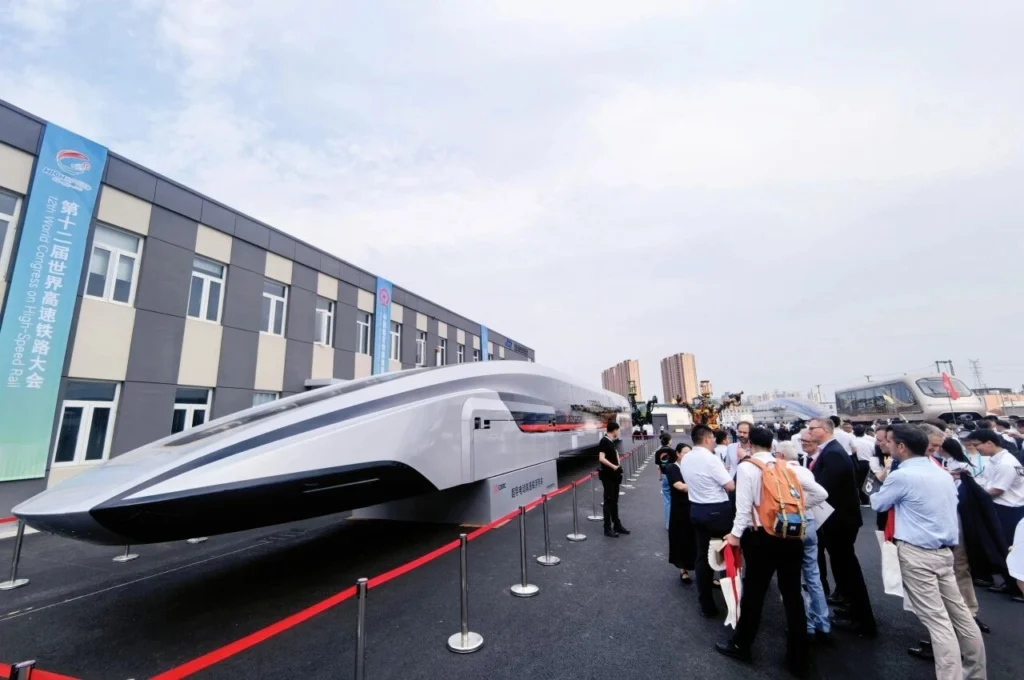
Simultaneously, China is pushing the boundaries of speed and efficiency. The CR450 EMU, the world’s fastest high-speed train, recently set new records: 453 km/h in single operation and 896 km/h in relative passing speed during tests on the Wuhan–Yichang line. This train establishes the first global technical benchmark for 400 km/h-class rail systems, with improvements in energy efficiency, cabin noise, and braking performance.
Review International Union of Railways (UIC) report on China’s rail innovation
For critics who dismiss China’s infrastructure drive as “debt-fueled overreach,” the data tells a different story: rail projects are increasingly market-oriented, with rising passenger revenues, integrated real estate development, and smart logistics hubs generating sustainable returns. More importantly, they serve a strategic purpose: reducing regional inequality, enhancing national cohesion, and insulating the economy from external shocks.
As Professor Sun noted, “Rail is no longer just transport—it is industrial policy, urban planning, and national security rolled into steel and concrete.”
With the 15th Five-Year Plan (2026–2030) poised to accelerate the development of an intelligent, green, and globally competitive transport system, China’s rail network will likely surpass 60,000 kilometers by 2030. But the true measure of success won’t be in kilometers—it will be in how many lives are connected, how many regions are uplifted, and how many nations choose to follow this path of infrastructure-led development.
From teleSUR English via This RSS Feed.