

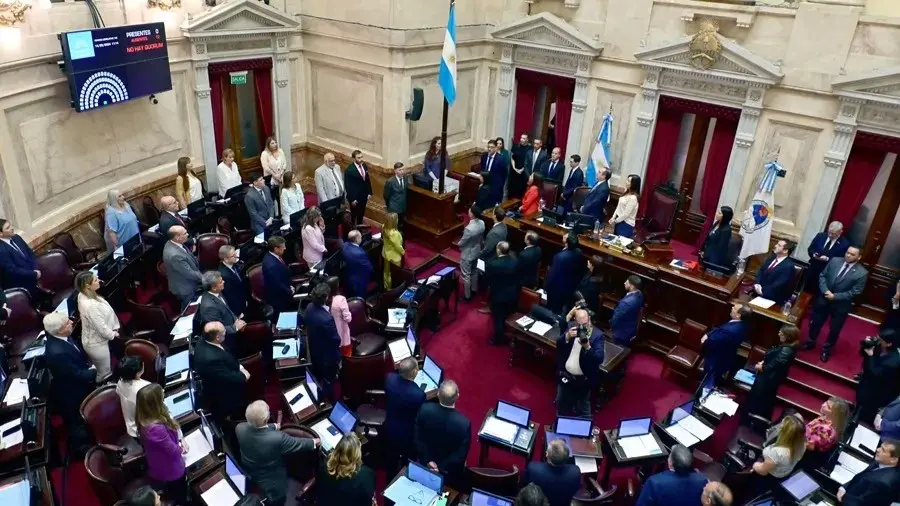
Argentina’s 2026 State Budget was approved by the Senate and will be enacted in the coming days, marking the first time President Javier Milei’s far-right administration has managed to pass a budget into law.
The vote resulted in 46 affirmative votes, 25 negative votes, and one abstention, reflecting complicity that extended beyond the ranks of the current government.
In order to secure a majority, the ruling party Freedom Moves Forward (LLA, in Spanish) seeked support from diverse blocs such as: Republican Proposal (PRO, in Spanish) and the Radical Civic Union (UCR, in Spanish), who largely backed the initiative; Federal Conviction, a Peronist faction that distanced itself from the leadership of the Justicialist bloc.
Con 46 votos afirmativos, 25 negativos y 1 abstención queda aprobado en general el proyecto de Ley de Presupuesto General de la Administración Nacional para el Ejercicio Fiscal 2026
— Senado Argentina (@SenadoArgentina) December 27, 2025
Text reads: “With 46 votes in favour, 25 against and 1 abstention, the law-project on the General Budget of the National Administration for fiscal year 2026 is approved.”
The 2026 Budget
The budget incorporates significant structural modifications that will cut State expenses.
The automatic indexation for family allowances and the Universal Child Allowance (AUH, in Spanish) is eliminated, effectively freezing these benefits despite ongoing inflation.
Meanwhile, the Feeding benefit—a supplement to the AUH consisting of cash transfers for food purchases—will experience a real-term decrease of 15.2% compared to the previous year. Similarly, funding for community kitchens will be cut by 28.9%.
The 2026 Budget allocates $7.7 trillion to the Education and Culture function -which encompasses all expenditures related to these areas, regardless of the jurisdiction responsible for them-. When adjusted for the inflation projected by the Government for 2026, this represents a real decrease of 1% compared to 2025, and a 47.7% drop relative to 2023 (the final year of the Everyone’s Front administration).
This law further scraps the progressive investment goal to reach 1% of GDP for science and technology, as it defunds the National Fund for Technical Schools.
Regarding pensioners, the minimum retirement benefit would fall by approximately 1%. A real-term decrease of 10.6% is also recorded in the funds allocated for disability pensions.
From teleSUR English via This RSS Feed.