

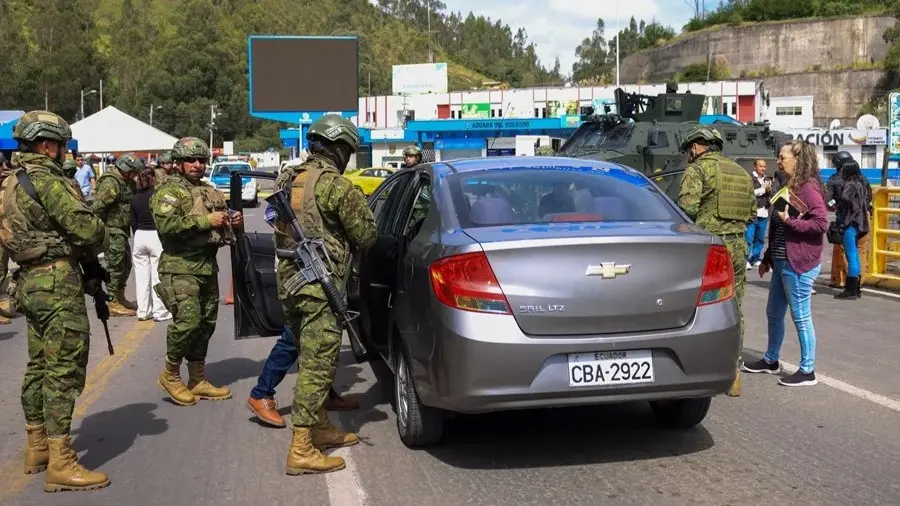
Ecuador has formally restricted access to several control points along its borders with Colombia and Peru, effective December 24, the Foreign Ministry announced in a statement. Under this new logistical framework, only two specific international corridors will remain operational for land transit.
At the northern border with Colombia, the crossing at Rumichaca, where the National Border Assistance Center operates, will be the only one authorized. Meanwhile, at the southern border with Peru, activity will be concentrated exclusively at the Binational Border Assistance Center (Cebaf, in Spanish) in Huaquillas and its respective international bridge.
RELATED: Nine Parties Submit Presidential Tickets for Peru’s 2026 Election
According to the Government, this action is part of a national security strategy aimed at centralizing the flow of people and goods under stricter surveillance in border areas.
The measure has been formally communicated to Bogota and Lima, emphasizing that any other crossing point is considered unauthorized as of the stipulated date.
The Ecuadorian Executive Branch stressed that this restructuring aims to guarantee internal order and optimize control resources in critical areas of the national territory.
A partir del 24 de diciembre Rumichaca y Huaquillas serán los únicos pasos internacionales en las fronteras norte y sur del país. pic.twitter.com/0DwfAW815m
— Cancillería del Ecuador 🇪🇨 (@CancilleriaEc) December 24, 2025
Text reads: “From December 24th, Rumichaca and Huaquillas will be the only international crossings on the northern and southern borders of the country.”
Peru’s Stance
In response to the measure, Peru’s Foreign Ministry reported that a communication channel is already open with its Ecuadorian counterparts to manage the implications of this partial closure. Lima’s objective is to establish joint protocols to mitigate the impact on border populations.
Similarly, the Peruvian government highlighted the need to strengthen binational operations to curb the activities of criminal groups operating in both territories. Peruvian diplomacy also emphasized the importance of controlling irregular migration through technical cooperation and respect for existing agreements.
In this regard, they reaffirmed their commitment to collaborate with the neighboring country’s authorities, prioritizing regional security and compliance with existing integration mechanisms.
Technical meetings are expected in the coming days to evaluate the flow of people at authorized points following this restriction. The situation at closed crossings will be monitored by each country’s security forces to prevent the use of illegal trails.
Meanwhile, travelers and heavy cargo transporters will have to adjust their routes according to the only two international crossings that remain in service.
From teleSUR English via This RSS Feed.