

Indigenous communities near the Uyuni salt flat urge prior consultation and impact studies.
Indigenous communities in southwestern Bolivia are asking President Rodrigo Paz to ensure that lithium extraction projects include environmental impact studies and prior consultation with local communities.
RELATED:
Bolivian Government Represses Protest Against Fuel Price Hike in La Paz
The demand is reflected in a draft bill prepared by authorities in the province of Nor Lipez, with the aim of becoming part of the projects and understanding “what awaits us over the next 10 years,” said Ivan Calcina, secretary of the Provincial Central Union of Indigenous Communities of Nor Lipez (CUPCONL).
“The most important points for us are free, prior, and informed consultation, as well as an environmental impact study, because we understand that previous laws did not stipulate this or addressed it only in general terms,” he said.
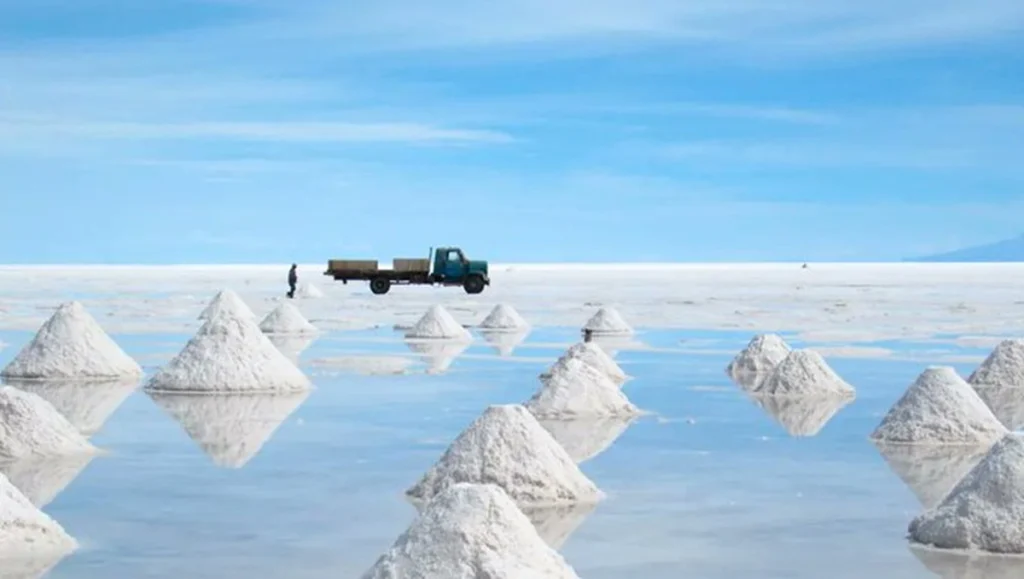
Currently, 14 Indigenous communities are located around the Uyuni salt flat, home to the country’s largest lithium deposit. They warn that lithium extraction and industrialization projects could cause serious damage to ecosystems and water sources.
“For the communities that live around the salt flat, that is their main concern. They want a hydrological study to be carried out, which will be important not only for the region but for all Bolivians,” Calcina said.
Bolivia has revealed the world’s largest battery reservoir: 23 million tonnes of lithium under Salar de Uyuni!
While this positions the nation for a green energy future, concerns over water scarcity & sustainability persist.
Can progress be balanced with eco-responsibility?… pic.twitter.com/PdtiWxf07S
— Critical Minerals Journal (@CritMinJrnl) December 24, 2025
Under the administration of President Luis Arce (2020–2025), Bolivia signed contracts with Chinese and Russian companies for the industrialization of lithium using direct lithium extraction technology. However, those projects lacked environmental impact studies.
Investments with the foreign firms were expected to reach US$2 billion but were put on hold due to strong objections to two of the contracts. In signing the agreements, Arce also did not carry out a process of prior consultation with Indigenous communities, as required under Bolivian law.
During Arce’s government, lithium reserves in Bolivia’s salt flats were estimated at 23 million tons, most of them in Uyuni, a 10,000-square-kilometer area that is also one of the country’s main tourist attractions.
In December 2023, a state-owned industrial complex was inaugurated there with an annual production capacity of 15,000 tons of lithium carbonate, operating with an evaporation pond system. However, it managed to operate at less than 20% of its capacity and suffered from design flaws. Located in the municipality of Colcha K, the industrial complex was built with an initial investment of US$96 million.
Before taking office on Nov. 8, Rodrigo Paz criticized previous governments for the lack of results in lithium extraction and industrialization. He also announced that his administration would work on the issue to deliver concrete solutions.
#FromTheSouth News Bits | Bolivia: The Prosecutor’s Office investigating an alleged embezzlement of the Indigenous fund has requested three months of preventive detention for former president Luis Arce. pic.twitter.com/1RbQafttUs
— teleSUR English (@telesurenglish) December 15, 2025
teleSUR/ JF
Source: EFE
From teleSUR English via This RSS Feed.