

Nearly $7 billion couldn’t keep President Donald Trump from returning to the White House and Republicans from controlling the House and Senate.
“It made me physically nauseous,” said Democratic congressional candidate Kat Abughazaleh, reflecting on the massive sums Democrats raised and spent on the 2024 presidential election, “thinking about how many people could be fed, or how many clinics could be funded, or how much student debt could be paid off.”
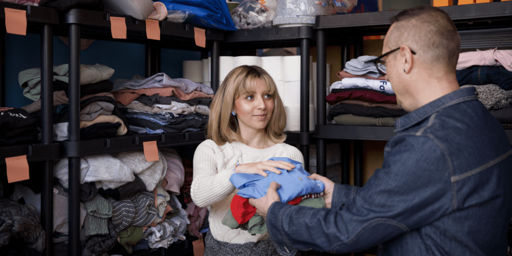
So after Abughazaleh announced her candidacy for a highly competitive primary in March, she transformed her campaign headquarters in Rogers Park — a lower-income neighborhood in Chicago’s North Side— into a mutual aid hub.
Situated at the front of her 9th Congressional District campaign office are rows of basics like diapers and winter clothes to medical supplies like Narcan. “We’ve also had people bring in stuff like nail polish,” said Abughazaleh, adding, “everyone deserves good things.” Anyone is welcome to come off the street, she explained, without checking for income or immigration status.
In addition to offering supplies while the office is open, the campaign also helps stock a community fridge available any time of day and hosts drives to collect specific supplies. A request for tampons for Chicago’s Period Collective, for example, resulted in a massive outpouring of support. “We ended up getting over 5,600, and my campaign manager’s car was just filled with tampons,” said Abughazaleh through laughter. “I wanted him to get pulled over so bad.”
The point here is to “show” the campaign’s values through providing for the community, rather than simply telling people why they should vote for me, said Abughazaleh.
“I can’t think of anything that would have made me be a Democrat faster … than people showing their values rather than just saying them.”
“I grew up Republican,” she said, “and I can’t think of anything that would have made me be a Democrat faster — especially if it were today, when people have lost all faith in the political system — than people showing their values rather than just saying them.”
Abughazaleh faces off against a competitive field to replace retiring Rep. Jan Schakowsky, D-Ill. As of early November, 21 candidates had filed to run in Illinois’s 9th Congressional District — including a whopping 17 Democrats and four Republicans. The Democratic primary race will be held in March.
Abughazaleh, a former journalist with a large social media following, is ahead of the pack in conventional fundraising, and hopes that her “experimental” approach to campaigning will help pull her over the finish line. In fact, she thinks the Democratic establishment could learn a thing or two from her.
[
Related
Insurgent Democratic Candidates Are Ready to Run on Shutdown Betrayal](https://theintercept.com/2025/11/13/democrats-midterms-primaries-government-shutdown/)
In November, with SNAP benefits paused due to the government shutdown, Abughazaleh’s campaign donated $2,500 to the Niles Township Food Pantry.
“I can’t think of anything more convincing for voters, but also just the right thing to do during that period, and during all of this, than the Democratic Party using its immense resources to — with no strings attached — stock food banks, fund clinics, and make sure people have what they need,” she said.
“We don’t need to spend $20 million to make lefty Joe Rogan in a lab,” Abughazaleh added, in a nod to a strategic pitch Democratic operatives offered earlier this year. “We can spend $20 million on making sure kids have enough to eat, or making sure that parents have baby formula, or making sure that older folks are having meals actually delivered.”

Shelves of folded clothing and donated supplies line the mutual aid hub inside the Abughazaleh campaign headquarters in Rogers Park, Chicago. Photo: Mia Festo/Kat Abughazaleh campaign
Abughazaleh’s approach has not been without its detractors. On social media, some people have accused the campaign of attempting to buy votes by offering free food, water, and clothes, in the same place as advertisements for the candidate.
Accusations of “vote buying” are a serious risk for candidates implementing strategies like Abughazaleh’s, said Jessica Byrd, a political strategist who served as chief of staff for Georgia gubernatorial candidate Stacey Abrams. “One accusation of buying votes, and your entire campaign is under a microscope. It slows you down, it makes you less effective, and then you have to spend money to defend yourself,” explained Byrd. “So it really is a risk.”
[
Related
Kat Abughazaleh on the Right to Protest](https://theintercept.com/2025/11/01/briefing-podcast-kat-abughazaleh-indictment-protest/)
Abughazaleh has already faced significant scrutiny in her race. In October, she was indicted along with five other activists on federal conspiracy charges over an Immigration and Customs Enforcement protest. She and her co-defendants are pleading not guilty.
“It’s incredible” that the Abughazaleh campaign is going ahead with its mutual aid efforts despite the reputational risks and associated costs, Byrd said. The Abrams campaign instituted a similar strategy in 2022, forming a program to connect Georgians with existing services, from legal support to food assistance. “We were barely out of COVID, and it was really clear that we couldn’t just ask for people’s votes,” said Byrd. “We actually needed to ask how everybody was doing.”
Byrd said she appreciated seeing another campaign focus on how they can help their constituents before coming into office.
“People are suffering deeply, deeply suffering,” said Byrd. “Every single person running, their constituents are looking at them saying, ‘How are you helping me right this moment, right now, not in the future, not when you get it through the legislature? How are you a hero right now?’ And it’s on all of us to figure out how we can serve people right this moment.”
From a political perspective, it’s hard to know whether this type of strategy will pay off in more votes. Andre Martin, who serves as Abughazaleh’s deputy campaign manager and runs the mutual aid operation, said while most of the items are donated, there’s still a cost associated with pulling something like this off.
“It’s really, really taxing. It’s not an easy thing. It takes a lot of our resources,” he said. “It’s not something that comes without cost to our ability to do more conventional organizing. We spend a lot of time helping folks.”
Part of that cost is spending a significant amount of time on compliance with campaign finance regulations. Abughazaleh told The Intercept that the campaign works with a compliance firm that carefully monitors the pools of resources being donated to, or by, the campaign’s mutual aid arm.
According to Martin, the purpose of the hub isn’t to actively campaign to people coming in for resources. “Sometimes people will ask because they see the signs,” he said, adding, “We are mostly just asking people if they need help, like, finding things on the shelves, navigating our sorting system, things like that. That’s the only information we solicit from them.”
However, Abughazaleh said canvassing isn’t the goal here. “I wanted to figure out the best way to use our funds to not just run a race, but also help the community,” she said, “because if every campaign did something like that, then every election would be a net benefit to the community, win or lose.”
The post Kat Abughazaleh Thinks Campaign Funds Should Help Feed People appeared first on The Intercept.
From The Intercept via This RSS Feed.