

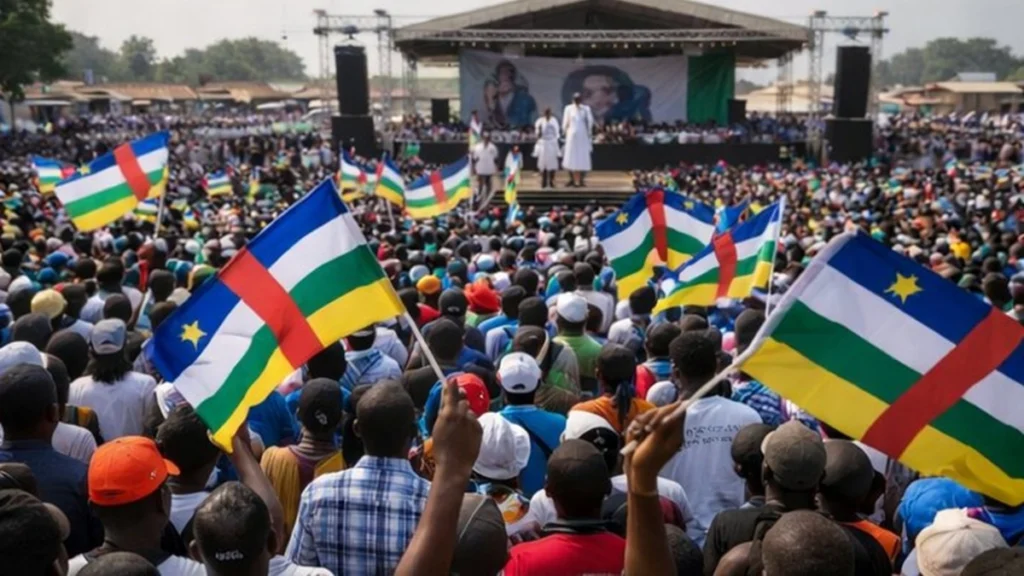
President Touadera is seeking a third term amid growing security concerns.
On Sunday, the Central African Republic (CAR) will hold general elections that will serve as a barometer of the country’s political stability and security.
RELATED:
Antonio Guterres Calls for Peaceful Elections in the Central African Republic
The CAR has faced systemic violence since late 2012, when a coalition of mostly Muslim rebel groups known as the Seleka seized Bangui, the capital, and overthrew then-President Francois Bozize (2003–2013), triggering a civil war.
These are the key issues surrounding the vote, in which CAR President Faustin-Archange Touadera is seeking a third term in this African country, one of the poorest in the world despite its wealth in minerals such as diamonds, gold and uranium.
1. What Is at Stake?
About 2.3 million people — out of a national population of roughly 5.5 million — are eligible to vote at some 6,700 polling stations in presidential, legislative, regional, and municipal elections, although the focus is on the presidential race.
Following a 2023 referendum, the country’s constitution extended the presidential term from five to seven years and removed term limits, allowing Touadera, who has been in power since 2016, to seek a third term.
To win the presidency in the first round, a candidate must secure more than 50% of valid votes, thereby avoiding a runoff between the two top vote-getters.
En 🇨🇫, le plan de sécurisation des élections est activé pour que les scrutins « se déroulent de manière pacifique, ordonnée, inclusive et crédible » comme l’appelle de ses vœux le SG @ONU_fr : réunions des états-majors, déploiement de renforts, intensification des patrouilles. pic.twitter.com/elOay1x51T
— MINUSCA (@UN_CAR) December 25, 2025
The text reads, “In Central Africa, the electoral security plan is being activated to ensure the elections ‘take place peacefully, orderly, inclusively, and credibly,’ as desired by the UN Secretary-General. This includes staff meetings, the deployment of reinforcements, and intensified patrols.”
2. Touadera and Six Other Presidential Candidates
Seven candidates are vying for the presidency, with Touadera considered the favorite as he seeks reelection under the banner of the United Hearts Movement (MCU).
The 68-year-old president has focused his campaign on rebuilding the state, improving security, and prioritizing cooperation with United Nations peacekeeping forces.
One of his main challengers is opposition leader and former prime minister Anicet-Georges Dologuele, 68, head of the Union for Central African Renewal (URCA). He renounced his French nationality to run and is promoting a platform centered on industrialization, youth employment and economic reconstruction.
Also notable is Henri-Marie Dondra, 59, a former finance minister and former prime minister and the founder of Republican Unity (UNIR). He is positioning himself as a candidate with experience in economic management and public administration after breaking with the ruling party.
3. A Divided and Weakened Opposition
The opposition will enter the race divided and weakened, partly due to the lingering effects of the internal conflict and operational restrictions that hamper campaigning in areas where armed groups are active.
Some opposition figures have denounced an uneven political playing field and called for a boycott of the elections, citing obstacles for candidates, administrative shortcomings and government control of the media and state resources.
Both Dologuele and Dondra were initially excluded from the race and were only approved as candidates on Nov. 14, a move some observers see as an administrative maneuver to favor Touadera.
UN peacekeepers in Central African Republic KILLED motorcyclist and FLED the scene — police source to TASS
Their commander’s now REFUSING access to car and crew for local cops to establish all circumstances
So much for peacekeeping… pic.twitter.com/NzQWB0vN58
— RT (@RT_com) December 25, 2025
4. The Role of MINUSCA
U.N. peacekeeping forces, deployed in the Central African Republic since 2014, will provide logistical and technical support for the elections, particularly the transport and distribution of electoral materials and the training of polling station staff.
The United Nations Multidimensional Integrated Stabilization Mission in the Central African Republic (MINUSCA), which includes just over 14,000 troops and 3,000 police officers, will also reinforce security measures to prevent election-related violence.
5. The Presence of the Wagner Group
Since 2012, the Central African Republic has experienced intermittent civil war that has killed thousands and displaced hundreds of thousands of people. Despite several peace agreements and dialogue processes with armed groups, violence has not fully disappeared.
Hundreds of members of the Wagner Group, a private military company, have arrived in the country since 2018, when Moscow and Bangui signed a bilateral military cooperation agreement. Since then, this Russian company has been protecting the Touadera administration against rebel attacks.
#FromTheSouth News Bits | Africa: At least 30 people died in a boat accident on the Kwango River, west of the Democratic Republic of Congo (DRC). pic.twitter.com/fpN5qvObNO
— teleSUR English (@telesurenglish) December 19, 2025
teleSUR/ JF
Source: EFE
From teleSUR English via This RSS Feed.