


By Nikos Mottas
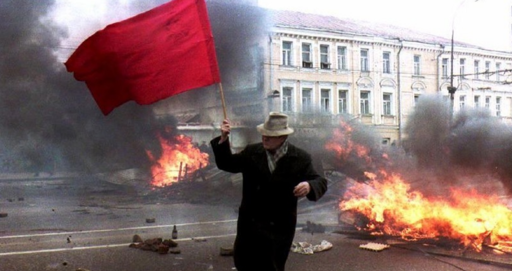
On 26 December 1991, when the red flag was lowered from the Kremlin for the last time, the world did not merely witness the dissolution of a state. It witnessed the victory of counterrevolution—the temporary triumph of capitalism over the most advanced historical attempt to abolish exploitation and class rule. The fall of the Union of Soviet Socialist Republics was not the end of an experiment that had “failed,” as bourgeois ideology insists. It was one of the greatest tragedies in human history precisely because it interrupted a process that had transformed the lives of hundreds of millions and reshaped the global balance of class forces.
For most of the twentieth century, the USSR stood as living proof that capitalism was neither eternal nor inevitable. It abolished unemployment, guaranteed universal education and healthcare, eliminated illiteracy, industrialized vast regions in record time, defeated fascism at a staggering human cost, and inspired revolutionary movements across every continent. Its existence alone constrained imperialism, strengthened workers’ struggles worldwide, and gave material meaning to the idea that another social system was possible.
The counterrevolution of 1991 therefore marked far more than a geopolitical realignment. It signaled the restoration of capitalist power, the privatization of social wealth created by generations of workers, and the descent of millions into poverty, insecurity, and social degradation. Life expectancy collapsed, inequality exploded, and the promise of socialist modernity was replaced by oligarchic plunder. The tragedy was real, measurable, and lived.
Yet to understand 1991, one must resist the convenient fiction that everything unraveled suddenly in the late 1980s. The counterrevolution was not an accident, nor merely the result of external pressure from imperialism. It was the outcome of a long process of ideological retreat and structural erosion within socialism itself.
A decisive turning point came much earlier, at the 20th Congress of the Communist Party of the Soviet Union in 1956. Under the banner of correcting past errors, a legitimate need for critical reflection was transformed into something far more damaging: a repudiation of key Marxist-Leninist principles, above all the understanding that class struggle does not disappear automatically under socialism.
The notion that socialism had essentially resolved class antagonisms fostered a dangerous complacency. Vigilance against the re-emergence of bourgeois social relations weakened. The revolutionary content of proletarian power was gradually replaced by an administrative, technocratic conception of governance. This ideological shift soon found expression in economic policy.
Step by step, capitalist criteria were reintroduced into the socialist economy. Profit indicators, enterprise “autonomy,” and the elevation of commodity-money relations began to shape planning decisions. What had once been technical instruments subordinated to social goals increasingly became guiding principles. Efficiency, cost reduction, and competitiveness—concepts rooted in capitalist logic—were treated as neutral tools rather than socially loaded categories.
These changes were not superficial. They altered social relations themselves. Managerial layers accumulated informal power, technocracy expanded, and material inequalities—though still limited—became more pronounced and socially corrosive. Within sections of the party and state apparatus, socialism came to be viewed less as a revolutionary process requiring constant struggle and more as a system to be “optimized” through market-like adjustments. This was not reform in a socialist sense; it was the gradual re-legitimization of bourgeois norms inside a formally socialist framework.
By the time Perestroika emerged in the 1980s, it did not introduce alien elements into a healthy organism. It accelerated tendencies already present, transforming partial concessions into a full-scale dismantling of planning, social ownership, and working-class political power. The counterrevolution triumphed not because socialism was unviable, but because it had been systematically undermined from within.
Equally decisive—and often glossed over—is the question of why the Soviet working class did not intervene decisively to halt this process. The answer does not lie in apathy, passivity, or betrayal by the masses. It lies in their gradual political and ideological disarmament.
For decades, socialism was experienced by workers primarily as a stable reality rather than as a conquest requiring active defense. Employment, housing, healthcare, and education were guaranteed—but direct participation in real decision-making steadily narrowed. Trade unions increasingly functioned as administrative and welfare bodies rather than as schools of class struggle and organs of workers’ power. The distance between the working class and the centers of political authority widened.
At the same time, the erosion of Marxist education weakened class consciousness. If exploitation was officially declared abolished once and for all, then the possibility of its restoration appeared unthinkable. When capitalist relations began re-emerging openly, they were often presented not as counterrevolution, but as “reforms,” cloaked in the language of democratization, modernization, and efficiency.
This left the working class organizationally fragmented, ideologically disoriented, and politically unprepared. The March 1991 referendum—where a clear majority voted to preserve the Soviet Union—revealed deep popular attachment to socialism. Yet it also exposed the central contradiction of the moment: the people wanted the USSR, but lacked the instruments to defend it.
This is not a moral condemnation of Soviet workers. It is a historical lesson of immense importance. No socialist society, regardless of its achievements, can remain secure if the working class ceases to function as a conscious, organized ruling class.
In the aftermath of 1991, triumphant ideologues proclaimed the “end of history.” Capitalism, we were told, had proven itself the final and natural form of human society. Socialism belonged to the past. Reality has rendered that claim absurd.
Capitalism since 1991 has delivered not harmony, but permanent crisis: financial collapses, endless wars, ecological destruction, deepening inequality, and the normalization of insecurity for billions. The very contradictions Marx analyzed in the nineteenth century now operate on a global scale. Labor is more exploited, wealth more concentrated, and democracy more hollow than ever.
From a Marxist-Leninist perspective, the fall of the Soviet Union was not a historical verdict against socialism, but a temporary defeat in a protracted struggle. Socialism is not a monument erected once and for all; it is a movement, a process, a form of class power that must be consciously exercised and defended.
The experience of the USSR— its achievements and its failures—remains an irreplaceable source of lessons. It teaches the necessity of planning, of proletarian power, of ideological clarity, and of constant vigilance against the regeneration of capitalist relations. These lessons are not relics. They are urgently relevant in a world once again searching for alternatives.
History did not end in 1991. It recoiled, regrouped, and entered a new phase. As long as exploitation persists, as long as labor is subordinated to profit, the conditions that gave rise to socialist revolution will continue to mature. New generations, shaped not by Cold War myths but by lived capitalist reality, are already questioning the system they inherited.
The red flag fell not because it was obsolete, but because it was abandoned before it could be fully defended. And that is precisely why its meaning endures.
The counterrevolution closed one chapter—but it did not conclude the book. The struggle for socialism is unfinished. And history, far from ending, is still very much in motion.
* Nikos Mottas is the Editor-in-Chief of In Defense of Communism.
From In Defense of Communism via This RSS Feed.