

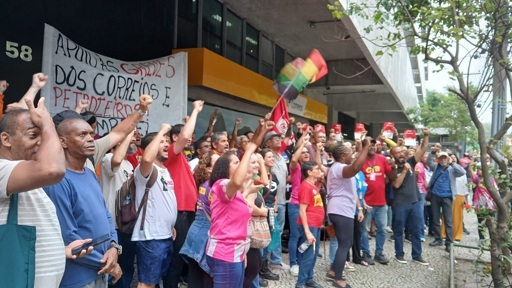
Last Friday, striking oil workers and postal workers held a joint rally in Rio de Janeiro, demonstrating growing cross-sector solidarity against privatization and attacks on labor rights in Brazil. Petrobras oil workers launched a national strike last Monday, followed by postal workers at Correios, who voted to strike the next day. Both companies are state-owned and currently undergoing restructuring and privatization processes that threaten jobs, wages, and public services.
The unified action was approved in a democratic oil workers’ assembly last Wednesday, which brought together more than 300 strikers. Workers from both sectors are demanding that President Luiz Inácio Lula da Silva reverse the right-wing, anti-worker measures imposed under former president Jair Bolsonaro.
Despite anti-privatization rhetoric, the Lula government has maintained company leaderships that prioritize dividends and profits of shareholders, many of whom are from the United States and other imperialist countries. Both Petrobras and Correios management have responded to strikes with police repression and concessions to business interests.
Oil Workers Confront Unsafe Conditions and Strikebreaking
Petrobras is Brazil’s biggest oil producer, with an output of about 2.52 million barrels of oil per day. Workers are demanding a collective bargaining agreement with real wage increases, safer working conditions, an end to layoffs, and equal rights for contracted workers and retirees. They have also denounced exhausting work schedules and attacks on offshore workers.
Since the strike began, two serious accidents have occurred, highlighting major safety issues amid management’s use of inexperienced scabs to continue production in place of striking workers. A gas leak on the P-40 platform and a fire on the P-68 platform — one of the company’s largest — forced production stoppages and endangered workers.
The company quickly released a statement downplaying the incidents, claiming that the fire was “quickly extinguished” and that “there is no connection whatsoever with the strike.”
As Esquerda Diario notes, these incidents are not accidents but the result of cost-cutting, deteriorating infrastructure, and the company’s insistence on maintaining output at any cost. Workers emphasize that their strike is also a fight for safety, proper maintenance, and the right to strike without risking lives or the environment.
Petrobras management has escalated repression, including calling in police against pickets. Meanwhile, the leadership of the Federação Única dos Petroleiros (FUP) has actively worked to end the strike, aligning itself with company and government interests. Despite this, major oil unions across the country remain on strike, shutting down production across the Petrobras system.
Postal Workers Resist Layoffs and Corporate “Restructuring”
The postal workers, for their part, went on a national strike that has reached nine states amid deadlocked negotiations for a new collective bargaining agreement for next year. They are also fighting a “restructuring plan” that Lula announced in November that will accelerate privatization in Correiros, the state-owned postal company. In an assembly on Monday, postal workers rejected the proposal presented by the company and the Superior Labor Court for failing to maintain their historical labor rights.
The plan includes a voluntary dismissal program targeting up to 10,000 workers, the closure of 1,000 post offices, and the sale of company real estate. It is paired with a massive loan intended to “modernize” the service. In reality, these plans will deepen job losses and reduce service — especially in remote areas.
The company has been facing massive deficits, which the government is using to justify these measures. While Lula has ruled out outright privatization, the government is pursuing layoffs, asset sales, and austerity measures to address company deficits. Postal workers warn that these policies shift the burden of the crisis onto workers and the public, undermining a vital public service.
Building Cross-Sector Unity from Below
Oil and postal workers are confronting the same political project: the dismantling of the public sector and the transformation of state-owned companies into instruments for private profit. Their joint mobilization is not symbolic, but a concrete step toward building unity across strategic sectors capable of confronting this agenda head-on.
Forging this unity is a fundamental task. The Rio de Janeiro rally should serve as a starting point for constructing a large, unified national mobilization bringing together the rank and file of Petrobras, Correios, and other sectors of workers. This requires breaking with passivity and pressuring union leaderships to move from a policy of accommodation of the Lula government to active mobilization against privatization and labor precarity.
At a moment when sections of the union leadership are capitulating to management or actively working to demobilize the struggle, it is urgent to build a national strike committee elected directly by the rank and file. Delegates must be accountable, and coordinate the struggle nationally. Workers cannot allow bureaucracies to act from above to disarm the strikes.
The strength the workers have already demonstrated shows that another path is possible. With unity, democratic organization, and rank-and-file self-organization, workers can push the struggle forward, defeat company offensives, and win real gains — not only for themselves, but in defense of public services for the broader population.
Defending a fully state-owned Correios under workers’ control, with real public participation, points to a clear alternative to the profit-driven logic that has been hollowing out public services across Brazil. Postal workers insist that those who do the work — together with the communities that rely on the service — are best placed to determine its priorities and reorganize it to fulfill its social function in a universal, efficient way, without layoffs or precarious working conditions.
Oil workers at Petrobras show that this is not an isolated struggle. From energy to communications, workers are drawing the same conclusion: strategic sectors cannot be run in the interests of shareholders without sacrificing safety, labor rights, and the public good. The convergence of these strikes points toward a collective fight to reclaim public services from the logic of profit and place them under democratic control, in the service of workers and society as a whole.
The post Striking Oil and Postal Workers in Brazil Unite Against Privatization appeared first on Left Voice.
From Left Voice via This RSS Feed.