

Today, we hear a lot about “democracy” from politicians and the mainstream media. Just a year ago, Kamala Harris claimed the U.S. was the “greatest democracy in the history of the world.” Meanwhile Trump, in his inaugural address to his second term, preached about how his return to office would restore democracy and freedom. Democrats, meanwhile, claim that Trump is a threat to “our democracy,” using it to help make themselves seem like the lesser of two evils.
And while it’s true that he attacks democratic rights in every way, the idea that before Trump there was real democracy for the working class and oppressed is laughable.
After all, for most of us, political power — and true democracy — feels distant. Our workplaces are essentially dictatorships where our bosses have a monopoly on power, and our votes each election cycle seem to change little. This is by design: What we experience in our jobs, in our communities, and throughout the country, is not actual democracy, but bourgeois democracy. This is essentially anti-democracy — a system that, as Vladimir Lenin explained, “always remains, and under capitalism is bound to remain, restricted, truncated, false and hypocritical, a paradise for the rich and a snare and deception for the exploited.”
Around the world, this form of bourgeois democracy is hegemonic and normalized. And while some democratic rights do exist, it’s not because of the generosity of the system, but instead because of episodes of class struggle — like the Civil Rights Movement — forcing the hand of the ruling class. Now, even these rights are being attacked by far-right leaders in the U.S. and around the globe. We see how quickly our rights can be threatened, attacked, and rolled back under this form of so-called democracy when it is beneficial to the ruling class.
So, if bourgeois democracy is not democracy at all and instead a machinery of class rule disguised as popular will, then what is the alternative? How do we practice a democracy that is direct, participatory, and empowers the majority? What is real democracy?
The answer lies in a form of self-organization of the working class: the assembly.
By building a tradition of assemblies, we can create the workers’ democracy necessary to forge a bottom-up struggle against the Far Right — to fight Trump, ICE, and imperialism from the belly of the beast. With their power, we can reach beyond the limits of our specific union, workplace, or university to form fighting united fronts that have the strength to win our demands.
What Is an Assembly?
Assemblies are open meeting spaces for collective discussion, decision-making, and action. These mass sites of democracy are practical organs of power that most often arise organically from struggle, typically emerging when a workplace, neighborhood, or campus is activated by a shared fight. Rather than the closed committee or decision-making bodies that are common in bourgeois democracy, assemblies should be open to the entire community impacted by that struggle. They reject the artificial divisions imposed by capitalism — such as isolating workers by industry, job title, or union jurisdiction — and instead unite all those with a stake in the outcome.
For example, neighborhood assemblies can address housing, policing, or mutual aid. Students and educators often forge assemblies to organize around their specific struggles. And these forms are not mutually exclusive: In a healthcare fight, the assembly could include hospital workers, patients from the surrounding community, and family members, recognizing that their concerns are inextricably linked. A teachers’ assembly could rightly include parents and students, as the fight for education is a community fight.
Under capitalism, struggles overlap. This is part of what makes assemblies so effective, as they help break down the artificial divisions created by capitalism, inviting impacted parties into the discussion and decision-making recognizing everyone has something to contribute. Critically, assemblies do not need to solely address just local issues. An assembly of healthcare workers and patients in New York City could vote to stage a protest against cuts to food stamps, or to lend their support to Starbucks workers on strike.
To achieve a more widespread impact, base-level assemblies can federate their power through delegate councils, or soviets meaning “councils” in Russian. Here, elected and instantly recallable delegates from multiple local assemblies coordinate on a city-wide, regional, or national scale. This structure allows local struggles to unite without sacrificing the direct, democratic control of the base. The assembly, in all its forms, is the mechanism for transforming isolated grievances into a collective project for real power.
What are some other characteristics of assemblies?
Free and Open Debate
In order to foster genuine democratic decision making, assemblies typically dedicate a significant amount of time to free and open debate of ideas. Different political stances, tendencies, or factions are able to present their ideas and views to the entire assembly for discussion and debate around the topic at hand. The goal is to collectively arrive at the most effective course of action through persuasion and reason, not simply a majority vote.
Direct Participation with a Mandate
Unlike typically hierarchically organized structures, whether the capitalist workplace or even most unions, the highest level of decision making and leadership rests on the rank and file of the assembly. In practice, this means that all members have equal right to speak, share ideas, propose actions, and vote on major decisions, whether setting minor goals or deciding whether to authorize a strike. If there are certain meetings individuals from the assembly are voted to attend (for example, a meeting with the boss in a factory), they represent the assembly itself and carry out the mandates given to them from the assembly, rather than vote on their own accord. This helps to prevent backdoor deals bureaucratic leaders often end up making.
Recallable Rotating Delegates
To help prevent an unaccountable group of folks taking power, any delegate can be recalled and replaced by the assembly if they fail to represent the decisions of the assembly or act against its interests. This is meant to keep power in the hands of the democratic base, which is the exact opposite of the structure of “representative democracy” (or, in reality, oligarchy) that we have today. At the same time, these recallable delegates are also rotated to ensure that the same people aren’t always leading.
Majority Discipline
After a full debate, members vote and the majority decision becomes the policy of the entire assembly. While members who disagreed are expected to uphold the decision in public action (for example, on a picket line or during an action), they still have the right to continue arguing their position internally and try to win over the majority to their view at a future meeting. To further this point, because an assembly is organic to or found in the structures in which they are part (for example, workers in a particular workplace, a school, or neighborhood taking part in that assembly), every member of the assembly is also responsible for helping “execute” the collective decisions while also mobilizing the larger mass of workers they are organic to as well. This encourages a far more dynamic, dedicated mass of workers than does bourgeois democracy.
Assemblies can serve as the basic building blocks of revolutionary organization or a future socialist society. They’re not just a tactic, but a strategy. The democratic process within these assemblies is designed to be direct, participatory, and empowering — a setting for radical democracy to gain life — unlike town halls, which often exist to give the guise of a democratic setting, while not actually having democratic structures for decision-making power. This type of facade — representation without effective power — is exactly what bureaucratic leaderships want and is why union leaderships will often use town halls as a tactic to bolster their image. In cases like this, assemblies are co-opted by the bureaucratic leaderships to maintain their power, rather than harnessing the real potential of assemblies to organize against the balance of power.
Building and organizing through assembly structures can begin to help create structures to move from bourgeois democracy (a.k.a. anti-democracy), to true democracy, or what Marxists call proletarian democracy or workers’ democracy. Assemblies are how we develop self-organization of the working class and develop our own methods of struggle. They are integral to building class independence in struggle and crucial for resisting the co-optation of the bourgeois leaderships and union bureaucracies who artificially divide us and hijack our struggles redirecting it back toward capitalist “democratic” institutions.
Assemblies in the Real World
The 1917 Russian revolution showed us how true workers’ democracy could be a direct alternative to bourgeois democracy through the Soviet state. As author John Reed noted, “highly complex political structure” had emerged in “all the cities and towns of the Russian land, which is upheld by the vast majority of the people and which is functioning as well as any newborn popular government ever functioned.” Under this structure, councils of workers, soldiers, and peasants (i.e., assemblies) existed at both workplace and municipal levels to make decisions about work and life. This process was democratic and decided what would be produced for the majority, not for a minority of capitalists.
At the same time, “local soviets elected representatives to a national assembly that helped guide the Bolshevik leadership as it wrestled with decisions for all of Russia, including foreign policy.” Reed notes how the structures that developed in the Soviet Union were some of the most democratic and responsive ever invented. Through this example, we see the true potential of assemblies on a large scale.
“Ok,” some may say, “But that was back in 1917. What are examples of assemblies today?”
On a smaller scale, in 2001 in the aftermath of the financial crisis in Argentina, workers took over a ceramics tile factory called Zanon, which they still control and run today. In this process, assemblies were sites of decision-making and were used to combat the union bureaucracy itself as it tried to co-opt the militancy of the rank and file — as bureaucratic union leaderships so often end up trying to do.
In 2006, assemblies arose in the Mexican city of Oaxaca. After the teachers’ union went on strike, police fired on peaceful protestors leading workers to fight back and push the cops out of the city. For months, “the working class and community groups, including the teachers’ union, ran the city through large, democratic assemblies as part of a broad movement known as the Popular Assembly of the Peoples of Oaxaca (APPO).”
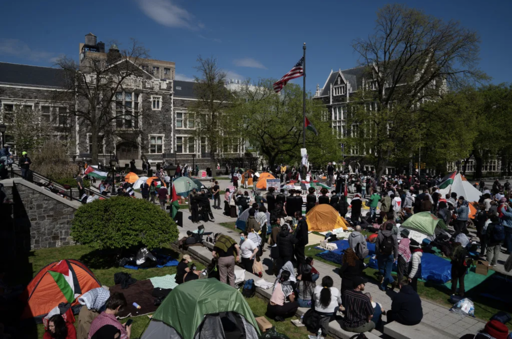
More recently, in 2024, PSC-CUNY rank-and-file academic workers held an assembly at the CCNY Gaza solidarity encampment, where they voted unanimously to endorse the five demands of the students organizing in the encampment. Students, teachers, and community members were all able to discuss openly and democratically how to move forward around organizing against Israel’s genocide against Gaza.
Later the same year, at least in part due to assemblies, organizing workers at the nation’s first overdose prevention center, OnPoint NYC, decided to form their own clinic outside the building in response to a lockout from the boss.
Recently in Detroit, a “People’s Assembly” was formed where hundreds of people debated and chose to act on strategies to counter ICE and the Trump administration.
Why Assemblies Today?
Today the world situation is characterized by militarism, imperialism, and crisis. The Far Right is on the rise. But whether it is nurses organizing strikes in their hospitals or oil workers triggering national strikes in Italy, the working class is fighting back. Often as workers and the oppressed organize resistance, their efforts are co-opted, curtailed, or diverted by bureaucracies tied to the capitalist parties. But organizing through assemblies is the key to fighting back against this co-optation by allowing for truly open political discussion, debate, and democratic decision making. With democratic methods, the working class can reach inevitable conclusions to confront the systems harming us all, and channel class struggle into organization.
These days, we are also seeing a crisis of bourgeois democracy. As constituents no longer see themselves as represented by their representatives, they begin to question ruling class parties. This is shown is the process of class dealignment in the United States and the crisis of the Democratic Party. Organic crises, as Italian Marxist Antonio Gramsci called them, weaken regimes and lead traditional political parties to grapple with new political phenomena, as masses of folks continue to lose faith in their traditional political parties and the institutions and they are driven to the brink under anti-democratic institutions they are told are “democratic.” This can also lead to a loss of faith in bourgeois democracy, or as Marx noted, where “the oppressed are allowed once every few years to decide which particular representatives of the oppressing class shall represent and repress them in parliament!”
Assemblies can be the revolutionary alternative, not to supplement or help traditional bourgeois (anti-)democratic structures, like left bureaucracies may suggest, but to fight back against, and ultimately completely replace, these structures. The assembly structure serves as the basis to build truly working-class parties around the globe. As we see capitalist parties continually betray the masses, it has never before been more evident that the working class needs its own fighting party not tied to capital.
If we had a truly working-class party, would “socialist” politicians like Zohran Mamdani put a Zionist in power as policy commissioner? Or choose to drop demands for universal healthcare from their program? Right now, many of Mamdani’s own supporters are angry with some of his recent decisions, but still hold out hope — despite the fact that he is part of the genocidal Democratic Party. With self-organization tools like assemblies, we wouldn’t need to put our hope in a figure that has already begun his betrayals. Instead, we could mobilize with our coworkers, students, and community members to discuss and fight for our demands.
By using assemblies, real socialist leaders would be voted to embody the voice of the majority who are discussing and debating politics. As part of a working-class party, internal assemblies can serve as a “school of revolution,” where members learn to debate strategy, make collective decisions, and hold their leaders accountable.
Workers run the world; our power at the point of production makes us the strategic revolutionary class, and without us, the ruling class would have nothing. Assemblies will allow us to collectively decide how, and to what ends, we use — or withhold — our labor power, giving us the real and democratic force necessary to overthrow capital.
In a world of capitalist crisis and bourgeois democracy, assemblies offer more than just a critique or alternative tactic: they are a practice. They are the means through which we move from the passive, spectator sport bourgeois democracy to becoming actually active architects of our own lives and struggles. By building these structures of open debate, direct mandate, and accountability in our workplaces, schools, and neighborhoods, we actively organize for today’s fights. But we also do more. We begin to build the framework of a genuine workers’ democracy, creating within struggle the tools we will need to govern a society free from exploitation.
The assembly is not merely a meeting, it is the foundation of a future worth winning in an era of capitalist decline.
The post What Is an Assembly? A Guide to True Democracy appeared first on Left Voice.
From Left Voice via This RSS Feed.