

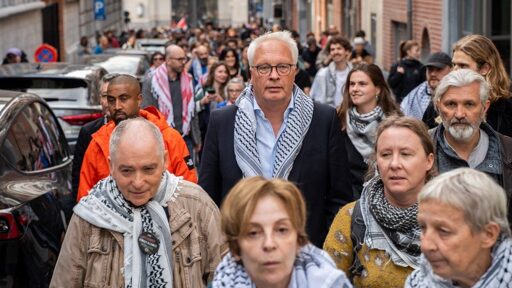
Throughout 2025, Europe’s political establishment has appeared increasingly lost. At home, governments have faced mounting anger over renewed austerity and accelerating militarization; internationally, they have been repeatedly sidelined and humiliated by the Trump administration. Yet European leaders continue to press ahead, committing billions in joint borrowing to prolong the war in Ukraine, while offering support for US imperial priorities elsewhere, from backing Israel’s genocide in Gaza to endorsing threats against Venezuela and other Latin American countries.
As these trends evolve into 2026, the coming year is shaping up to pose serious risks for Europe’s working class: through the prospect of conscription, the normalization of war logic, and more attacks on hard-won rights. At the same time, these developments could generate new forms of resistance across the continent.
In this context, Peoples Dispatch spoke with Peter Mertens, general secretary of the Workers’ Party of Belgium (PTB-PVDA), whose party has become a key reference point for anti-war, anti-austerity politics in Europe. Mertens reflects on the key political trends of 2025 – and the dangers and opportunities that lie ahead in the year to come.
Peoples Dispatch: At the beginning of the year, Belgium saw the appointment of a new government, the so-called Arizona coalition. Ever since, there have been large-scale mobilizations against it. I’d like to start by asking: where do things stand now with the government and what can we expect from the mobilizations going forward?
Peter Mertens: For about a year now, Belgium has had a very right-wing government, one that is half-jokingly referred to as the Arizona coalition. What they are trying to do is organize a major social rollback, essentially a big hold-up against workers.
Resistance to this government was immediate. In mid-January, just before the government officially took office, 35,000 people protested in Brussels. One month later, there were already 100,000 people on the streets. And this mobilization has continued without interruption. It is one of the largest social mobilizations since the 1960s: over the past year, there have been 13 national demonstrations focused on social and economic issues. There have also been five national strike days across the country. And there is now an action plan extending through January, February, and March 2026, backed by the ACV-CSC and ABVV-FGTB unions.
I think one of the key reasons this mobilization has held for so long is that its demands are widely shared, not just among workers, but across broad layers of society. The central issue is pensions. There is strong opposition to policies that would push people to work until 67 years old.
Then there is wage indexation. In Belgium, there is an automatic indexation mechanism, which ensures that wages rise when prices rise to protect workers from inflation. This is a hard-won achievement of the working class, but the government wants to weaken this system. A third issue concerns premiums – additional pay for workers who, for example, work at night. The government is proposing cuts there too. Finally, there is a positive demand that unites the movement: a tax on millionaires.
That said, the government is refusing to listen to the trade unions and is pushing forward anyway, with a very authoritarian, very austerity-driven approach. So we don’t yet know how this will end. What is clear is that it will be a major confrontation.
PD: The Arizona government has also been one of the most vocal proponents of militarization in Europe. What do you make of this growing normalization of military spending and war?
PM: We’ve been mobilizing against this from the very beginning. Our position is clear: we are against the war in Ukraine, and we are also against the European Union’s policy of prolonging it. What we see today is that some European leaders – I’ll call them secondary leaders, who are unpopular in their own countries – are now driving EU policy and pushing to continue this bloody, crazy war.
We’ve opposed not only the war itself but also the broader militarization of society. Donald Trump already succeeded in advancing this militarization agenda at the NATO summit in The Hague in June, when he imposed the 5% spending norm – what we immediately called the “Trump norm”. His message there was clear: the war in Ukraine is too expensive for the US, and we want to focus on China. Europe is expected to pay the bill.
In this context, what happened recently in Germany, with the large school strike in early December, was very important. Tens of thousands of young people mobilized against the return of conscription. And that debate is also appearing in Belgium.
It’s not surprising that we hear a lot of anxiety from young people. Statements like the one made recently by Mark Rutte, saying that people should prepare for a large-scale war like their grandparents did, create fear. In response, we are trying to build a movement that resists the militarization of youth and of society as a whole.
This struggle is important on its own account, but it is also clearly linked to austerity. The connection is obvious. The right-wing government wants to impose a €32 billion austerity package, which is enormous for Belgium. At the same time, a significant portion of public spending is being used for military expansion. Every sector of Belgian, and I think European, society is being squeezed: healthcare is underfunded, roads are deteriorating, youth services are collapsing, even prisons are overcrowded. It’s a disaster all over Europe. The only sector that is seeing massive growth is the military.
PD: And are people already feeling the consequences of this austerity drive?
PM: In Belgium, it’s translating directly into austerity. The same government that is cutting billions from social spending is buying F-35 fighter jets, new navy ships, weapons systems. We don’t need all these things. Belgium’s coastline is only about 66 kilometers long: it’s a small country. If a plane takes off from Belgian territory, it is outside the country within a minute. This is not about defense. This is about building an offensive military force tied to imperial interests: European imperial interests and Belgian imperial interests. That much has been clear from the start.
There is an alternative to austerity, of course. Belgium gives billions of euros in tax advantages to large corporations. Companies receive exemptions for all sorts of things, in the form of reductions in social security contributions and tax cuts, reaching €15 billion in 2025. By rethinking even part of these gifts, we can free up billions to fund social security. Billions more are hidden in tax havens and not pursued, partly because tax authorities don’t employ enough people. At the same time, millions continue to flow to the US for expensive and environmentally destructive LNG gas instead of cheaper alternatives, like gas from Russia. And, of course, there is no serious tax on the super-rich.
So this is not only a budgetary issue, it’s a political one. Sections of the European bourgeoisie have chosen to militarize society and prepare for war against Russia, and now they’re poking around and inciting hate. Internally, this kind of drive always means the same thing: war on the working class, on social security, and on public services, which will pay the price for militarization.
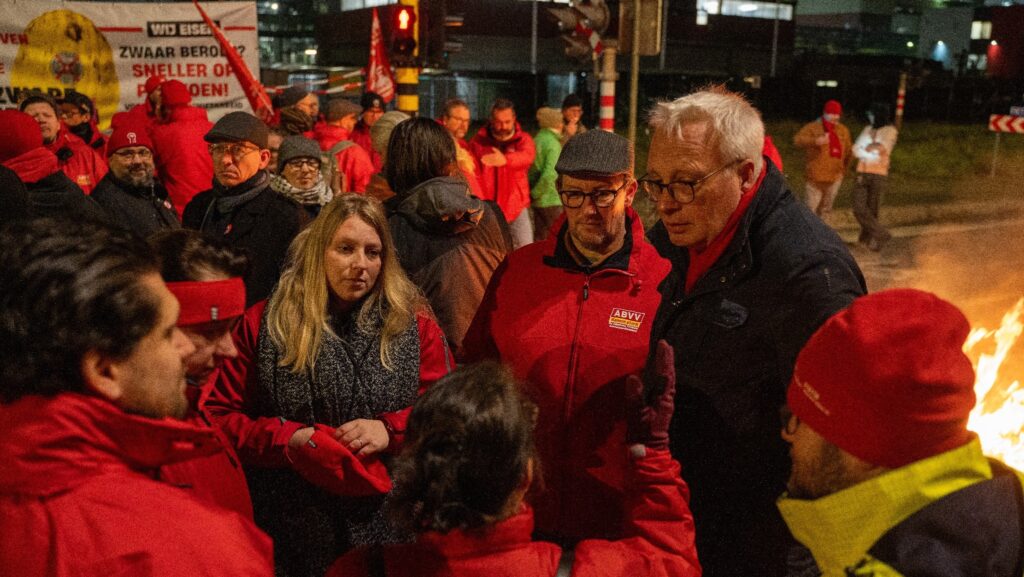
Peter Mertens at a picket during Belgium’s 2025 general strikes. Source: PTB-PVDA
PD: At the same time, we’re also seeing European elites lose their footing internationally. Since the start of the second Trump administration, many European leaders have been openly trying to appeal to him, to stay in his good graces – but that doesn’t seem to be working. Instead, Europe appears to be in somewhat of a crisis. From your point of view, how would you describe Europe’s position in the world right now?
PM: This somewhat Freudian attitude of Mark Rutte and second-rank European leaders, calling President Trump “daddy” and trying to please him, is a disaster. It’s also a mirror of Europe’s broader situation.
What happened over the course of this year? In June, Trump imposed the 5% defense NATO norm. In July, we saw this so-called “trade agreement” – which isn’t really an agreement at all, because US goods can enter Europe with 0% tariffs, while European goods face 15% tariffs, even 50% on steel and aluminum. On top of that, Europe promised USD 1.35 trillion in investments. It was a summer of humiliation, no other way to put it.
This reflects a deeper problem: this generation of European leaders barely exists as a political generation. These are secondary figures. That’s not an insult, it’s simply a description. Take Germany: Friedrich Merz was sidelined during Angela Merkel’s time, considered unfit for leadership. Now, suddenly he’s in charge. Mark Rutte left the Netherlands in crisis, still ongoing. Emmanuel Macron governs without popular support, Keir Starmer also. Kaja Kallas comes from a very small country where she doesn’t enjoy support, yet presents herself as a major anti-Russian, anti-communist figure in EU spaces.
This group has no real vision, and certainly no serious understanding of the global situation. The reality is that the center of the world economy is shifting to Asia, to China, India, and the BRICS countries. In reaction to this historic shift, the US is panicking and implementing a new security strategy. And the truth is simple: the US is saying, we don’t give a damn about Europe anymore. In that context, following Trump like a little puppy is not the answer. Buying LNG gas from Trump is not the answer. Buying weapons from Trump is not the answer.
PD: And then another current of EU political figures is trying to respond to this situation by pushing for what they call military and strategic autonomy.
PM: The alternative to US domination cannot be building a new European imperialist bloc. But this option is becoming more and more popular. Look at Germany again: the latest investment plans are about building an autonomous German army. In 2022, when Germany announced an extra €100 billion for the army, it was mostly to buy American weapons. Now the plans are to buy German weapons.
We say clearly: neither US aggression nor European aggression is the answer. What we need instead is a completely different European position, based on cooperation – including with the BRICS countries – not neo-colonialism or neo-imperialism. I believe this can only be fully realized when there is socialism in Europe, and I think that debate will grow in the coming decade. Europe is in decline, but that also means we are at a crossroads.
On one side, you have US policy open about its national security strategy: intervene in European politics, support the far right, promote racist policies, and divide Europe through bilateral deals. On the other side, you have sections of the European elite – for example around the German arms industry, companies like Rheinmetall – saying we need a stronger EU, but in an authoritarian form, dismantling what little popular control still exists.
We reject both options. We want a completely different Europe. And we will try to advance that vision, not only in Belgium, but across Europe, with the forces we have.
PD: In this context, what to make of Europe’s failure to respond to US aggression in the Caribbean and to threats against Venezuela and other Latin American countries? As you’ve suggested, current European governments are unlikely to change course.
PM: I think we need to be very clear: Europe, or better, the EU, was never a peace project. When it was launched after World War II, its original countries were colonial powers: Belgium, France, Italy, and so on. The first official map of the European Economic Community (EEC) was a map that included Algeria, the Congo… Most of the EEC was made of colonies. In the heads of those creating the EU, it was an imperialist construction from the outset.
That said, because of the existence of the Soviet Union, there were counterforces inside Europe that promoted diplomacy and dialogue. This included Russia, which is, after all, a European country. Russia is not going to move, it won’t be transported to another place. That reality once shaped a tradition of diplomacy.
But that tradition has now disappeared. Today, regime change in Venezuela is openly discussed and supported in EU bodies and in national parliaments. Figures like Kaja Kallas openly say they won’t even talk to Russia. At the same time, of course, they do talk to – and fully support – the murderous and genocidal Israeli regime. Not only do they talk to Israel, they arm it: with German submarines, German weapons, and US weapons routed through European ports.
This double standard has become impossible to ignore, especially since the genocide in Palestine. People see the contradiction clearly: 19 sanction packages against Russia, zero against Israel. Silence on illegal bombings of Iran. The use of naval bases in Cyprus to support Israeli military operations. This hypocrisy is pushing people to question Europe’s role. That’s why we’ve seen massive mobilizations: in Belgium alone, there have been 12 national demonstrations for Palestine.
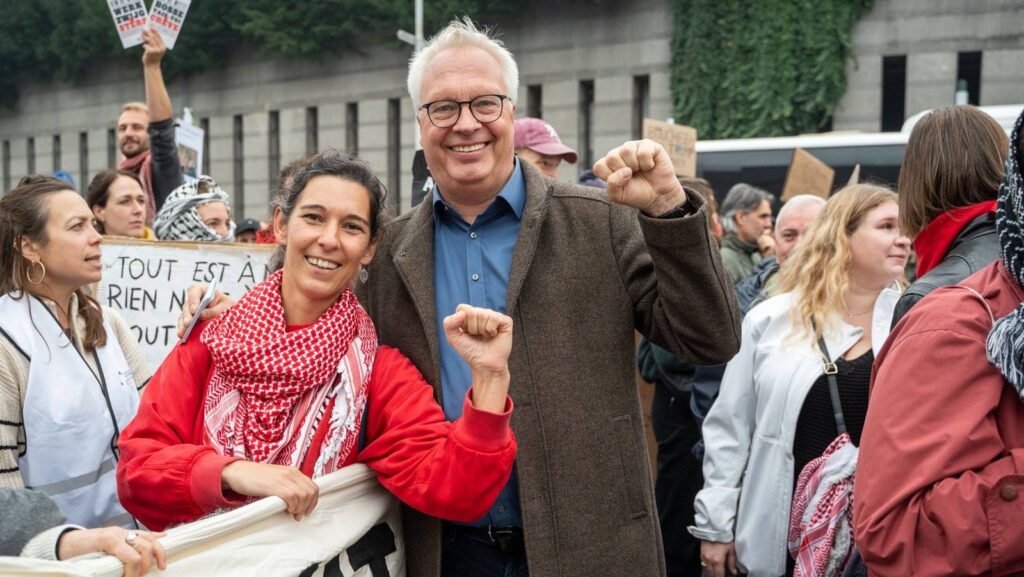
Peter Mertens with Dr. Hanne Bosselaers, a participant of the “Conscience” boat to break the siege on Gaza. Source: PTB-PVDA
PD: Considering the EU was never a peace project, what do its military and economic ambitions today mean for the rest of the world, especially the Global South?
PM: Take Africa for example. According to Eurostat figures from 2020, France extracted €67 billion in turnover from Africa, Germany €24 billion, and Italy €11 billion. That’s around €100 billion a year flowing from Africa to just three European countries. That’s why they’re terrified of what’s happening in the Sahel. If access to uranium is disrupted, France faces a major energy crisis because of its dependence on nuclear power. This is one reason behind Europe’s military reorganization: it serves the bloc’s own imperial interests.
Europe is not just a submissive vassal of the US. It has its own imperial ambitions. Germany, France, and Italy all have strategies to defend and expand their zones of influence. Since 2022, Germany has openly stated that it wants to become a global military power again.
That’s a new and dangerous development. We know that this path leads to more conflict, more austerity, more racism, and more attacks on the working class. But within this chaos, there is also opportunity for a genuine Marxist force, or a genuine left, working-class force, to gain influence.
I agree with Lenin when he said that in calm periods, people can be asleep for a long time – but in times of turmoil, people can learn very quickly. Leaders of the working class can also learn very quickly. I think we are approaching such a period. Those at the top no longer know where they are going, and those below increasingly understand that things cannot continue like this. We are not fully in that moment yet, but we are approaching it.
PD: Over the past years, the PVDA-PTB has become a source of inspiration for many on the left across the region. As a way of concluding, what are your expectations for 2026 and the period ahead?
PM: At the European level, I think one thing is very clear: the link between struggles against austerity and struggles against militarization will only grow. It’s already visible in Eastern Europe, and as governments across the continent are pushed toward the 5% military spending norm, this will inevitably mean deeper budget cuts elsewhere.
This will be accompanied by authoritarian measures – against free speech, free assembly, and the right to protest. We are already seeing this as well. Militarization and authoritarianism always go hand in hand. So class struggle will not be the question in Europe, it will exist everywhere, in different forms and at different intensities. The real question is whether we will be able to build forces across Europe that can lead those struggles, earn the trust of working people, and connect them clearly to opposition to militarization and to the struggle for socialism. That, for me, is the central task for 2026.
The discussion is already picking up. In the UK, for example, when Your Party launched, the discussion was explicitly about opposing war, NATO, and austerity, and about socialism. In Germany, left forces are again talking about socialism or barbarism, quoting Rosa Luxemburg. I think this question of what kind of society we want to live in will become increasingly important by 2027.

Peter Mertens during a discussion at ManiFiesta 2025. Source: PTB-PVDA
This also has to be linked to solidarity with struggles in the Global South. You cannot have real empowerment or liberation in Europe without linking it to liberation struggles in other parts of the world. We need to talk about the resistance of the Venezuelan people against US imperialism, about the resistance of the Chilean people against this new right-wing clown. So when we go to strike pickets, we won’t only talk about Belgium. We will talk about BRICS, about international struggles, and we will even bring political books to picket lines. That really helps open people’s horizons and connect local struggles to global dynamics.
There are also major dangers ahead, including the petty-bourgeois forces in Europe, those who fall into defeatism, who say, “We can’t win, everything is lost.” That attitude has to be overcome by spreading the most positive examples of struggle. Change is built through many smaller victories: factories where workers successfully build a union for the first time; cities where privatization or austerity measures are pushed back. All of this shifts the balance of forces.
Finally, we should have confidence in people. People don’t want war. They don’t want exploitation. They don’t want climate catastrophe, floods, droughts, and devastation. Common sense, if we can use that word, lies with the working class. Our task is to recognize it and organize it. There will be many dangers, of course. There will be fascists, there will be violence, there will be repression not unlike the one we’re seeing in the US. Europe already has its own version of ICE – Frontex – letting people drown in the Mediterranean.
But there will be real possibilities for change from below, from class struggle. So my conclusion is this: don’t be afraid. Take these opportunities with both hands.
The post Peter Mertens: “Don’t be afraid, seize the opportunities of 2026 with both hands” appeared first on Peoples Dispatch.
From Peoples Dispatch via This RSS Feed.