

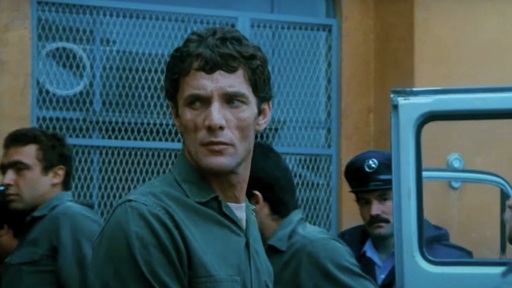
“A village without electricity – but there was cinema.” This is how Mohammad Bakri (1953-2025) remembered his childhood in al-Bi’neh, a Palestinian village in the Galilee. Born on November 27, 1953, Bakri grew up among the Palestinian minority that remained within what became the State of Israel after the 1948 Nakba – descendants of the 159,000 who were not expelled when over 800,000 Palestinians were driven from their homeland and more than five hundred villages were destroyed. In al-Bi’neh, a boy without electricity discovered cinema, and cinema would become his main tool of cultural resistance.
On December 24, 2025, Mohammad Bakri – the legendary Palestinian actor and filmmaker with a four-decade career – died at the age of seventy-two in Nahariya Hospital after suffering from heart and respiratory complications. He was buried the same day in al-Bi’neh, the village of his birth.
When I had the opportunity to interview Bakri in July 2025 for the publication Despite Everything: Cultural Resistance for a Free Palestine, he told me many stories, including the “five seasons” of his politicization – each corresponding to a rupture in Palestinian history. The first was the Nakba itself, whose stories he heard from his father and grandfather. “The second season was 1967,” he recalled, “the Six-Day War between Israel and the Arab world, when Israel occupied Gaza, the West Bank, and East Jerusalem.” He remembered watching his father cry as a fourteen-year-old boy; later, he understood that his tears were for the “new catastrophe of the Arab world and the Palestinian people – the first generation of refugees was created in 1948, and the second was created in 1967.” The fifth season, he told me, was the ongoing genocide in Gaza.
This was a man for whom history was not abstraction but lived experience – transmitted through generations, inscribed in the body, expressed through art.
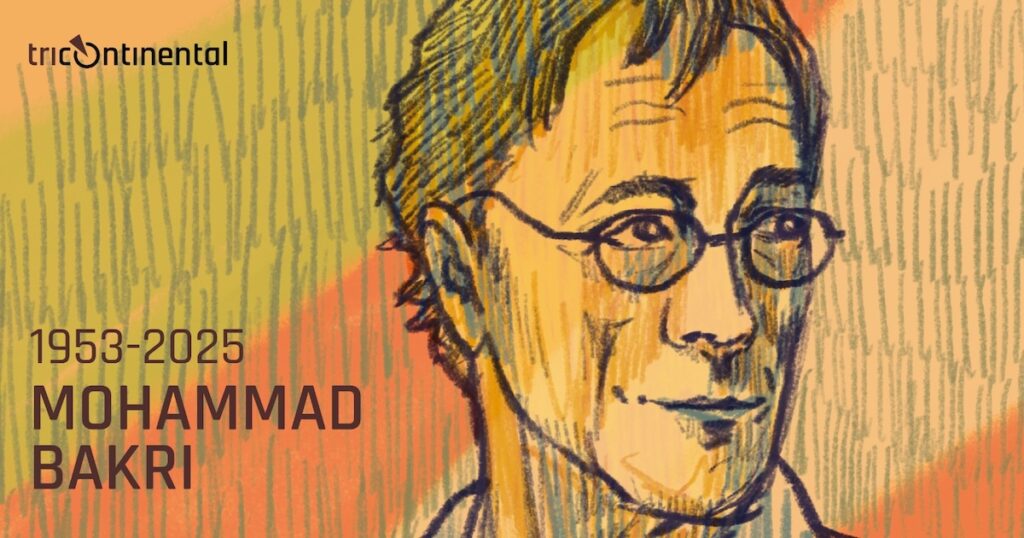
Illustration of Mohammad Bakri by Tings Chak of the Tricontinental: Institute for Social Research
After receiving secondary education in Acre, Bakri studied acting and Arabic literature at Tel Aviv University, graduating in 1976. He began his professional career at Habima Theatre in Tel Aviv, Haifa Theatre, and al-Kasaba Theatre in Ramallah, performing in major productions including Federico García Lorca’s Blood Wedding and the Yiddish classic The Dybbuk. His breakthrough came in 1983 with Fellow Travelers, followed by his role in Beyond the Walls (1984) – a film depicting Palestinian and Israeli prisoners held together in an Israeli jail that premiered at the Venice Film Festival and earned an Academy Award nomination. Throughout his career, he insisted on roles that, as he put it, “did not offend Arabs and Palestinians”, collaborating extensively with Palestinian filmmakers including Michel Khleifi, Rashid Masharawi, and Ali Nassar.
Perhaps Bakri’s most enduring contribution to Palestinian theater was his one-man show The Pessoptimist (1986), adapted from Emile Habibi’s 1974 novel – a cornerstone text on the identity of Palestinians within Israel. This sardonic, painful drama, combining Kafka and Voltaire with One Thousand and One Nights, charts the plight of Palestinians since 1948. Bakri performed it over 1,500 times across the world, in Arabic and Hebrew, from London to Tokyo. It made him the biggest Palestinian acting star of his generation.
As a director, Bakri turned the camera toward Palestinian testimony. His documentaries – 1948 (1998), Jenin, Jenin (2002), Since You’ve Been Gone (2005), Zahra (2009) – meticulously collected the voices of refugees and residents, documenting experiences of occupation, resistance, and survival. Jenin, Jenin, which compiled testimonies from residents of the Jenin refugee camp following Israel’s devastating military assault during the Second Intifada, won Best Documentary at the Carthage International Film Festival. It also triggered two decades of legal persecution.
The Israeli Film Board banned Jenin, Jenin after just three screenings. Five Israeli soldiers filed defamation lawsuits. In 2021, an Israeli court ordered the film banned, all copies seized, online links removed, and imposed financial penalties equivalent to USD 52,000 – effectively criminalizing Palestinian testimony. “The film was banned in Israel,” Bakri told me. “I have been paying USD 1,000 a month to an Israeli soldier who claimed he appears in my film – for three and a half seconds. And I will keep paying for years to come… It is like the Middle Ages – like when they burned books.”
What Israeli director Uri Barbash described as “an unbelievable journey of boycotts, isolations, and ostracism” never silenced Bakri. He continued making films, asking the question that a Jenin resident had posed to him during filming: “What can your camera do when the whole world does nothing to help me?” Thinking of Gaza, he reflected: “The same is happening in Gaza. What can a camera do for starving people? My camera can’t bring them bread.” And yet – despite everything – he kept creating.
In our interview, Bakri articulated a philosophy that has stayed with me:
Culture is life. Culture is roots, and history. Culture is humanity. If we lose culture, we lose our identity. We lose our life. There is no meaning without culture. There is no meaning to life without love. Culture is love. I will not permit them to take my love away from myself. My culture. This is my heart. This is my people. These are my memories. This is my childhood, when I walked without electricity and without water. The songs that I heard. The food that I ate. The air that I smelled. The mountain that I climbed. The sea that I swam in. This is my culture, my existence. Nobody will take that from me. So I will continue making films. Despite everything.
These final words – “Despite everything” – became the title of the dossier on Palestinian cultural resistance, published by the Tricontinental: Institute for Social Research. It was Bakri’s phrase, his defiance distilled.
Mohammad Bakri is survived by his wife Leila, their daughter, and five sons – Adam, Ziad, Saleh, and others who have followed their father into acting. He received the Palestine National Appreciation Award in 2023. The Jerusalem International Film Festival of Gaza established an award in his name for Best National Film.
Just four weeks before his passing, on November 29, 2025 – the International Day of Solidarity with the Palestinian People – we had the privilege of hosting Bakri in an online event to launch the dossier alongside other Palestinian artists and international cultural workers organizing for Palestinian liberation. I did not know that it would be one of the last opportunities to see him speak passionately, insisting on the power of culture until the end.
Bakri’s legacy is not merely a body of work to be archived. It is a call to all of us. At a time when Israel has extended its genocide beyond the physical destruction of Gaza to a deliberate assault on Palestinian culture – targeting libraries, universities, cultural centres to erase collective memory – Bakri’s life demonstrates that cultural resistance is not supplementary to liberation struggle but essential to it. As Ghassan Kanafani wrote, “Cultural resistance is essential and is no less important than the armed resistance itself.”
To fellow artists, cultural workers, and intellectuals: our songs, our films, our paintings, our poems, our stories are not separate from the struggle for Palestinian liberation – they are the very terrain upon which that struggle is waged. As the genocide continues, let us continue the cultural work until we see a free Palestine – despite everything.
Tings Chak is the Art Director of Tricontinental: Institute for Social Research and author of “Despite Everything: Cultural Resistance for a Free Palestine” (2025).
The post Despite everything: remembering Mohammad Bakri (1953–2025) appeared first on Peoples Dispatch.
From Peoples Dispatch via This RSS Feed.