

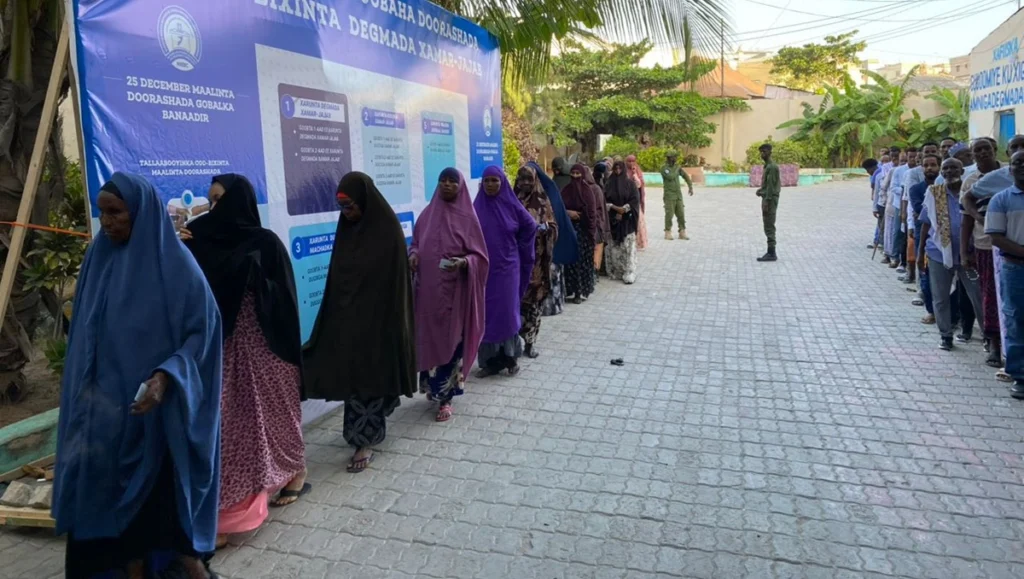
Historic vote takes place amid opposition boycotts and heavy security measures.
On Thursday, residents of Mogadishu, the Somali capital, headed to the polls in the first direct local elections in more than half a century, a historic milestone unfolding amid opposition boycotts.
RELATED:
Drought Impacts Over 4.6 Million People in Somalia
Polling stations opened at 6 a.m. local time, and lines of voters formed early as residents sought to take part in what President Hassan Sheikh Mohamud has described as “a new chapter in the country’s history.”
About 500,000 people registered to elect 390 members of Mogadishu’s district councils, with a total of 1,605 candidates competing for seats at 523 polling centers.
To ensure security, authorities deployed nearly 10,000 police officers, imposed an urban lockdown restricting the movement of vehicles and pedestrians, and suspended flights to the city’s main airport.
Information Minister Daud Aweis described the voting day as a “rebirth of democratic practices” after decades without direct elections. Electoral Commission Chairman Abdikarim Ahmed Hassan said voters can have 100% confidence in the security measures in place.
Mohamud, who has come to power twice through the indirect system, pledged in 2023 to implement universal suffrage at the local, federal and presidential levels.
After so many years, the people of Mogadishu are voting. Today, history is made. For the first time, many people in Mogadishu are standing before a ballot, holding a right that was denied to them for decades. A right their parents only spoke about and their grandparents once… pic.twitter.com/OUKS5qII2L
— Fardowsa Matan Bulle (@princeser) December 25, 2025
Somalia last held direct elections in 1969, months before an October military coup that kept civilians out of power for three decades.
After the fall of military ruler Mohamed Siad Barre in 1991, an indirect, clan-based system was established in which clan representatives selected politicians, who then chose the president. That model has historically been criticized by presidential hopefuls.
Although the government succeeded in passing constitutional reforms and establishing a national electoral commission, the opposition has argued that the Mogadishu vote lacks legitimacy.
The opposition Council of the Future, which has questioned how the federal government is managing the electoral process and constitutional changes, said it will not recognize the results of the vote, arguing that it is being run solely by President Mohamud without a competitive process.
At a news conference, former President Sharif Sheikh Ahmed (2009-2012), former prime ministers Hassan Ali Khaire and Mohamed Hussein Roble, and lawmaker Abdirahman Abdishakur described the elections as “flawed.”
The Council of the Future said the Mogadishu vote does not constitute legitimate elections but instead appears to serve an agenda linked to extending the president’s term.
#FromTheSouth News Bits | Africa: At least 30 people died in a boat accident on the Kwango River, west of the Democratic Republic of Congo (DRC). pic.twitter.com/fpN5qvObNO
— teleSUR English (@telesurenglish) December 19, 2025
teleSUR/ JF
Source: EFE
From teleSUR English via This RSS Feed.