

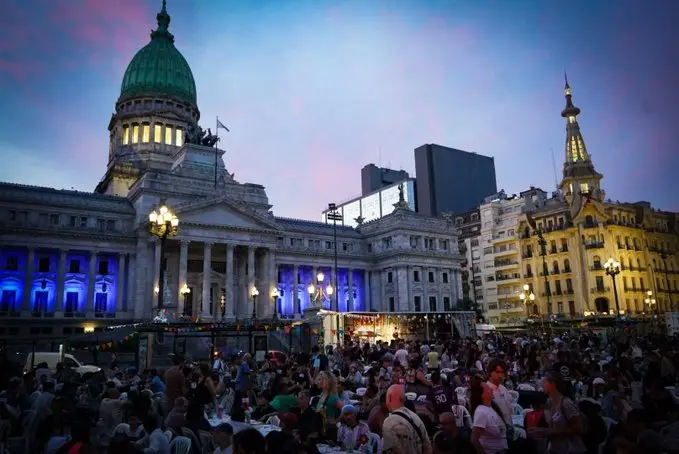
Grassroots organizations in Argentina organized a Christmas Eve dinner for 5,000 people facing homelessness and economic hardship in Buenos Aires, as social groups respond to the widening social impact of President Javier Milei’s austerity policies.
RELATED:
Targeted Energy Subsidy Reform Moves Forward in Argentina
The initiative was led by the Movement of Excluded Workers (Movimiento de Trabajadores Excluidos, MTE), which set up the event in front of the National Congress under the slogan “No family without Christmas.” The gathering began at 5:00 p.m. local time and was scheduled to continue past midnight, with the Plaza of the Two Congresses transformed into a collective space providing food and basic services.
According to the MTE, the site included showers, hairdressing services, health stations, toys and recreational areas for children. The organization said the food was prepared by more than 50 community cooks, the same women who sustain soup kitchens in working-class neighborhoods throughout the year. Referring to the initiative’s nine-year history, the MTE stated that “the Plaza of the Two Congresses will stop being just a political stage and become a huge family table.”
En esta Nochebuena, en el Congreso, ninguna familia va a quedar sin celebrar la Navidad.
Una jornada que ofrece mucho más que un plato de comida a personas en situación de calle y familias que no lo tendrían: reafirma la solidaridad, la organización y el amor en un contexto… pic.twitter.com/PuE4Ppocc7
— MTE (@mteargentina) December 24, 2025
National lawmaker Itai Hagman highlighted the continuity of the event in a message shared on social media. “I’ve been coming to the Christmas at Congress organized by the MTE for nine years, and each time it surprises me more. Against cruelty and disposability, a small piece of solidarity and organization. Happy holidays,” he wrote.
The program included a dedicated space for children with inflatable games, play areas and recreational activities, along with the distribution of toys. Health posts were also installed, and volunteer artists provided live music during the evening.
Other social organizations announced similar initiatives. The Corriente Clasista y Combativa (CCC) scheduled a Christmas Day celebration on December 25 at noon for families in the city of La Plata who lack “bread on the table.” In a statement, the organization said: “At a time when austerity generates anguish and the lack of work leads to hunger, we want to counter it with solidarity, determination and the commitment of our comrades who will cook and serve lunch with deep love for our people.”
These initiatives took place amid deteriorating economic indicators. According to consultancy PxQ, prices rose 0.5 percent during the third week of December, while inflation is projected to average 2.6 percent for the month, slightly higher than in November. Food prices increased 2.7 percent during December.
Holiday consumption has also declined. The Argentine Toy Industry Chamber reported a 6.9 percent drop in toy sales by units compared with the same period last year, which had already been considered critical. The outlet Tiempo Argentino warned that “while Argentine families gather for one of the most austere Christmases in memory, President Javier Milei opted for a digital staging to deliver a message that, far from festive harmony, sounded like a warning.”
Housing costs have added further pressure. A joint report by researchers from the University of Buenos Aires, CONICET, the Center for Legal and Social Studies and the Civil Association for Equality and Justice found that between September 15 and October 1, among 1,107 cases surveyed, 93 percent of tenants were up to date with rent payments. However, 29 percent had taken out loans in the past year, and 77 percent of those who became indebted did so to pay rent.
The government maintains that it has lifted 12 million people out of poverty, a claim that contrasts with social and academic indicators cited by civil society organizations. In July alone, 63 people experiencing homelessness died from cold-related causes, according to records compiled by the Popular Assembly for the Rights of People in Street Situations and the research group Sociability at the Margins at the UBA Faculty of Psychology.
As Christmas Eve unfolded in front of Congress, social movements framed their actions as an immediate response to growing social vulnerability, seeking to ensure that, at least for one night, no family was left without a shared meal.
From teleSUR English via This RSS Feed.