

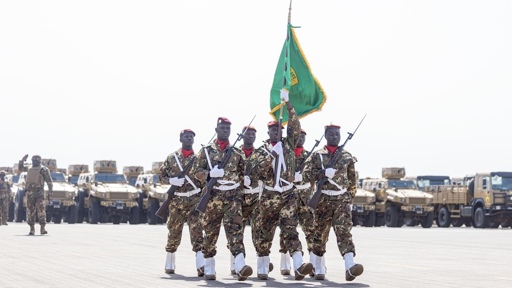
The Alliance of Sahel States (AES) has taken a decisive step toward regional self defense after officially launching a joint military force aimed at combating Islamist insurgency and terrorism across the Sahel. The force was inaugurated on December 20, 2025, during a ceremony held at an air base in Bamako, Mali’s capital.
The ceremony was presided over by Mali’s Transitional President, Head of State, Supreme Chief of the Armed Forces, and outgoing President of the AES, Army General Assimi Goïta. The event was the formal handover of the Unified Force of the AES banner, marking the operationalization of a long-declared commitment by Burkina Faso, Mali, and Niger to jointly secure their territories’ sovereignty.
The newly established force, known as the FU AES, brings together approximately 5,000 troops drawn from the three member states. It is designed to integrate air power, intelligence sharing, and coordinated ground operations to confront armed groups that have destabilized large parts of the Sahel for over a decade.
Addressing the gathering, General Aliou Boï Diarra delivered a deeply symbolic and emotional speech, underscoring the historical and moral significance of the banner. He described the standard as far more than a ceremonial object.
“The standard that you are presenting to the unified AES force represents a memory, a will, an irreversible commitment. It profoundly affirms a certainty now deeply engraved in the hearts of our beloved peoples. This is indeed a truly historic and momentous act,” General Diarra said.
Read more: Mali defends sovereignty against a Western-backed “proxy war” by terror groups
Diarra declared that the banner embodied sacrifice and struggle rather than decoration: “This sacred standard is not merely a decorative symbol. It is the profound and enduring result of precious blood bravely shed, immense courage valiantly embraced, and fundamental truth profoundly rediscovered.”
Paying tribute to the fallen, he added:
“To our cherished martyrs, to all innocent civilians, and to the brave soldiers who have fallen in battle, I humbly pay a solemn and heartfelt tribute beneath the eternal snow. They did not die in vain.”
General Goïta, in his own address, described the launch as a historic turning point for the Sahel. He began by saluting the defense leadership and troops of the region.
“On this significant occasion, I would like to extend my sincere congratulations and profoundly salute the exceptional courage, unwavering professionalism, steadfast commitment, and resolute determination of the ministers of defense, the chiefs of general staff, and especially all the brave defense and security forces of the AES area for the remarkable achievements they have made in their relentless fight against armed terrorist groups,” he said.
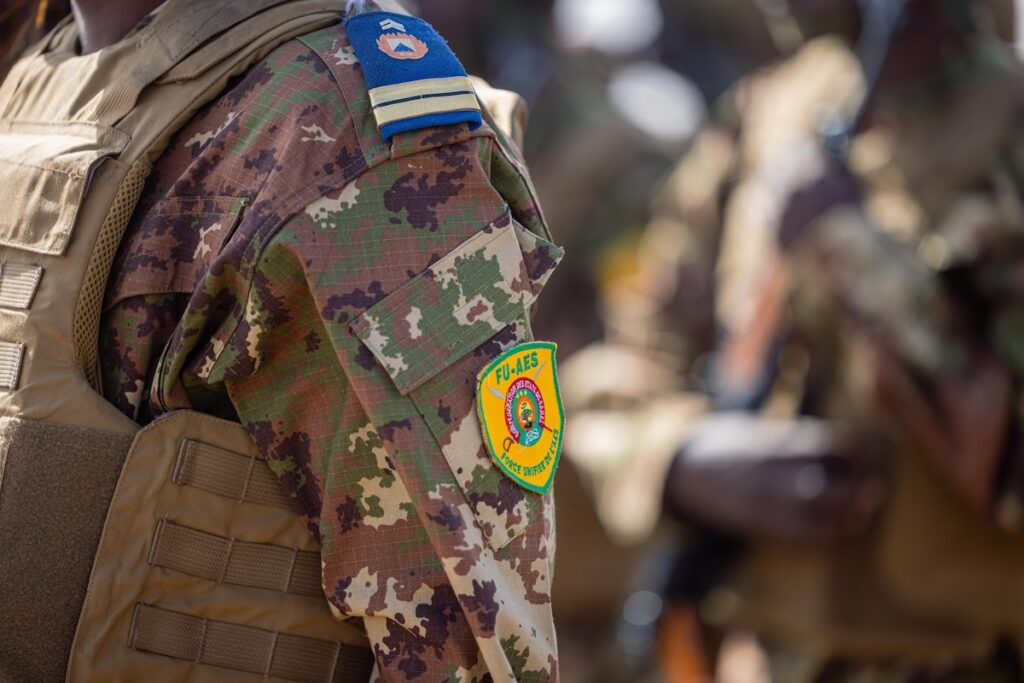
Detail of AES Joint Military Force, FU AES, uniform. Photo: Presidence Mali / Facebook
The AES president recalled that since the Niamey Mutual Initiative (NMI) declaration of July 6, 2024, joint military operations have already been underway, noting that they resulted in the neutralization of several terrorist leaders and the destruction of multiple insurgent sanctuaries.
According to Goïta, “All these positive results were achieved thanks to meticulous planning, timely and effective intelligence sharing, and above all the comprehensive pooling of our collective efforts and resources.”
He further announced key institutional steps consolidating the unified force, including the appointment of a new commander, the establishment of a central command post in the strategic city of Niamey, and the assignment of specialized battalions fully dedicated to AES operations. He stressed that the task ahead would require adaptability to the evolving tactics of armed groups.
“It is now critically important for the new commander not only to anticipate the increasingly complex operating methods of terrorist groups, but above all to resolutely continue this crucial fight to secure the entire Sahel region and ensure lasting peace and stability.”
General Goïta added that the conflict confronting the Sahel is multidimensional, “This war is not only military. It is also political, economic, and informational.”
Read more: France is a state sponsor of terror, AES countries declare
He identified what he described as three major threats facing Sahelian states: armed terrorist violence, economic terrorism, and media terrorism. In response, he noted that the confederation has adopted a comprehensive strategy that goes beyond battlefield operations.
“We have taken measures to counter these threats not only by establishing this unified force, but also by creating AES Television, AES Radio, and AES print media,” he said, framing these platforms as tools to counter disinformation and psychological warfare.
The military launch follows a series of symbolic and political moves that underline the bloc’s growing autonomy. Earlier in the year, the AES unveiled a new flag, representing the confederation’s shared identity and its intention to redefine political, economic, and security cooperation outside the shadow of French imperialism and Western neoliberal frameworks. Leaders of the bloc have repeatedly criticized past military partnerships with France and other Western powers, arguing that foreign interventions failed to bring peace while undermining national sovereignty.
Read more: On the road: an unprecedented cross-country journey by Niger’s president amid a neo-colonial proxy war
The AES summit
Mali hosted a summit of the Alliance of Sahel States in the same week, which concluded on Tuesday. During the summit, Burkina Faso’s leader, Captain Ibrahim Traoré, was appointed as the new head of the Alliance of Sahel States. Following the meeting, the Alliance announced that the summit would be followed by a large-scale military operation.
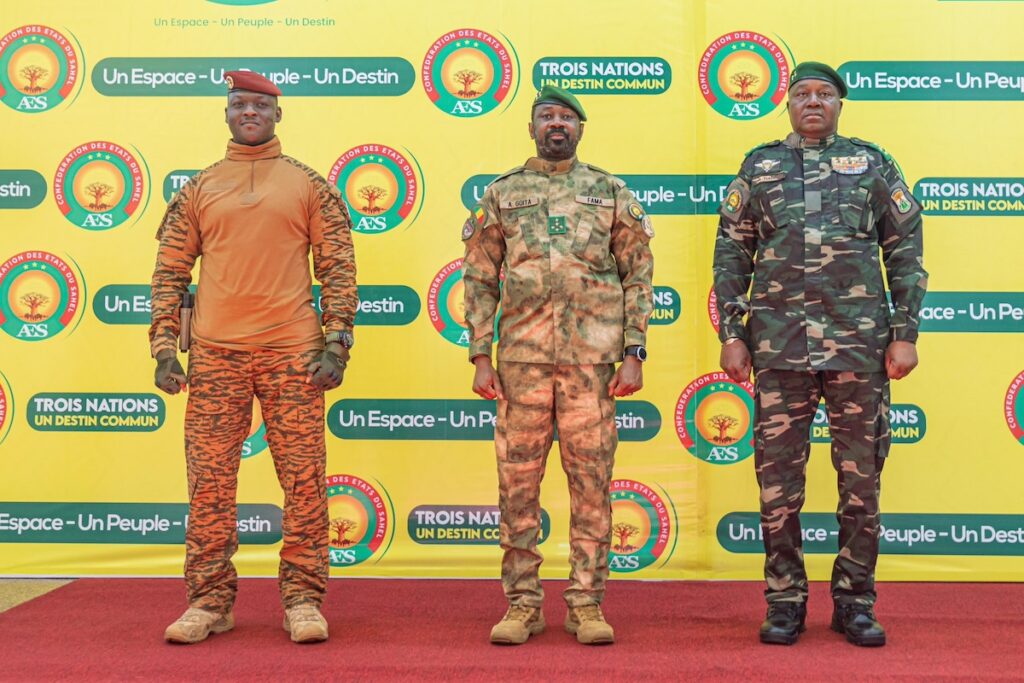
Leaders of the AES, Burkina Faso’s Ibrahim Traoré, Mali’s Assimi Goïta, and Niger’s Abdourahamane Tchiani at the AES Heads of State Summit in Bamako, Mali. Photo: Presidence Mali / Facebook
Earlier this year, the three countries also introduced a joint AES passport, a major step toward deeper integration. This move came after Burkina Faso, Mali, and Niger formally withdrew from the Economic Community of West African States (ECOWAS), an organization they now openly describe as hostile.
The launch of the unified force also takes place amid rising regional tensions. Nigeria and Côte d’Ivoire, both influential ECOWAS members, have been criticized by AES leaders and their supporters for what they see as counter revolutionary postures. In official and popular discourse within the Sahel, these countries are increasingly portrayed as attempting to contain or reverse the radical political shifts unfolding in Bamako, Ouagadougou, and Niamey.
What is clear is that Burkina Faso, Mali, and Niger are charting a new path, one that is redefining power, alliances, and resistance in the heart of West Africa.
The post The Alliance of Sahel States launches unified military force and strengthens regional security appeared first on Peoples Dispatch.
From Peoples Dispatch via This RSS Feed.